Interactive Demo vs Video Demo vs Live Demo (2026)
Interactive demos vs video demos vs live human demos vs AI voice demos. Honest format-by-format comparison with conversion data for B2B sales teams in 2026.
Quick answer
No demo format wins outright; each solves a different problem at a different funnel stage. Interactive click-through tours suit top-of-funnel self-education at near-zero marginal cost. Video demos broaden awareness and travel off-site. Live human demos win bottom-of-funnel deals at 30 to 50 percent but cap on rep count. AI voice demos run 24/7 on the live product and convert 25 to 40 percent. Treat them as a portfolio, not substitutes.
Want this running on your product? Rayko demos it live, with your prospects asking questions by voice.
START LIVE DEMOThe product demo is the most important asset in B2B SaaS sales, and the category that describes it is a mess. Walk into any G2 grid and you will find a Storylane click-through tour, a Loom screen recording, a Consensus video board, a scheduled Zoom demo, and a Rayko AI voice agent all stacked together under "demo software" as if they are interchangeable. They are not. Each of those formats solves a different problem, costs a different amount, converts at a different rate, and fits a different stage of the buying journey.
This post unpacks the four real formats that dominate B2B demos in 2026: interactive click-through demos, video demos, live human-led demos, and AI voice demos. Each gets a full section with the conversion data, the leading vendors, and the use cases where it earns its keep. Then a decision matrix to help you pick the right format for the right buying stage.
The goal is not to crown a winner. It is to stop treating different formats as substitutes and start treating them as a portfolio.
Why the format question matters more than the tool question
Most demo-platform buying decisions start with the wrong question. Teams ask "Should we use Storylane or Navattic?" before asking "Should we use a click-through tour at all?" The result is months of implementation on a format that was never going to fit the sales motion, followed by a frustrated team and a churned subscription.
Three forces make the format question harder to dodge in 2026.
First, buyer behavior has shifted. Gartner's research on the B2B buying journey shows that buyers spend only 17 percent of the total purchase cycle interacting with sales reps. The other 83 percent is independent research. The format you choose to fill that 83 percent (interactive tour, video, async video board, AI agent) is the format your buyers actually evaluate you in.
Second, the demo has become the funnel. Forrester's research on B2B buying notes that buyers expect to see the product before they will agree to a sales call, not after. The demo is no longer a step that happens after qualification. It is the qualification.
Third, the cost calculus has flipped. Five years ago a live demo cost a sales rep's time and a Zoom seat, roughly 80 to 200 dollars per session at typical loaded SDR or AE costs. Today an AI voice demo costs 1 to 9 dollars per session, an interactive click-through tour costs roughly zero per view after the build, and a video demo sits in between. The economic case for AI and interactive content was always obvious; what changed is that the quality is now competitive at the new cost basis.
Pick the format first, then pick the tool. That is the order that produces decisions you do not regret in six months.
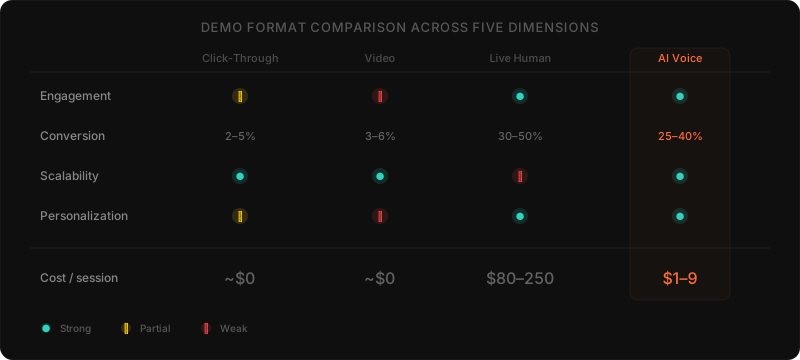
The diagram above shows how the four formats stack across the five dimensions that drive most format decisions. Each row tells a different story; the rest of this post unpacks them format by format.
Format 1: Interactive click-through demos
The interactive click-through demo is the format that put product tours into B2B SaaS marketing. The pattern is simple: capture your product's UI as screenshots or HTML, overlay clickable hotspots, and let prospects advance through a guided sequence at their own pace.
How it works
A click-through tour is built once and replayed many times. The product marketer or sales engineer captures the relevant screens, writes the annotations, and embeds the result on a website page or sends it as a link. Prospects click through the path, optionally branching when the tool allows, and the platform tracks engagement at each step.
The leading vendors split along workflow lines. Storylane optimizes for speed-to-build with a no-code editor and flexible publishing. Navattic emphasizes HTML capture for higher fidelity and stronger website embedding. Walnut leans into per-prospect customization, where reps clone a tour and personalize the data, text, or branding for a specific account. Arcade blends screen capture with video-like polish, sitting between click-through and recorded video. Supademo offers a lightweight screenshot-based alternative with AI-generated annotations.
The conversion numbers
This is the format with the most published benchmark data because the vendors compete on it. Navattic's annual interactive demo benchmark report tracks completion rates across thousands of embedded tours and lands them at roughly 30 to 50 percent for well-built demos, with completion rates higher on shorter tours and on pages that match the demo's intent.
Storylane's published case studies tell a similar story, with embed-page email-capture lift in the 2 to 3 times range versus pages without an interactive demo. Both vendors point to a 4 to 6 times improvement over static product screenshots when the demo replaces a screenshot block on equivalent pages.
The conversion rate is highest at the funnel positions where the demo replaces a friction point: pricing pages, feature pages, comparison pages. It is lower on top-of-page hero placements where the prospect has not yet self-selected as interested.
Where click-through tours genuinely work
Three use cases are nearly unbeatable for this format.
Top-of-funnel education at scale. When you have meaningful website traffic and need to convert anonymous visitors into engaged prospects without consuming rep time, an embedded click-through tour delivers the highest dollar return per hour of build time. A product marketer with no engineering background can ship a tour in an afternoon. The marginal cost per view rounds to zero.
Self-service awareness for product-led companies. If your sales motion is product-led growth, the click-through tour replaces or augments the "free trial" entry point. Prospects can taste the product without committing to a signup, which lowers the activation threshold. See our piece on self-serve product demos for how this fits into a broader PLG motion.
Compliance-sensitive buyers. Click-through tours are deterministic. The same clicks produce the same output every time. There is no AI hallucinating incorrect product information, no live product showing a partial outage. For prospects in regulated industries (banking, healthcare, government), that predictability lowers procurement friction.
Where they fall short
The structural limit is responsiveness. Click-through tours cannot answer the prospect's question. If a CTO lands on a tour wanting to understand API rate limits and the tour covers the dashboard overview, there is no path forward. They click through your script or they leave.
Maintenance is the second issue, and it is the one most vendors downplay in the sales pitch. Every UI change in your product breaks affected tours. Teams that ship weekly find themselves spending half a day per sprint maintaining demos rather than building new ones. The faster you ship product, the heavier the maintenance burden grows.
Finally, the analytics tell you what but not why. You know the prospect dropped off at step 7 of 12. You have no idea what question they had, what feature they were looking for, or what objection arose. The conversion-rate floor is solid; the diagnostic ceiling is low.
Format 2: Video demos
Video demos cover a wide format range, from a 90-second product overview to a 30-minute recorded walkthrough to an async video board with chapter selection. They share one structural property: the prospect watches rather than interacts.
How it works
A video demo is a recorded asset distributed across the funnel. Marketing teams use 60 to 90 second hero videos on landing pages and social. Sales teams use 3 to 5 minute walkthrough videos in email follow-up and proposal documents. Customer success teams use longer training videos in onboarding sequences. The unit economics are favorable: build once, distribute infinitely, no marginal cost per view.
The vendor landscape splits into three sub-formats.
Recording and hosting. Loom, Vidyard, and Wistia are the leading tools for produced and ad-hoc video. Loom dominates the asynchronous personalized-video category where reps record short videos for individual prospects. Vidyard and Wistia compete in the higher-production-value end with stronger analytics, embedded calls-to-action, and integrations with sales engagement platforms.
Async video boards. Consensus pioneered the demo board model where prospects receive a curated set of video segments organized by topic, role, or use case. Stakeholders pick the segments they want to watch. The tracking layer shows which executive watched which section, which is genuinely useful intel for multi-threaded enterprise deals.
Sandbox-style and hybrid. Demostack and TestBox lean closer to live product environments, but they share with video the property that the prospect explores without rep guidance. Arcade sits between video and click-through, blending recorded screen capture with annotation overlays.
The conversion numbers
Video has the most data of any format because the platforms have been measuring it for over a decade.
Wistia's annual State of Video report puts average completion rates for business videos in the three-to-fifteen-minute range, the typical demo video length, at roughly 40 to 60 percent. Vidyard's annual business-video benchmark report tells a similar story. Both note that completion rates drop sharply past the five-minute mark; by minute eight, half the audience is gone even on well-targeted content.
The completion rate at the demo-video range (3 to 8 minutes) sits above click-through completion rates because watching is lower-effort than clicking. But the conversion-from-completion rate is typically lower because passive viewers convert at lower rates than active explorers. Net conversion (views times completion times conversion-from-completion) is roughly comparable to click-through demos for top-of-funnel content, with click-through pulling slightly ahead on evaluation-stage pages.
For Consensus-style async video boards, the metric that matters is stakeholder reach, not completion rate. Consensus' published reports show that interactive video boards consistently surface buying-committee members the AE did not know about, with 30 to 50 percent of viewing happening from people who were not on the original deal. That is intelligence no other format produces.
Where video genuinely works
Three patterns make video the right format.
Awareness-stage social distribution. Short-form video (under 90 seconds) is the dominant format on LinkedIn, YouTube Shorts, and most newsletter sponsorships. If your demo asset will be distributed outside your website, video is the only format that travels.
Async multi-stakeholder enterprise deals. Buying committees of four to seven people rarely all attend the live demo. Sending a Consensus video board to the absent stakeholders, with chapter selection so each role watches the relevant section, is dramatically more effective than emailing a 45-minute Zoom recording and hoping. This is the use case where video earns its keep.
Mobile-first audiences. Click-through tours are weak on mobile because the hotspot interaction was designed for cursor pointing. Video plays cleanly on phones. If your buyers consume content on the go (field-services managers, retail operators, on-site engineers), video accommodates that posture in a way that click-through demos do not.
Where they fall short
Video is a monologue. Even with branching and chapter selection, the prospect is watching someone else use the product. They cannot ask "What happens if I click that?" They cannot say "Skip ahead, I already know this part." Engagement drops off at predictable rates because the format gives the prospect no agency.
Length-management is hard. The same video that feels too short to a CFO feels endless to an engineer. Most teams resolve this by producing multiple videos for different audiences, which moves the unit-cost back up and reintroduces the maintenance problem.
Production quality matters more than for any other format. A janky click-through tour still works. A janky video looks unprofessional and undermines trust. Investing in a good video team or video tooling is non-negotiable.
Format 3: Live human-led demos
The live demo is the original B2B SaaS sales artifact. A scheduled call, usually 30 to 60 minutes on Zoom or in person, where a sales engineer or AE walks the prospect through the product and handles questions in real time. It is the format every other format on this list is trying to either replace or augment.
How it works
A prospect requests a demo through a form, an SDR qualifies the request, a meeting gets scheduled (often three to seven days out), the rep prepares a personalized walkthrough based on the qualification call, and the meeting happens with one to ten attendees on the prospect side. The rep typically has a deck, a live product, a set of pre-prepared scenarios, and the discretion to improvise based on the conversation.
The tools are mature. Zoom, Google Meet, and Teams handle the video. Salesforce, HubSpot, and Pipedrive handle the CRM layer. Chili Piper, RevenueHero, and Default handle the scheduling. Saleo enhances the live demo by overlaying realistic personalized data on top of the product, removing the "everyone has the same demo data" problem. The format is not changing much; the supporting tools are.
The conversion numbers
Live demos are the highest-converting format per session and the lowest-volume format. Salesforce's State of Sales report tracks live demos converting to opportunities at 30 to 50 percent for qualified prospects, which is dramatically higher than any other format. The catch is that the no-show rate sits at 20 to 30 percent for typical mid-market B2B inbound flows, meaning a meaningful portion of booked sessions never happen.
The math gets sharper when you account for cost. A loaded AE costs roughly 150,000 to 250,000 dollars per year. A live demo session, including prep, the meeting, and follow-up, consumes 60 to 90 minutes of rep time. At 200 working days per year and 4 to 6 demos per AE per day, the loaded cost per demo lands at 80 to 250 dollars. For deals over 25,000 dollars in ARR, this math works easily. For deals under 10,000 dollars in ARR, it does not.
The hidden number is the calendar-time cost. Buyers who have to wait three days for a demo are evaluating other vendors during those three days. The first vendor to engage substantively often wins by default, not because of product superiority, which is why response-time decay matters so much in inbound funnels. Our piece on AI voice demos reducing sales cycle covers the cycle-length math in detail.
Where live demos genuinely work
Live demos earn their keep in three scenarios.
High-ACV enterprise deals. When the deal size justifies the rep cost, a live demo is the most effective format by a wide margin. The rep can probe for the real concern, navigate political dynamics, build rapport, and adapt to the conversation in ways no other format can match. For deals over 100,000 dollars in ARR, a live demo is usually mandatory regardless of what other formats you offer.
Complex consultative sales. When the conversation is "which deployment model fits your environment" or "how should we think about the migration from your current vendor," the prospect is not asking a product question. They are asking a strategic one. AI handles product questions well; humans handle strategic questions better.
Trust-critical procurement. In some industries (financial services, healthcare, government), a procurement decision requires meeting the people who will support the deployment. The live demo doubles as a trust-establishment ritual. Skipping it is not an option even if the AI version would work.
Where they fall short
Live demos do not scale. A team of 5 AEs running 5 demos per day caps out at 25 demos per day, or roughly 500 to 600 demos per month. If your inbound volume is 1,500 demo requests per month, two-thirds of prospects will not get a live demo. They get a video, a follow-up email, or silence, and most of them quietly evaluate competitors instead.
Quality varies. The gap between your best AE's demo and your worst AE's demo is typically 3x in conversion rate. Your worst AE is actively losing deals you should be winning. Even your best AE has off days. Live demos are a high-quality-ceiling format with a low-quality-floor problem.
The scheduling tax is real. Buyers who fill out a "Book a demo" form at 9 PM Tuesday do not want to wait until Friday afternoon for the meeting. Every day that passes between request and demo erodes intent. The best live demo in the world cannot recover the prospect who already evaluated three competitors during the wait.
Format 4: AI voice demos
The AI voice demo is the youngest format on this list and the one growing fastest. An AI agent navigates the live product, has a voice conversation with the prospect, answers questions in real time, and adapts the walkthrough based on what the prospect says. The architecture combines speech-to-text, an LLM for reasoning, browser automation for product control, and text-to-speech for voice output.
How it works
When a prospect clicks "Start Demo" on a website, the AI agent connects within seconds. The prospect explains what they want to see. The agent navigates the product, narrates what it is doing, and responds to follow-up questions throughout the session. Sessions typically run 5 to 15 minutes, capture full transcripts, and produce structured qualification data the sales team can act on.
The vendor landscape is small but specializing fast. Rayko builds AI voice agents that run on the live product using Playwright on cloud-hosted browsers, with Deepgram for speech-to-text and Cartesia for text-to-speech. The architecture detail is covered in how Rayko AI demo agent works and the broader category in the complete guide to AI demo agents.
Saleo's AI agent extends their data-overlay product with conversational AI on top of seeded demo data. Supersonik focuses on conversational AI for mid-market SaaS with both voice and chat modalities. Karumi sits closer to the rep-augmentation end of the spectrum, helping reps prepare and deliver personalized demos rather than running fully autonomous sessions.
The conversion numbers
The data is younger but consistent across the early deployments. AI voice demo session-completion rates land in the 50 to 80 percent range, higher than click-through tours (30 to 50 percent) and competitive with video demos (40 to 60 percent). The completion-rate gap reflects engagement: a prospect who is talking to an AI is more invested than a prospect who is clicking through screenshots.
The conversion-from-completion rate is the more interesting number. Early benchmark data from teams running AI voice demos in production shows opportunity-conversion rates of 25 to 40 percent on completed sessions, comparable to live demo conversion rates and 3 to 5 times higher than click-through tour conversion rates. The reason is qualification depth: an AI agent captures 8 to 10 distinct qualification signals per session (role, company size, use case, current vendor, top three feature interests, two to three explicit objections, competitive context) versus the 2 to 3 signals a marketing form fill produces.
The cost per session lands at 1 to 9 dollars depending on session length and provider. Versus a 200 dollar live demo, that is a 20 to 200 times cost reduction at conversion rates that come within striking distance of live-demo conversion rates. The math has been compelling for over a year; the question now is implementation rather than adoption.
Where AI voice demos genuinely work
Three use cases are the strongest fit.
Inbound overflow. When inbound volume exceeds AE capacity, AI voice demos handle the overflow at a quality level that sits between a generic video and a competent AE, with the data-capture layer that makes the follow-up call dramatically more effective. Our AI lead qualification and CRM routing post covers how to architect this routing.
24/7 availability. A buyer who wants to see the product at 11 PM Saturday is not going to get a human. They will get a video, a chatbot, or a competitor. An AI voice demo handles the after-hours moment with a real product experience and captures full intent data the rep team can review Monday morning.
Question-rich evaluation. When a prospect has a specific question (does this support webhook retries with exponential backoff, can I configure SSO for 500 users, how does the API rate-limit work), no static format can answer in real time. An AI voice agent that hears the question, navigates to the relevant section, and demonstrates the actual behavior is in a different category from a click-through tour or a video. The conversational demos buyers prefer talking post covers the underlying psychology.
Where they fall short
The honest constraints are worth naming.
Latency. A voice conversation needs to feel conversational, which requires the full loop (speech recognition, LLM reasoning, browser navigation, speech synthesis) to complete fast enough that the prospect does not feel like they are waiting. Hitting that target consistently across product complexity and network conditions is a real engineering problem, not a solved one.
AI accuracy. A click-through tour will never navigate to the wrong page or misstate a feature, because every frame is human-authored. An AI agent operating on a live product can misinterpret a DOM element, take an unexpected path, or generate a response that is technically inaccurate. The quality floor is lower than scripted content even when the quality ceiling is far higher.
Maturity. AI voice demo platforms are newer. The ecosystem of integrations, templates, and best practices is less mature than what Navattic or Consensus have built over years. Teams adopting voice-interactive demos are early adopters with the upside and the risk that implies. See what is voice-enabled product demo for the broader category context.
Which format for which buying stage
The formats are not interchangeable, but they are complementary. The right format depends on where the prospect sits in the buying journey and what they are trying to learn.
Top of funnel: awareness and discovery
The prospect is researching the category, not yet committed to your product. They have minutes to spend, often on mobile, often without giving an email. The right formats here are short video and embedded click-through tours.
A 60 to 90 second video on the homepage hero, a 2 to 3 minute interactive click-through tour on the feature pages, and a few short walkthrough videos on social channels cover this stage. The goal is education and email capture, not qualification. Storylane, Navattic, Loom, Vidyard, and Wistia all serve this stage well.
Mid funnel: evaluation and comparison
The prospect has narrowed to a shortlist. They want depth: how the product handles their specific use case, how it compares to alternatives, what the integration story looks like. They are willing to spend 5 to 15 minutes and willing to share an email or company.
This is where AI voice demos and async video boards earn their keep. AI voice demos let the prospect ask the specific questions they have without booking a call. Consensus and similar async video boards let the prospect's buying committee self-educate at their own pace. Click-through tours are useful here too, especially personalized ones from Walnut for account-specific scenarios.
Bottom of funnel: decision and procurement
The prospect is close to deciding. The questions are political, commercial, and risk-oriented: "Will my team adopt this?", "What does the contract look like?", "Will procurement sign off?". The format that matches this stage is the live human-led demo, supported by Saleo for personalized data overlays and Consensus for stakeholder briefings.
Sending an AI voice demo to a procurement officer evaluating a 250,000 dollar deal is the wrong move. Sending a Consensus video board to the absent CFO who needs to see the security section is the right one.
Post-sale: onboarding and expansion
Customer success teams often inherit demo assets and use them for onboarding new users at existing accounts. Click-through tours from Storylane and recorded videos from Loom or Wistia carry most of this load. AI voice demos are starting to appear here too, especially for self-serve product activation flows.
Decision matrix
The full comparison across the dimensions that drive most format decisions:
| Dimension | Interactive Click-Through | Video Demo | Live Human Demo | AI Voice Demo |
|---|---|---|---|---|
| Prospect experience | Self-paced clicking | Watching | Real-time conversation | Voice conversation with live product |
| Engagement | Active (clicking) | Passive (watching) | Active (talking) | Active (talking) |
| Personalization | Per-tour customization | Branch selection | Real-time human adaptation | Real-time AI adaptation |
| Can answer questions | No | No | Yes (best-in-class) | Yes |
| Maintenance burden | Re-capture on UI changes | Re-record on UI changes | None (rep adapts live) | None (runs on live product) |
| Setup speed | Hours to a day | Hours to days per video | Days for ramp; minutes per session | Days to weeks for initial config |
| Analytics depth | Clicks, drop-off | Watch time, segment views | Rep notes (subjective) | Full transcript, intent, navigation |
| Best funnel stage | Top of funnel | Top to mid funnel | Bottom of funnel | Mid to bottom funnel |
| 24/7 availability | Yes | Yes | No | Yes |
| Cost per session | Roughly zero (post-build) | Roughly zero (post-production) | 80 to 250 dollars | 1 to 9 dollars |
| Conversion-to-opportunity (typical) | 2 to 5 percent | 3 to 6 percent | 30 to 50 percent (when held) | 25 to 40 percent (on completion) |
| Volume capacity | Unlimited | Unlimited | Capped by rep count | Effectively unlimited |
| Risk of inaccuracy | None (human-authored) | None (pre-recorded) | Variable (rep-dependent) | Possible (AI-generated) |
| Best-in-class vendors | Storylane, Navattic, Walnut, Arcade | Loom, Vidyard, Wistia, Consensus | Native team plus Saleo, Demostack | Rayko, Saleo, Supersonik, Karumi |
No single row decides the format. The matrix is a starting point for weighting what matters to your team. A B2B team with high inbound volume and small AE capacity will weight the volume-capacity row heavily. A team selling 250,000 dollar enterprise deals will weight the conversion-to-opportunity row. The right format usually emerges from the two or three rows that matter most for your specific motion.
What this means for your demo portfolio
The single biggest mistake teams make is picking one format and treating it as the answer. The right approach is a portfolio that uses each format where it earns its keep.
A typical mid-market B2B SaaS demo portfolio in 2026 looks like this:
- Hero video on the homepage (90 seconds, produced).
- Interactive click-through tour embedded on pricing and feature pages (Storylane or Navattic, 2 to 4 minutes per tour).
- AI voice demo as the primary conversion CTA on high-intent pages (Rayko or equivalent, 5 to 15 minutes per session).
- Async video board for shareable content sent to absent buying-committee stakeholders (Consensus, segmented by role).
- Live human-led demo reserved for qualified opportunities meeting the deal-size threshold (typically 25,000 dollars in ARR or higher, scheduled within 24 hours of the AI demo handoff).
The pattern is to use cheap formats early and expensive formats late, with the AI voice demo doing the heavy lifting in the middle stages where conversion sensitivity is highest and rep time is scarcest.
The migration path most teams follow is: start with a click-through tour and live demos, add AI voice demos when inbound volume exceeds AE capacity, layer in async video boards when enterprise deal sizes require multi-stakeholder coverage, and refine the click-through and video assets continuously based on the analytics that the AI agents and the click-through platforms produce.
The teams that get the highest ROI treat the demo portfolio like the email program: a set of assets, each measured separately, each tuned independently, each replaced when better data justifies the change.
Implementation: how to test multiple formats without burning the budget
You do not have to pick one format and commit. The cost of running parallel formats has dropped enough that most teams can A/B test their way into the right portfolio over a quarter.
Week 1 to 2: Instrument the baseline. Measure your current state. Conversion rate from website visitor to demo request. Conversion rate from demo request to opportunity. Average time from demo request to first rep contact. Without these baselines, you cannot measure improvement.
Week 3 to 4: Add an interactive click-through tour. Build a Storylane or Navattic tour for your highest-intent page (usually pricing). Measure email-capture lift versus the baseline. This is the lowest-cost addition to the portfolio and almost always pays for itself.
Week 5 to 6: Add an AI voice demo. Replace or supplement the "Book a demo" button with a "Start AI demo" CTA on the same high-intent pages. Run 50 percent of traffic through each path. Compare conversion to opportunity, time to first rep contact, and rep satisfaction with the data captured. Most teams see the AI voice demo path produce more opportunities and better rep handoff data within four weeks. See demo personalization at scale for how to tune this layer.
Week 7 to 8: Tune the routing. Define the qualification thresholds that promote prospects from AI voice demo to live demo. Tune over four weeks based on AE feedback. The goal is for AEs to walk into every live demo with a full transcript and a clear opportunity hypothesis.
Week 9 onwards: Add async video for enterprise deals. If you have multi-stakeholder enterprise deals, layer in Consensus or equivalent for the absent stakeholders. Measure stakeholder coverage and deal velocity.
This sequence works because each step is reversible and each step produces measurable data within four weeks. The teams that run this path end up with the four-format portfolio described above and a clear sense of which format does what for their specific motion.
What buyers actually want
The empirical answer cuts across all four formats. Buyers want three things from a demo, regardless of format:
Specificity. "Show me how this handles my use case," not "Here is a tour of every feature." The format that delivers specificity wins. Click-through tours deliver it through pre-built scenarios. Live demos deliver it through rep adaptation. AI voice demos deliver it through real-time response. Video delivers it least well, which is why Consensus' chapter-selection model has won the async-video category.
Speed. "Now," not "Friday afternoon." This is the structural advantage of the three asynchronous formats over live demos and the reason live demos work best after the prospect has already self-served on the other formats.
Honesty. "Here is what it actually does, including the limitations," not "Here is the polished marketing version." This is where live demos still win in trust-sensitive deals; reps can speak to limitations in ways that no scripted format does. Buyer-trust research from Forrester consistently shows transparency as a top-three factor in B2B vendor selection.
A demo format that delivers on all three is rare. The portfolio approach is how teams approximate it: use the right format for each combination of buyer-stage and buyer-need, and accept that no single format covers the full journey.
What to read next
If you are choosing between specific click-through tools, our interactive demo platforms compared post tests nine vendors head to head with a three-generation framework. The piece on human vs AI demo covers the live-vs-AI choice in deeper detail, especially for hybrid deployments.
For the AI voice demo category specifically, the AI demo agent buyer's guide covers vendor selection and evaluation criteria. The state of AI demos 2026 report puts the broader market trajectory in context.
If you want to see what an AI voice demo actually looks like, the Rayko public demo runs Rayko on Rayko itself. It will ask you the same qualifying questions a real B2B prospect would get and walk you through the product live, in voice, in under 10 minutes.
The format-versus-format debate is not going away. New variants will emerge (multi-modal video-plus-voice, AR-based product previews, agent-to-agent demos for procurement). But the underlying principle is stable: the right demo format depends on what the buyer is trying to learn and how much time they want to spend learning it. Build the portfolio that covers the journey, measure each format separately, and tune as the buyer behavior shifts. The teams that do this win the next decade of B2B SaaS sales.
If your decision is specifically between AI agents and AI video tools, our AI demo agent vs AI demo video tools breakdown covers that choice.
How should teams weigh demo formats in September 2026?
Treat formats as a portfolio, not as substitutes. Use tours and video for early learning, voice for evaluation questions, and live calls for complex decisions and trust building.
Reviewed in September 2026 against the sources cited above, including Navattic, Storylane, and Walnut product resources, Wistia State of Video, Vidyard business video benchmarks, Consensus demo automation resources, Salesforce State of Sales, Gartner buying journey research, and Forrester buying insights, the portfolio guidance in this post remains sound. Click through tours still suit self paced early education, video still travels best for awareness and absent stakeholders, live calls still carry trust heavy decisions, and voice still fills the middle where buyers have specific questions outside business hours. The September action is routing discipline. Match each high intent page to the format that fits visitor intent, keep lengths matched to funnel stage, make the handoff from self serve to human explicit, and measure each format separately so budget follows evidence rather than habit. No format has made the others obsolete.
Frequently asked questions
What's the difference between AI demos and live demos?
A live demo is a scheduled call where a human rep walks a prospect through the product on Zoom or in person. An AI demo is an on-demand session where an AI agent walks the prospect through the same product, usually over voice or chat, without scheduling. Live demos win on relationship building, complex objection handling, and enterprise-deal political navigation. AI demos win on availability, scale, and consistency. The two are not direct substitutes. Most modern B2B teams use AI demos as the front door for inbound traffic and route warm prospects to a live demo when the deal-size or complexity warrants the human cost.
Interactive demo vs static demo: what works better?
Interactive beats static for almost every B2B SaaS use case. A static demo is a screenshot, a PDF, or an unannotated screen recording. An interactive demo lets the prospect click, navigate, or ask questions. Navattic's annual benchmark reports show embedded interactive tours converting at four to six times the rate of static product screenshots on equivalent pages. The advantage compounds at higher-intent pages like pricing and feature pages. Static still has a role in sales decks, asynchronous email follow-up, and analyst reports where the prospect cannot interact. For website embedding and inbound capture, interactive is the obvious choice.
Interactive demos vs demo calls: which saves more time?
Interactive demos save more rep time per qualified prospect, but demo calls produce more qualified prospects per session. Self-serve interactive tours from Storylane or Navattic let prospects self-educate without rep involvement, freeing 6 to 10 hours per rep per week on a typical mid-market team. Live demo calls consume 45 to 90 minutes of rep time including prep and follow-up. The hybrid pattern most teams settle into is interactive demos for top-of-funnel education, AI voice demos for evaluation-stage questions, and live demo calls reserved for deals over a threshold (usually 25,000 dollars in ARR or higher) where the deal-size justifies the rep cost.
Interactive demos vs video demos: which converts better?
Interactive demos convert better than video demos for most B2B SaaS funnel positions. Storylane's published benchmark data and Navattic's annual report both show click-through interactive tours outperforming product videos on conversion rate by 2 to 4 times on equivalent pages. The reason is engagement. Wistia's State of Video puts average completion rates for business videos in the 40 to 60 percent range, with sharp drop-off past five minutes. Interactive tours sit at 30 to 50 percent completion, but the prospect who completes is far more likely to convert because they actively chose what to explore. Video still wins for mobile-first audiences, social distribution, and broad awareness campaigns where viewing friction matters most.
What's the best AI tool for creating product demos?
There is no single best AI tool because the category contains four very different formats. For click-through tours with AI annotations, Storylane and Supademo lead. For AI-assisted video demos, Vidyard and Wistia have shipped strong AI features. For async video boards with stakeholder tracking, Consensus is the established choice. For voice-interactive AI demos that talk to prospects and navigate the live product, the leading tools are Rayko, Saleo, Supersonik, and Karumi. Pick the format that matches your sales motion first, then pick the tool within that format. See our interactive demo platforms compared post for the full landscape.
What should you include in an interactive product demo?
Five things. First, a clear hook in the first 10 seconds that shows the product solving the prospect's primary pain. Second, a guided path through the three or four highest-value workflows, not a tour of every feature. Third, escape hatches that let advanced prospects skip ahead or jump to a specific section. Fourth, contextual capture moments where the demo asks for an email or qualifies the prospect at a natural break point, not on entry. Fifth, a clear next-step CTA at completion, usually 'book a call' or 'try it free'. The most common failure mode is treating the demo as a product walkthrough instead of a conversion asset. Build for the prospect's question, not your feature list.
What are best practices for interactive product demos that actually work?
Six principles separate demos that convert from demos that gather dust. Lead with the result, not the interface. Keep total length under 90 seconds for top-of-funnel and under 4 minutes for evaluation-stage demos. Personalize the data shown to match the prospect's likely use case. Capture analytics on every interaction so you can iterate weekly. Embed the demo on the highest-intent pages (pricing, feature pages, comparison pages) rather than burying it in the resource library. Build for re-watchability, prospects often share demos with internal stakeholders, so the demo should make sense without you explaining it. Tools like Storylane, Navattic, and Walnut all support these patterns; the discipline is in the editorial choices, not the tooling.
How long should an interactive demo be?
Match length to funnel stage. Top-of-funnel awareness demos should run 60 to 90 seconds and cover one workflow. Mid-funnel evaluation demos run 3 to 5 minutes and cover the three core workflows that map to the prospect's likely use cases. Late-funnel decision demos can run 10 to 15 minutes and dive into integration, security, and edge cases. Storylane's product analytics and Navattic's benchmark data both show steep completion-rate drops past the 4-minute mark for unsegmented audiences. The fix is not shorter demos universally, but right-sized demos per audience segment. A CFO and a developer should see different demos at different lengths.
When should I use an AI voice demo instead of a live demo call?
Use AI voice demos when the prospect's question is product-mechanical (how does X work, can it do Y, what does the integration look like) and the deal size sits below your live-demo threshold. Use live demos when the conversation is consultative (which deployment model fits your environment, how do other companies in your industry use this), when the deal size justifies the rep cost, or when the prospect explicitly requests human contact. The boundary is moving over time as AI agents handle more complex conversations. Most B2B SaaS teams under 100,000 dollar ARR deals are now using AI for first-touch and live for close, with the handoff triggered by qualification thresholds.
Sources
- Interactive product demos benchmark, Navattic
- Storylane interactive demo platform, Storylane
- Walnut interactive demo software, Walnut
- State of Video Report, Wistia
- Vidyard Video in Business Benchmark Report, Vidyard
- Consensus demo automation reports, Consensus
- State of Sales Report, Salesforce Research
- B2B Buying Journey Insights, Gartner
- B2B Buying and Selling Trends, Forrester
Cite this article
Utkarsh Agrawal. "Interactive Demo vs Video Demo vs Live Demo (2026)." RaykoLabs Blog, May 10, 2026. https://raykolabs.com/blog/interactive-demo-vs-video-vs-live

Utkarsh Agrawal
CTO, RaykoLabs
Utkarsh Agrawal is CTO of RaykoLabs, where he leads engineering on Rayko, the AI demo agent that runs live, voice-enabled product demos in a real browser for B2B SaaS teams. His work spans real-time voice interaction, browser automation with Playwright and Browserbase, speech-model orchestration, and the infrastructure that keeps autonomous demos reliable around the clock. On the RaykoLabs blog he writes practical guides on voice-enabled product demos, demo automation, and what it takes to ship production AI agents for sales: how to qualify prospects mid-demo, how to measure demo performance, and how buying teams actually evaluate demo software. His comparisons of demo platforms are built from hands-on testing and vendor documentation, with trade-offs stated plainly so buyers can decide fit.
See RaykoLabs in action
Watch an AI agent run a live, personalized product demo, no scheduling, no waiting.
START LIVE DEMORelated articles
Interactive Demo Platforms Compared: 9 Tools Tested (2026)
We tested 9 interactive demo platforms, Navattic, Storylane, Walnut, Arcade, Saleo, Consensus, and AI voice agents. Honest trade-offs for B2B sales teams.
2026 Interactive Demo Mistakes: 9 Fixes That Convert
Find the nine structural mistakes that stall interactive demos, from length to gating to weak CTAs, and how to fix each. Audit your demo today.
Consensus vs Navattic: Video Demos or Interactive Tours
Consensus vs Navattic for 2026: video Demo Boards with stakeholder tracking vs embeddable HTML tours. Honest trade-offs, pricing, and best fits.