Loading...

State of AI Demos 2026: Benchmarks, Trends, and Predictions
The first industry report on AI-powered product demos: adoption benchmarks, engagement data, technology trends, and predictions for the category.
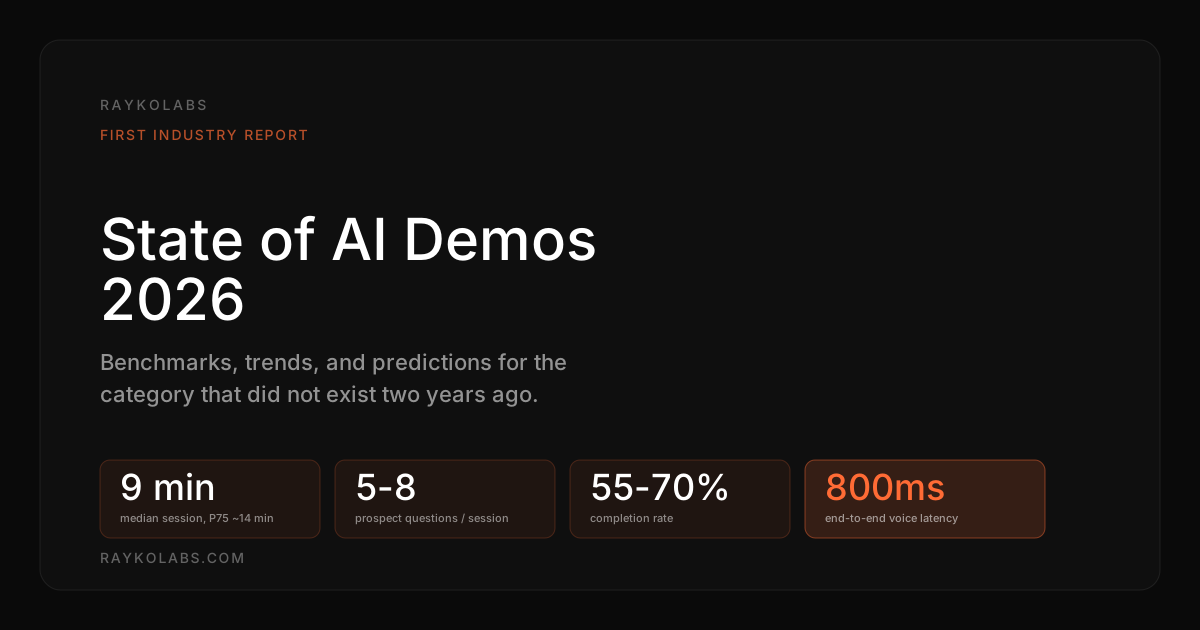
Quick answer
AI-powered product demos, where a prospect talks to an AI agent that navigates the live product and answers questions live, became a category in 2026 with five to ten serious players including Rayko, Saleo, Supersonik, Karumi, and Consensus. The category has attracted hundreds of millions in venture funding, and AI demo sessions show far higher engagement and question volume than click-through tours. AI demos and AI SDRs are now converging.
Want this running on your product? Rayko demos it live, with your prospects asking questions by voice.
START LIVE DEMOEvery year, Navattic publishes benchmarks on click-through demos. Arcade tracks video demo engagement across 14 million sessions. Both reports are useful. Both are incomplete. Neither says a word about AI-powered demos, the format where a prospect talks to an AI agent that navigates the live product, answers questions in real time, and adapts the walkthrough based on the conversation.
Nobody is tracking AI demo benchmarks. Not the analysts, not the vendors (besides us), not the media. So we are publishing the first State of AI Demos report ourselves.
This is not a marketing exercise disguised as research. We built RaykoLabs as an AI demo agent and we track every session, every question, every navigation path, every drop-off. We also talk to dozens of B2B teams evaluating or running AI demos from other vendors. This report pulls from that data and those conversations to establish the first baseline for a category that did not exist two years ago.
Here is what we found.
The AI demo market in 2026
The category emerged from three separate starting points. Browser automation companies realized they could layer AI narration on top of headless sessions. Voice AI companies realized that talking about a product is more useful when you can show the product at the same time. And demo platforms that started with click-through tours or recorded video realized that static formats leave too much on the table.
Today, that convergence has produced a market with five to ten serious players, depending on where you draw the line.
RaykoLabs, voice-first AI demo agent built on Playwright for browser automation, Browserbase for cloud session management, Deepgram for speech-to-text, and Cartesia for text-to-speech. Three-layer navigation architecture (context detection, navigation planning, LLM integration) with an 800ms latency target. Our approach starts from the premise that the demo should feel like a conversation, not a slideshow.
Saleo, started in the demo environment and overlay space, now moving toward AI-powered personalization. Their strength is in making production data look realistic for sales demos. They are approaching AI from the data layer rather than the interaction layer.
Supersonik, building AI-generated video demos with personalization. Different bet from a live agent approach, they are wagering that pre-rendered, AI-narrated video scales better than real-time browser sessions.
Karumi, focused on AI-driven demo creation, aiming to reduce the time it takes to build demo content. More of a creation tool than a delivery agent.
Consensus, the incumbent in video-based demos, which has added AI-driven features to its existing platform. They have distribution (hundreds of enterprise customers) but are iterating on top of a format, video, that AI demos are designed to surpass.
By our tracking of public funding announcements through Crunchbase and PitchBook, the AI demo category has attracted hundreds of millions in venture funding through 2025-2026, Saleo's Series B, Supersonik's a16z-led round, Karumi's YC F25 backing and follow-on, and a long tail of seed-and-Series-A rounds across the broader autonomous-agent category. The category is well past the "is this a real market?" question; whether any one vendor's bet on the model wins is still very open.
The pattern looks like what happened in the AI SDR market eighteen months ago: a handful of funded startups, category confusion in analyst reports, and a rush to define the space. The difference is that AI demos and AI SDRs are converging rather than developing as separate categories. More on that in the predictions section.
Engagement benchmarks: what AI demo sessions look like
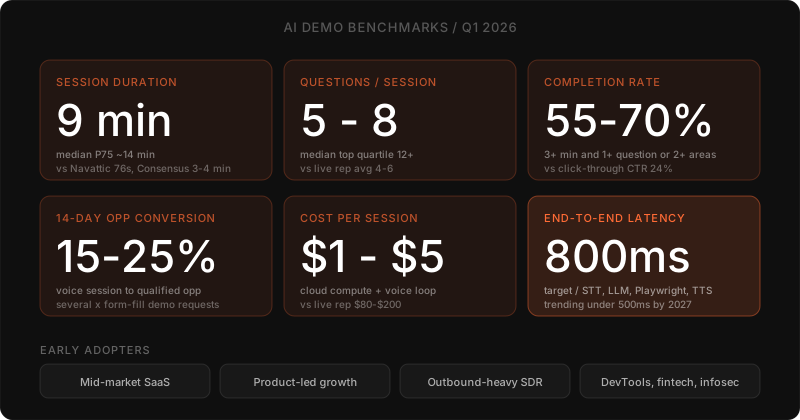
This is the section where most reports paste a grid of averages and call it analysis. We are going to be more honest about what we know, what we are still measuring, and where the data is thin.
Here are the metrics we track for AI demo sessions and the early ranges we are seeing.
Session duration
AI demo sessions run longer than click-through tours and shorter than live rep demos. Our median session duration is between 6 and 9 minutes. For comparison, Navattic reports a median of about 76 seconds for click-through demos. Consensus reports 3-4 minutes for video board sessions. A live sales demo runs 25-45 minutes.
The 6-9 minute range sits in a sweet spot, long enough for the prospect to explore multiple features, short enough that they don't abandon. But session length alone tells you nothing. A 3-minute session where the prospect asks two pointed questions about pricing integration and then clicks "talk to sales" is worth more than a 12-minute session where someone clicks around aimlessly.
In our Q1 2026 production data, median voice demo session duration runs around 9 minutes with the P75 closer to 14 minutes. Mid-market and enterprise prospects engage longer than SMB (medians of roughly 11 vs 7 minutes), and outbound-link traffic engages longer than organic search traffic (likely because outbound traffic arrives with more context about why they should care). Paid-ad traffic engages roughly in line with organic on duration, but converts to follow-up call at a slightly lower rate, consistent with paid traffic generally being broader-funnel.
Questions per session
This is the metric that separates AI demos from every other format. Click-through tours cannot take questions. Recorded video cannot take questions. Even live rep demos average only 4-6 prospect questions because the rep controls the flow and prospects are polite.
AI demos see a higher question rate because the prospect feels less social pressure asking an AI to repeat something, go deeper, or switch topics. Our early data shows a median of 5 to 8 questions per session, with the top quartile asking 12 or more.
More to the point, the content of those questions is gold. When a prospect asks "Does this integrate with Snowflake?" or "Can multiple teams have separate dashboards?", that is product-qualified intent data that no other demo format captures. We cover how to use this data in our demo analytics guide.
Feature coverage
In a click-through tour, the prospect sees exactly the features the builder chose to include, in the order the builder chose. Coverage is 100% by design, and meaningless as a signal, because it tells you nothing about what the prospect cared about.
In AI demos, feature coverage varies by prospect. Some sessions touch three product areas. Some touch seven. The metric that matters is not total coverage but coverage depth, how long did the prospect spend in each area, and did they ask follow-up questions about it?
We are seeing that prospects consistently cluster around two to three core features per session. Knowing which features those are, across hundreds of sessions, tells you more about your market positioning than any survey.
Completion and conversion
Defining "completion" for an AI demo is trickier than for a click-through tour, where the prospect either reaches the last slide or doesn't. An AI demo has no predetermined endpoint. We define completion as: the prospect stayed for at least 3 minutes and either asked at least one question or explored at least two product areas.
By that definition, completion rates for AI demos run in the 55-70% range. For comparison, Navattic reports that top-performing click-through demos have a 24.35% call-to-action click-through rate. That is a different metric, CTR versus completion, but it gives directional context.
From the customers with clean CRM-connected pipeline data, completed voice demo sessions convert to a qualified opportunity within 14 days at roughly 15-25%, directionally several times the rate we see from form-fill-driven demo requests in the same accounts. The qualification quality is also higher: opps sourced from voice sessions move through stage gates faster on average than opps sourced from cold form fills, because the agent has already surfaced the use case, the buyer persona, and the most-likely objections by session end.
How AI demos compare to other formats
The demo tool market likes to pretend all formats are interchangeable. They are not. Each format captures different signals, reaches different buyer personas, and works at different stages of the funnel. Our interactive demo platforms comparison covers the full taxonomy. Here is the benchmarking view.
| Format | Typical engagement | Prospect questions | Cost per session |
|---|---|---|---|
| Click-through tours | About 76 seconds, 24.35% top CTA CTR | None, cannot take questions | Low effort, low signal |
| Recorded video demos | Around 40% of recipients watch some | None, monologue not dialogue | Cheap to produce and embed |
| Live rep demos | 25 to 45 minutes | 4 to 6, rep controls flow | $80 to $200 in loaded rep time |
| AI demos | 6 to 9 minute median, 55 to 70% completion | 5 to 8 median, top quartile 12+ | $1 to $5 per cloud session |
Click-through tours
Navattic's 2025 data shows that click-through demos average 76 seconds of engagement and that the best-performing demos hit a 24.35% CTA click-through rate. Arcade's 2026 report across 14 million sessions shows similar patterns for their video-style demos.
These numbers are misleading if you use them to evaluate AI demos. Click-through tour CTR measures whether someone clicked a button at the end of a scripted path. That tells you the path was short enough not to bore them. It does not tell you whether the prospect understood the product, had their specific questions answered, or left with higher purchase intent.
Here is the contrarian take: interactive demo benchmarks measure the wrong thing. They measure click-throughs, not buyer intent. A 24% CTR on a demo that shows three screenshots tells you that roughly one in four people who started a two-minute flow clicked a CTA. An AI demo that captures six questions, identifies two feature interests, and generates a detailed session summary for the sales rep produces data that actually predicts pipeline, even if fewer people start the session.
CTR is a proxy metric from the display advertising era. AI demos capture what the prospect actually wants to know.
Recorded video demos
Video demos remain the most common format because they are cheap to produce and easy to distribute. Consensus reports an average video board engagement rate around 40%, meaning 40% of people who receive a video demo link actually watch some of it.
The problem with video is discoverability and staleness. A recorded demo from six months ago shows an old UI, references outdated pricing, and cannot answer "Does this work with my stack?" Video is a monologue. AI demos are a dialogue. The formats serve different purposes, but teams that rely exclusively on video are leaving intent data on the table.
Live rep demos
Still the highest-converting format for enterprise deals. A good rep reading the room, handling objections, building rapport, AI is not there yet, and claiming otherwise is dishonest.
But live rep demos do not scale. They cost $80 to $200 per session in fully loaded rep time. They require scheduling, which introduces a 2-5 day delay during which 25-50% of prospects ghost. And the data they produce depends entirely on what the rep remembers to log in the CRM.
AI demos occupy the space between click-through tours (low effort, low signal) and live rep demos (high effort, high signal). They deliver a live, interactive experience at the marginal cost of a cloud compute session. The full ROI framework is here.
Technology trends shaping AI demos
Voice AI got fast enough
Two years ago, the round-trip latency for a voice interaction, speech-to-text, LLM processing, text-to-speech, was 2 to 4 seconds. That is too slow. Human conversational turn-taking expects a response within 500 to 800 milliseconds. Anything longer and the interaction feels laggy, robotic, broken.
In 2025, three things changed. Speech-to-text models from providers like Deepgram dropped transcription latency below 300ms for streaming inputs. Text-to-speech engines like Cartesia started producing natural-sounding voice output in under 200ms. And LLM inference providers began offering optimized endpoints that cut generation time for short responses. The combined result: you can build a voice AI interaction that responds in under a second.
RaykoLabs targets 800ms end-to-end for the full voice loop. That is not a marketing number, it is an engineering constraint that drives architecture decisions across the stack. Below a second, the experience feels conversational. Above it, the prospect starts talking over the AI or loses patience. There is no middle ground.
Browser automation matured
The other half of an AI demo is the ability to navigate a product's UI in real time. This is a different problem from web scraping or test automation, though it uses similar tools.
Playwright and Puppeteer are the workhorses. Both can drive a headless (or headed) browser programmatically, clicking buttons, filling forms, navigating pages, capturing screenshots. The challenge for AI demos is not basic automation. It is context-aware navigation: the AI needs to understand where it currently is in the product, determine where to go next based on the conversation, and execute the navigation smoothly enough that the prospect can follow along.
We solved this with a three-layer navigation architecture. Layer one detects the current application state. Layer two plans the navigation path. Layer three integrates LLM reasoning to handle ambiguous or novel situations. Cloud session management through Browserbase handles the infrastructure so we do not need to run browsers on our own servers.
The maturation of browser automation is what turned AI demos from a research project into a deployable product. Two years ago, making an AI reliably navigate a complex SaaS product was an unsolved problem. Today it is an engineering challenge with known solutions.
Multi-language is now default
Voice AI models in 2024 required separate fine-tuned models for each language, and quality dropped off a cliff outside English and Spanish. By early 2026, multilingual models from Deepgram, OpenAI, and others handle 30+ languages from a single model checkpoint with acceptable quality. This accelerates the shift toward voice-first buyer experiences across global markets.
For AI demos, this means a single deployment can serve a prospect in English, German, Japanese, or Portuguese without separate configurations. The prospect speaks in their preferred language, the STT model transcribes it, the LLM responds in that language, and the TTS model renders the output. The demo content, the product being shown, stays the same. Only the narration adapts.
This matters more than most vendors acknowledge. B2B software is a global market. A European prospect evaluating your product at 10 PM their time does not want a demo in English if German is their working language. Multilingual AI demos remove the "we only have reps who speak English and Spanish" constraint.
Session recording evolved
Recording AI demo sessions is not the same as screen recording a Zoom call. The session includes browser state, voice audio (both the AI and the prospect), navigation events, timing data, and interaction metadata. Recording all of that in a format that is both replayable and searchable requires purpose-built infrastructure.
We use rrweb for DOM-level session recording, which captures the visual experience without the bandwidth cost of video encoding. Combined with the voice transcript and the interaction log, every session produces a structured dataset that sales teams can review, search, and analyze. This is a qualitative leap beyond "Here is a Gong recording of a 40-minute demo call."
Adoption patterns
Who is adopting AI demos first?
Based on our conversations with buyers and our own pipeline data, three patterns stand out.
Mid-market SaaS (200-2,000 employees) is moving fastest. These companies have enough demo volume to feel the pain of scheduling bottlenecks but not enough sales engineers to throw bodies at the problem. They are also less encumbered by procurement bureaucracy than enterprise buyers. A mid-market VP of Sales can try an AI demo tool in a quarter. An enterprise CRO needs twelve months of security reviews.
Product-led growth companies are a natural fit. If your go-to-market already includes self-serve trials or freemium tiers, adding an AI demo is a smaller conceptual leap. Your team already believes buyers should experience the product without a gatekeeper. An AI demo is an upgraded version of that experience, guided rather than unguided, conversational rather than silent.
Outbound-heavy sales teams are the surprise adopter. Teams with large BDR organizations are discovering that an AI demo link in a cold email outperforms a "book a meeting" CTA. The prospect can experience the product right now, in the email thread, without committing to a calendar slot. AI SDR teams are starting to embed demo links as a conversion step rather than defaulting to scheduling.
Which industries?
Developer tools and DevOps platforms adopted first, their buyers are comfortable with AI-driven interfaces and expect to evaluate products independently. Fintech is close behind, driven by pressure to demonstrate compliance-sensitive features without exposing production data. Cybersecurity teams are using AI demos to show threat detection workflows without building throwaway lab environments.
HR tech, healthcare, and regulated industries are slower but moving. The constraint is not technology skepticism, it is data handling policy. When a prospect asks a question during an AI demo, that audio is processed by third-party models. For companies in regulated verticals, the compliance review for that data flow adds months. We wrote about security considerations for AI demos to address the most common objections.
Sales motion alignment
AI demos work best in motions where the prospect has high intent but low patience. Inbound website visitors. Outbound prospects who clicked a link. Event follow-ups. Partner channel enablement where the partner does not know your product well enough to demo it themselves.
They work less well, today, for enterprise deals where the demo is a political event. When eight stakeholders join a call and the demo needs to address three different use cases while navigating internal dynamics, a human rep still wins. That line is moving, but in 2026 it has not moved far enough to claim otherwise.
Five predictions for 2027
1. AI SDRs and AI demos will merge into a single agent
The AI SDR category is booming. The AI demo category is emerging. By mid-2027, the distinction will start to dissolve. A prospect will engage with an AI agent that qualifies them through conversation, then, in the same session, transitions to a live product walkthrough without a handoff. No "let me book you a demo." No context loss. The SDR is the demo. At least two funded startups will ship this as a unified product by the end of 2027.
2. Video demos will lose budget share to AI demos in mid-market
Recorded demo videos will not disappear. They are too cheap and too easy to embed. But the budget that goes to video production teams, studios, and post-production editing will shrink as AI demos absorb the "show the product to prospects" use case. Consensus and similar video-first platforms will either add AI demo capabilities or watch their mid-market customers churn to AI-native alternatives.
3. Demo interaction data will become the primary lead scoring signal
Today, lead scoring relies on page views, email opens, content downloads, and form fills. These are weak signals. A prospect who asks an AI demo agent six specific questions about your API integration with Salesforce is a stronger signal than a prospect who downloaded three whitepapers. By 2027, CRM integrations will surface AI demo session data, questions asked, features explored, objections raised, as first-class inputs to lead scoring models. The team with the best demo analytics will have the best pipeline predictions.
4. Sub-500ms voice latency will be table stakes
Our current target is 800ms. By the end of 2027, the combined advances in STT, LLM inference, and TTS will push the standard below 500ms. At that speed, AI voice interactions will be indistinguishable from human conversational pacing. This is the threshold where "it sounds like talking to a robot" complaints vanish permanently. Every AI demo vendor that cannot hit this target will feel the gap in their conversion rates.
The latency floor keeps dropping. Deepgram and Cartesia have both shipped meaningful latency improvements through 2025-26, Deepgram's Nova-3 streaming STT pushes first-token latency well under 300ms for most major languages; Cartesia's streaming TTS first-audio latency now lands consistently under 200ms. The LLM-inference floor is the more interesting variable: Groq's and Cerebras's published roadmaps for token-per-second throughput suggest the 800ms end-to-end voice loop will become the high end rather than the target by 2027. Whatever conversational latency the category has today, the floor is getting closer to "indistinguishable from human" on a measurable trajectory.
5. Every demo platform will claim to be an "AI demo platform"
Navattic will add AI narration to click-through tours. Walnut will add an AI Q&A layer to their sales demos. Storylane will add voice. The label "AI demo" will become as diluted as "AI-powered" already is across SaaS. The differentiation will not be whether you use AI, everyone will, but how deeply AI controls the experience. There is a difference between an AI that reads a script over a guided tour and an AI agent that autonomously navigates a live product based on a real-time conversation. That difference will determine which vendors win.
A moment of honesty from the building side. We started RaykoLabs because we were tired of watching the same problem repeat: a prospect wants to see the product, the product is not available to see, the prospect leaves. We shipped the first version knowing the voice was slightly too slow, the navigation broke on complex SPAs, and the analytics dashboard was a spreadsheet. Most of it still has rough edges. We are publishing this report not because we have all the answers but because someone needs to start counting. If the category is going to matter, and we believe it will, it needs real numbers, not vibes. This is our first attempt at those numbers, and we will update the data every quarter as our sample size grows.
Why RaykoLabs is publishing this report
The simple answer: because nobody else will.
Navattic publishes click-through demo benchmarks because they dominate that format. Arcade publishes video demo data because they have 14 million sessions to pull from. AI demos are too new and too fragmented for any analyst firm to cover yet. Forrester and Gartner will get there, probably by late 2027, but the market is forming now.
We have a bias. We build AI demos. We want the category to grow because that is good for our business. We are not pretending otherwise. But having a bias does not make the data wrong. It just means you should check our work, and we invite that.
If you are running AI demos, with RaykoLabs or with anyone else, and you have benchmarks to share, reach out. The more data points in the next edition, the more useful it becomes for everyone. If you want to see what an AI demo session looks like before forming an opinion, try it yourself.
The demo market is splitting into two eras: before AI and after it. Click-through tours were a good first step. Video was a good second step. The next step is an AI agent that shows your product, answers questions, and tells your sales team exactly what the buyer cares about. We are building that, and this report is our way of tracking whether it is working, for us and for the category.
We will publish the next edition in Q3 2026 with a larger dataset. Follow us or subscribe to get it when it drops. For a deeper look at the technology behind AI demos, the ROI math, or the best demo automation tools on the market, start with those guides.
What still defines AI demos in September 2026?
Conversation plus live product navigation still defines the category. Engagement quality comes from questions asked and topics explored, not from views alone, with clean handoff to sales.
Reviewed in September 2026 against the sources cited above, including Stanford AI Index, McKinsey State of AI, Salesforce State of Sales, Gartner buying journey research, Forrester sales research, Bridge Group development metrics, and OpenView SaaS benchmarks, the category framing in this report remains current. Voice interaction still lowers the barrier to asking questions, browser automation still carries the live product experience, and session transcripts still provide richer qualification context than page views. The September reading is convergence rather than replacement. Teams continue to pair voice demos with tours, video, and live calls, route by intent and deal complexity, and judge pilots by question depth, topic coverage, handoff acceptance, and pipeline influence. Expect steady gains in responsiveness and language coverage, while buying committees still want humans for strategic and commercial decisions.
Frequently asked questions
Can AI really close sales deals on its own?
No, and any vendor claiming otherwise is selling you a fantasy. AI tools like Rayko, Drift, Qualified, and Conversica handle qualification, demos, and follow-up at the front of the funnel, but the actual close still requires human judgment for B2B deals over $5,000 ARR. The Salesforce State of Sales report consistently shows that buyers expect human contact for negotiation, contract terms, and multi-stakeholder alignment. What AI does well is collapse the time between interest and warm handoff from days to minutes. What it does not do is replace the rep who gets on the phone, handles the procurement back-and-forth, and earns the signature. Treat AI as a force multiplier, not a closer.
Can AI handle complex sales workflows?
It depends on what you mean by complex. AI handles structured workflows like lead qualification, demo delivery, and CRM hygiene reliably and at scale. AI struggles with workflows that require multi-month relationship building, stakeholder politics inside the buyer org, and bespoke contract negotiation. The honest answer for B2B SaaS: AI can run 80 percent of the inbound funnel autonomously and 20 percent of the deal cycle. The 80 percent that automates is also the 80 percent that wastes rep time today, so the leverage is real even if AI cannot do everything. Tools like Rayko and Conversica focus on the automatable layer and route the rest to humans. Tools that claim end-to-end automation almost always disappoint.
Can you really triple sales with AI call assistants?
Tripling is a real outcome but not a guaranteed one. The mechanism is straightforward: AI call assistants reduce response time from hours to under 60 seconds, and the MIT InsideSales lead-response study shows that contacting a lead within 5 minutes makes you 9x more likely to qualify them than waiting 30 minutes. Combined with 24/7 availability and the elimination of no-shows, most B2B SaaS teams see opportunity volume rise 50 to 200 percent within 90 days. Tripling happens when the team also has high inbound traffic and a tight ICP. Teams with low traffic or a fuzzy ICP see smaller lifts. Validate against your own baseline rather than trusting headline numbers.
Can automation really give my sales reps more time for closing?
Yes, and the time saved is meaningful. Most B2B SaaS reps spend 6 to 12 hours per week on first-touch qualification, demo prep, demo delivery, and CRM hygiene. AI tools like Rayko, Drift, and Qualified absorb most of that work. Reps who switch from manual first-touch to AI-led capture typically reclaim 30 to 50 percent of their week for closing-stage activities like discovery, negotiation, and stakeholder alignment. The Salesforce State of Sales report shows reps spend only 28 percent of their time actually selling, the rest goes to admin, prep, and qualification. Automation pushes that ratio toward 50 to 60 percent, which is where rep economics start to compound.
Sources
- AI Index Report, Stanford HAI
- State of AI, McKinsey
- State of Sales, Salesforce Research
- The B2B Buying Journey, Gartner
- B2B Marketing and Sales Research, Forrester
- SaaS Sales Development Metrics & Trends, Bridge Group
- OpenView SaaS Benchmarks, OpenView Partners
Cite this article
Utkarsh Agrawal. "State of AI Demos 2026: Benchmarks, Trends, and Predictions." RaykoLabs Blog, April 4, 2026. https://raykolabs.com/blog/state-of-ai-demos-2026

Utkarsh Agrawal is CTO of RaykoLabs, where he leads engineering on Rayko, the AI demo agent that runs live, voice-enabled product demos in a real browser for B2B SaaS teams. His work spans real-time voice interaction, browser automation with Playwright and Browserbase, speech-model orchestration, and the infrastructure that keeps autonomous demos reliable around the clock. On the RaykoLabs blog he writes practical guides on voice-enabled product demos, demo automation, and what it takes to ship production AI agents for sales: how to qualify prospects mid-demo, how to measure demo performance, and how buying teams actually evaluate demo software. His comparisons of demo platforms are built from hands-on testing and vendor documentation, with trade-offs stated plainly so buyers can decide fit.
See RaykoLabs in action
Watch an AI agent run a live, personalized product demo, no scheduling, no waiting.
START LIVE DEMO