Loading...

2026 Demo Personalization: Scale Wins Without Extra Reps
Learn how to personalize demos by persona, account, and role without adding reps. See the enterprise playbook for relevance at scale. Start here.
Quick answer
Demo personalization at scale means moving up a five-level spectrum, from generic to segment, persona, account, and individual real-time, without a human rep preparing every session. Manual personalization hits a ceiling because effort does not scale, so the playbook combines a persona matrix, reusable content modules, and account enrichment with an AI agent that adapts the live product to each viewer in real time. Personalization, not production polish, drives conversion.
Want this running on your product? Rayko demos it live, with your prospects asking questions by voice.
START LIVE DEMOThree people visit your website on the same Tuesday afternoon. The first is a CTO evaluating your platform's architecture, security posture, and integration story. The second is a VP of Sales who wants to see pipeline dashboards, forecasting accuracy, and rep productivity metrics. The third is an end user, an account executive, who just wants to know if this thing is easier than the spreadsheet she currently lives in.
Same product. Three completely different demos needed. And if you show all three the same generic walkthrough, you will lose at least two of them.
This is the core tension of enterprise sales: personalization drives conversion, but personalization requires effort, and effort does not scale. Most teams default to one of two extremes, either everyone sees the identical tour, or a human rep spends hours preparing a bespoke session for every prospect. The first wastes opportunity. The second wastes people.
There is a third path, and this playbook lays it out: how to personalize demos across personas, industries, and buying committees at a scale that no sales team can match manually.
Why personalization matters more than polish
Sales teams obsess over demo production quality. The transitions need to be smooth. The environment needs to look clean. The script needs to be tight. None of that matters if the content is wrong for the audience.
Partners face the same content problem per reseller: see demo automation for partner enablement. Forrester found that 77% of B2B buyers describe their last purchase as "very complex or difficult." The difficulty is not understanding the product, it is understanding whether the product solves their specific problem. A polished demo that walks through features in alphabetical order does not answer that question. A rough demo that nails the prospect's use case in the first thirty seconds does.
Gartner's and Demand Gen Report's research on demo personalization is consistent: personalized demos outperform generic demos by 30-50% on conversion to next-stage opportunity across most B2B categories, with the lift more pronounced in enterprise deals than in self-serve. The mechanism is straightforward, personalization is not a feature, it is a respect signal, and buyers reward vendors that take the time to speak to their specific context.
The numbers across the industry paint a consistent picture. Personalized demos convert at two to three times the rate of generic walkthroughs. Average deal size is 20-40% larger because personalized demos surface value that generic ones miss, the prospect sees a use case they hadn't considered, or a feature that solves a problem they assumed they'd need a separate tool for. Sales cycles compress because the prospect reaches conviction faster when the demo speaks directly to their situation.
Here is the uncomfortable part: personalization theater is worse than no personalization. Pasting a company logo onto a generic demo insults the buyer. Adding "Hi Sarah" to the greeting of an otherwise identical walkthrough signals that you put in exactly five seconds of effort. Buyers recognize surface-level personalization instantly, and it erodes trust faster than a completely generic experience would. At least the generic demo is honest about what it is.
Real personalization changes what you show, the order you show it, the language you use to describe it, and which outcomes you emphasize. Everything else is decoration.
The personalization spectrum
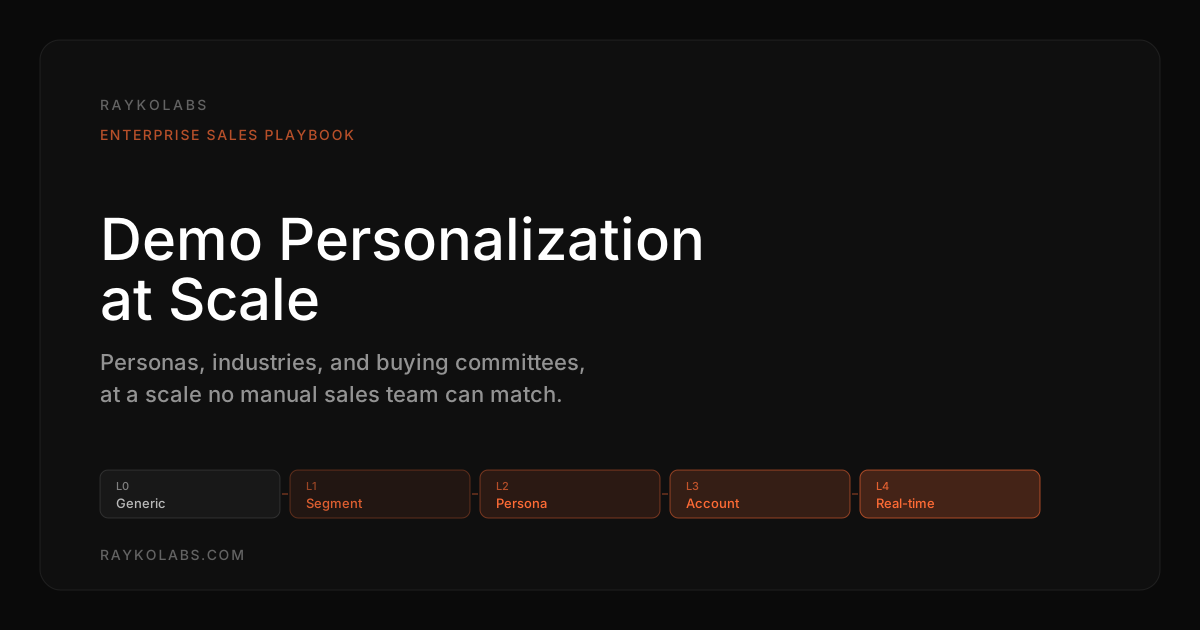
Not all personalization is equal. Think of it as five levels, each building on the last.
Level 0: Generic
One demo for every prospect. The same script, the same flow, the same emphasis. This is where most companies start and where a surprising number stay. It is the fastest to build and the lowest to convert. Click-through tools like Walnut and Consensus often live here, a captured product tour that plays the same way for everyone.
Level 1: Segment-based
Demos split by broad categories, industry vertical, company size, or product tier. An HR tech company might have one demo for enterprise and another for SMB. A fintech platform might have separate tracks for banks and credit unions. This is better than generic but still assumes everyone in a segment has the same priorities. They do not. For examples of segment-level personalization done well, see our HR tech demo and fintech demo deep dives.
Level 2: Persona-based
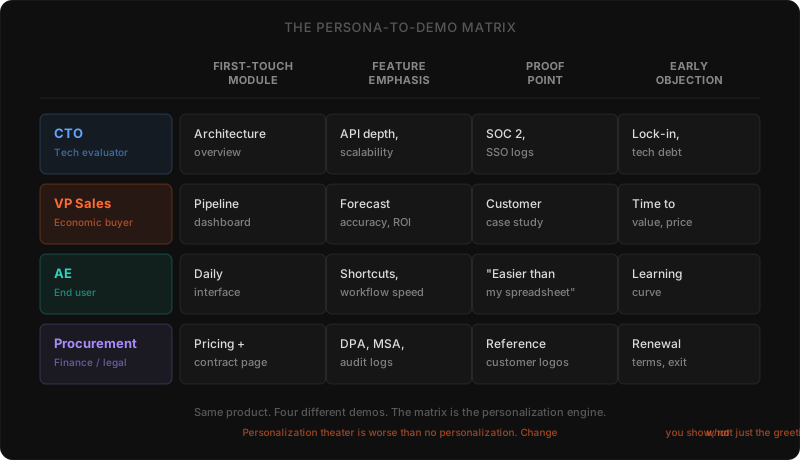
Demos tailored to the buyer's role. The CTO sees architecture, security, and integrations. The VP of Sales sees dashboards, analytics, and workflow automation. The end user sees the daily interface, shortcuts, and time-to-value. This is where conversion rates start to climb meaningfully, because you are matching content to what the individual actually cares about.
Level 3: Account-based
The demo reflects not just the persona but the specific company. Their industry context, their tech stack, their known pain points from discovery calls or intent data, their competitive situation. The demo might reference their specific CRM integration, show data volumes that match their scale, or highlight a feature that directly addresses a problem mentioned in a prior conversation. This level requires information, preparation time, and a rep who can synthesize it all. Most enterprise sales teams attempt this level for their top-tier accounts.
Level 4: Individual real-time
The demo adapts dynamically based on what the prospect says, asks, and does during the session. If the prospect asks about reporting, the demo pivots to reporting. If they spend extra time on a particular screen, the agent digs deeper. If they mention a competitor, the demo addresses the comparison. This is the level that used to require a senior sales engineer with deep product knowledge and fast thinking. It is also the level where AI demo agents now operate.
| Level | What it personalizes | What it requires |
|---|---|---|
| Level 0: Generic | Nothing, one script and flow for everyone | Fastest to build, lowest to convert |
| Level 1: Segment-based | Broad categories: industry vertical, company size, product tier | A segment library of pain points and use cases |
| Level 2: Persona-based | The buyer's role: CTO, VP of Sales, end user | A persona matrix mapping features to outcomes each role cares about |
| Level 3: Account-based | The specific company: tech stack, known pain points, competitive situation | Account enrichment data and rep synthesis time |
| Level 4: Individual real-time | What the prospect says, asks, and does during the session | Real-time listen, reason, and act, a senior SE or an AI demo agent |
How to personalize at each level
The tactics vary dramatically across the spectrum. Here is what works at each stage.
Level 0 to Level 1: Build your segment library
Start with the segments that matter most. For most B2B companies, this means three to five industry verticals and two to three company sizes.
For each segment, document the top three pain points, the primary use case, the features that matter most, and the language the segment uses to describe their problems. A healthcare buyer says "patient outcomes" where a retail buyer says "customer experience." Same product capability, different framing.
Build a separate demo flow for each segment. You do not need separate demo environments, the same product instance works. You need different starting points, different navigation paths, and different emphasis. Record which features to show first, which to skip, and which talking points to hit.
Level 1 to Level 2: Map personas to content
Within each segment, identify the two to four buying personas and build a persona matrix. Across the top: feature categories. Down the side: personas. Each cell answers the question: "When showing this feature to this persona, what outcome do they care about?"
A reporting feature shown to a CFO emphasizes financial visibility and audit compliance. The same feature shown to a team lead emphasizes workload distribution and performance tracking. The same feature shown to an individual contributor emphasizes personal productivity metrics.
This matrix becomes the decision engine for your demo. Whoever or whatever is running the demo uses it to select content and frame it correctly.
Level 2 to Level 3: Enrich with account context
Account-level personalization requires intelligence. Pull data from your CRM, your intent data providers, LinkedIn, earnings calls, job postings, and prior conversation notes. Build a pre-demo brief for each account that includes:
- Industry and sub-industry
- Company size and growth trajectory
- Known tech stack and integrations they will care about
- Pain points from prior conversations or public signals
- Competitive tools they are currently using or evaluating
- Internal champions and their roles
This brief informs which demo variation to run, which features to emphasize, and which proof points to reference. A financial services company with a compliance-heavy mandate sees security features front and center. The same company during rapid hiring season sees onboarding workflow automation first.
Level 3 to Level 4: React in real time
This is where static preparation gives way to dynamic adaptation. Real-time personalization requires three capabilities: understanding what the prospect is asking or doing, determining what to show next based on that input, and executing the transition smoothly.
A human sales engineer does this intuitively, they hear a question, recall the relevant feature, and navigate to it while framing a response. Replicating this requires a system that listens, reasons, and acts simultaneously. We will come back to how AI demo agents handle this in a moment.
The manual personalization ceiling
Enterprise sales teams know personalization matters. They invest heavily in it. And they hit a ceiling every time.
The math is straightforward. A sales engineer spends 30-60 minutes researching an account before a personalized demo. The demo itself runs 30-45 minutes. Post-demo follow-up and notes take another 15-30 minutes. That is 75 to 135 minutes per prospect at the high end, which means a single SE can deliver four to six deeply personalized demos per day.
Now run those numbers against your pipeline. If marketing generates 200 demo requests per month and you have two SEs, you can personalize 40-50 of them. The rest get generic demos, wait in a queue, or never get a demo at all. The human vs. AI demo comparison breaks down exactly where this gap becomes painful.
Three specific bottlenecks kill manual personalization at scale.
Research time scales linearly. Every additional account requires the same research effort. There is no compounding gain. Your tenth demo takes as long to prepare as your first. Experienced reps build shortcuts and templates, but the core work of understanding a specific account cannot be automated with static tools.
Expertise is concentrated. The people who deliver the best personalized demos are your most senior, most expensive people. They are also the ones you need on strategic deals, product feedback sessions, and customer escalations. Using them for first-touch demos is a terrible allocation of their time. But using junior reps who lack the product depth to improvise results in weaker personalization that undermines the whole exercise.
Consistency degrades under volume. The first demo of the day is sharp. By the fifth, fatigue creeps in. The research gets thinner. The transitions get sloppier. The responsiveness to questions drops. Every rep knows this, and every sales leader pretends it is not happening. The analytics tell the truth, late-day demos convert at lower rates, and Friday demos are measurably worse than Tuesday demos.
There is also the coverage problem. Your team works business hours in one or two time zones. Your prospects are global and increasingly expect self-service. The 60% of demo requests that arrive outside your team's working hours either wait until the next business day or get routed to a generic, non-personalized experience. Both options leak value.
AI-powered personalization
AI demo agents eliminate the ceiling because they decouple personalization from human availability.
An AI demo agent operates at Level 4 personalization by default. It processes context about the prospect, role, company, industry, prior interactions, before the demo begins. It adapts the narrative and navigation in real time based on what the prospect says and does. And it does this simultaneously for every concurrent session, at any hour, without degradation.
Here is what happens technically when personalization meets automation. RaykoLabs runs on Playwright for browser automation through Browserbase, with Deepgram handling speech-to-text and Cartesia powering voice synthesis. The three-layer navigation system, context detection to read the current page state, navigation planning to determine optimal paths, and LLM integration to generate contextual responses, makes real-time adaptation possible rather than theoretical. We tuned the pipeline to hit an 800ms latency target between prospect input and agent response, because anything slower than that breaks the conversational feel that makes personalized demos effective. Session recording through rrweb captures every interaction for post-demo analysis, so the personalization data flows back into your pipeline intelligence.
In our customer deployments where we can cleanly compare personalized agent flows against generic flows, the lift on conversion-to-follow-up-call lands in the 30-50% range, directionally consistent with the Gartner/Demand Gen baseline above, sometimes higher when the persona signal is strong (an obvious enterprise buyer with a recognizable email domain) versus weaker (anonymous prospect with a generic Gmail address).
The practical implications for personalization at each level:
Segment and persona detection happens automatically. The agent identifies whether it is speaking to a technical evaluator or an executive buyer within the first exchange and adjusts the demo flow, vocabulary, and depth accordingly. No pre-configuration required for each session.
Account context is ingested, not memorized. CRM data, prior interaction history, and enrichment data feed into the agent's context window. When a prospect from a financial services company starts a demo, the agent already knows to lead with compliance features and security certifications, not because someone programmed that path, but because the context makes it the obvious choice.
Real-time adaptation is continuous, not reactive. The agent does not wait for a question to personalize. It reads engagement signals throughout, dwell time on screens, the specificity of questions, the topics that generate follow-up questions versus silence, and adjusts in real time. The ROI implications of this continuous personalization are significant: higher conversion, shorter cycles, and better-qualified pipeline.
Personalization scales horizontally. The hundredth simultaneous demo is as personalized as the first. The 2 AM demo is as sharp as the 10 AM demo. The Friday afternoon demo is as effective as the Tuesday morning demo.
Building your personalization playbook
Abstract strategy is useless without execution. Here is a step-by-step framework for building demo personalization into your sales motion, whether you use AI agents, human reps, or a hybrid.
Step 1: Audit your current state
Run your existing demo through the personalization spectrum. Be honest about where you land. Most companies overestimate by one or two levels. Record three to five demos your team delivers this week and score each one:
- Did the demo reference the prospect's specific industry?
- Did it address the prospect's role-specific concerns?
- Did it include any account-specific context?
- Did it adapt to questions or signals during the session?
If the answer to most of these is no, you are at Level 0 or 1 regardless of what your demo playbook claims.
Step 2: Build your persona matrix
Identify every buying persona involved in your typical deal. For enterprise sales, this is usually four to seven roles across technical, operational, financial, and executive functions.
For each persona, document:
- Their primary outcome (what success looks like to them personally)
- Their top three concerns about a product like yours
- The features they need to see in the first five minutes
- The language they use, jargon, metrics, acronyms
- The objections they are most likely to raise
This matrix is the single most valuable asset in your demo personalization program. It drives everything downstream, content selection, narrative framing, objection handling, and follow-up strategy.
Step 3: Create your content modules
Break your demo into modular components rather than a single linear flow. Each module covers a feature area, use case, or workflow. Modules should be self-contained, they make sense regardless of what came before or after.
For a typical B2B product, you might have 15-25 modules. Not every prospect sees every module. The personalization engine, whether human or AI, selects and sequences modules based on the persona matrix and account context.
A concrete example for a hypothetical project-management SaaS: the agent might carry six modules, a "first-touch overview" (used for any visitor without a clear persona), "PM-for-engineering" (for VPs of engineering, leads with API and integration depth), "PM-for-marketing" (for marketing leads, leads with campaign-tracking and asset-management views), "executive overview" (three-minute high-altitude tour for VPs and C-suite), "security-and-compliance" (for IT and security buyers, leads with audit-log and SSO views), and "pricing-and-procurement" (for finance buyers, leads with the pricing page and ROI calculators). Persona detection picks one at session start and the agent's narration, navigation order, and feature emphasis all adjust. The same product, six different demos.
Step 4: Map context signals to content decisions
Define the rules that connect prospect signals to content choices. This is the intelligence layer of your personalization system.
Signals include explicit information (job title, company, industry from form fills or CRM data), behavioral information (pages visited, content downloaded, features explored in a prior session), and conversational information (questions asked, objections raised, topics of interest expressed during the demo).
Each signal maps to a content decision. "Prospect is a VP of Engineering" maps to "lead with architecture overview, show API documentation, emphasize scalability metrics." "Prospect asked about SOC 2 compliance" maps to "show security certifications, demonstrate audit logging, reference compliance customer stories."
Write these rules down. If they live only in your best rep's head, they die when that rep leaves.
Step 5: Implement and instrument
Deploy your personalization system, whether that means training reps on the persona matrix and content modules, configuring an AI demo agent with the appropriate context, or both.
Instrument everything. For every demo session, capture which persona was detected, which modules were shown, what questions were asked, how long the prospect engaged with each section, and what happened after the demo (follow-up meeting booked, content requested, deal advanced). This data feeds the optimization loop in Step 6.
If you are implementing an AI demo agent, the instrumentation comes built in. RaykoLabs captures session recordings via rrweb, full conversation transcripts via Deepgram, and structured engagement data through its analytics pipeline. For human-delivered demos, you need to build the discipline of post-demo documentation, and be realistic about how consistently it will happen. Our complete guide to demo analytics covers the measurement framework in detail.
Step 6: Optimize based on data
Personalization is not a launch-and-forget initiative. It is a continuous optimization loop.
Review your demo analytics monthly. Compare conversion rates across personalization levels. Identify which modules drive the highest engagement and which get skipped. Look for patterns in the questions prospects ask that your current modules do not address, those gaps are content opportunities.
A/B test personalization approaches where volume allows. Does leading with the prospect's industry use case convert better than leading with their persona-specific feature? Does mentioning the prospect's current tooling increase engagement or create defensiveness? Let the data answer questions your intuition cannot.
The teams that win at demo personalization treat it like a product, with roadmaps, iteration cycles, and metrics-driven decisions. The teams that lose treat it like a one-time project.
The unpopular truth about personalization
Here is a take most demo tool vendors will not say out loud: Levels 1 and 2 personalization are table stakes, not differentiators. Splitting demos by segment or persona is what every competent sales team already does. Calling it "personalized" is like calling a restaurant "personalized" because they ask if you want water or sparkling. The real gap is between Level 3 and Level 4 -- between preparing a custom demo before the call and adapting in the moment when the prospect asks something you did not anticipate. That gap is where deals are won or lost, and it is the gap that no amount of pre-call research can fully close. Only real-time adaptation -- whether from an experienced SE or an AI agent -- bridges it.
The personalization gap is a competitive gap
A prediction worth tracking: within two years, the difference between companies that personalize demos and companies that do not will be as stark as the difference between companies that adopted CRM and those that stuck with spreadsheets. The underlying capability, understanding each buyer and adapting the experience accordingly, is too powerful to remain optional.
The manual approach worked when deal volume was low and buyers tolerated scheduling friction. Neither condition holds in 2026. Buyers expect immediate, relevant experiences. Deal volume continues to climb. And the cost of a missed or blown demo compounds into lost pipeline that no amount of follow-up email can recover.
AI demo agents make the highest level of personalization, real-time, individual, adaptive, the default rather than the exception. That is not a marginal improvement. It is a structural advantage. When every demo your company delivers is personalized to the individual watching it, and your competitor is still sending everyone the same product tour, the conversion gap becomes a revenue gap becomes a market position gap.
Build the playbook. Start where you are on the spectrum. Move up one level at a time. And recognize that the ceiling on manual personalization is not a temporary constraint, it is a permanent one that only automation removes.
The companies that figure out demo personalization at scale will close more deals, close them faster, and build deeper relationships with their buyers from the first interaction. The companies that do not will keep wondering why their demo-to-close rate refuses to move.
September 2026 check: does personalization at scale still drive conversion?
Yes. Relevance still beats polish. Buyers still find purchases complex because they cannot tell if the product solves their specific problem. Moving up the spectrum from generic to segment to persona to account to real time adaptation still explains the conversion lift.
We rechecked the cited hubs in September 2026, including the Gartner buying journey hub, the Forrester research hub, the Salesforce State of Sales hub, the McKinsey growth insights hub, and the TrustRadius buyer research hub. They remain sound support for complexity and personalization lift. The manual ceiling math also holds. Research per account still scales linearly, senior expertise is still scarce, and quality still degrades under volume and off hours coverage gaps.
Keep the playbook order as written. Audit current level honestly, build a tight persona matrix, ship modular content, map signals to content decisions, instrument persona and module use, and optimize monthly. Treat surface decoration as theater and invest in what is shown, in what order, and in which language. No level definition required revision in September 2026.
Verdict: Personalize by persona and account with reusable modules plus live adaptation
Demo personalization at scale works best when you combine reusable content modules with live adaptation. Build one path per core persona, enrich each session with account context, and let an AI agent adjust depth, examples, and proof points in real time.
Start with three to five personas and one modular path each, then layer account enrichment for industry and role. Review transcripts weekly to tune examples and proof points. Relevance in the first minute matters more than visual polish.
Frequently asked questions
How do I customize AI assistants for my sales process?
Three layers of customization matter. First, the knowledge base: feed the AI your product documentation, ICP definitions, competitive battle cards, and pricing logic so it answers in your voice. Second, the qualification flow: define which 4 to 7 questions the AI asks, in what order, and how it scores answers against your warm-lead threshold. Third, the routing rules: define who handles each lead bucket (warm to AE, lukewarm to SDR, cool to nurture, cold to close-out). Tools like Drift, Qualified, Intercom Fin, and Rayko expose all three layers. The teams that get the most ROI rebuild their qualification flow on a 90-day cadence to match product release cycles, static flows go stale fast.
How do I personalize interactive demos for different customer types?
Branch on persona, vertical, and use case at the start of the demo. Three practical mechanisms. URL parameters: route campaign traffic to demo variants where each variant emphasizes the features that matter to that audience (CTO, VP Sales, end user). In-demo branching questions: the AI's first question identifies the persona, then the rest of the conversation adapts to that persona's priorities. Account-level enrichment: pass the prospect's domain through Clearbit or Apollo, surface industry, size, and tech stack, and have the AI tailor examples accordingly. McKinsey's research on B2B personalization consistently shows that segment-specific demos lift conversion 30 to 50 percent versus a single generic demo for everyone.
How do I segment interactive demo experiences across user personas?
Define three to five personas, not fifteen. For most B2B SaaS, the meaningful splits are economic buyer, technical evaluator, and end user, with a fourth for procurement or finance on enterprise deals. Build one demo path per persona, each emphasizing the proof points that persona cares about. The economic buyer wants ROI math and competitive positioning. The technical evaluator wants architecture, security, and integration depth. The end user wants ease and speed. AI demo agents like Rayko, Storylane, and Saleo support persona branching natively. The trap is over-segmentation: more than five personas and you cannot maintain the demos, and the marginal lift on persona six is rarely worth the maintenance overhead.
How do I train an AI agent for my specific product?
Five inputs do the work. Product documentation (help center articles, API docs, video transcripts) so the AI can answer feature questions accurately. ICP and persona definitions so the AI calibrates qualification to your real buyers. Competitive battle cards so the AI handles 'how are you different from Storylane' and similar questions correctly. Pricing logic so the AI quotes the right plan for the prospect's context. Recorded sales calls or rep transcripts so the AI learns your team's actual phrasing. Tools like Rayko, Saleo, and Drift each handle ingestion differently, but the inputs are roughly the same. Plan for two to four weeks of tuning before the AI sounds like your product team rather than a generic SaaS agent.
Sources
- The B2B Buying Journey, Gartner
- Account-Based Marketing Research, Forrester
- State of Sales, Salesforce Research
- B2B Personalization at Scale, McKinsey
- B2B Buyer Insights, TrustRadius
Cite this article
Utkarsh Agrawal. "2026 Demo Personalization: Scale Wins Without Extra Reps." RaykoLabs Blog, March 17, 2026. https://raykolabs.com/blog/demo-personalization-at-scale

Utkarsh Agrawal is CTO of RaykoLabs, where he leads engineering on Rayko, the AI demo agent that runs live, voice-enabled product demos in a real browser for B2B SaaS teams. His work spans real-time voice interaction, browser automation with Playwright and Browserbase, speech-model orchestration, and the infrastructure that keeps autonomous demos reliable around the clock. On the RaykoLabs blog he writes practical guides on voice-enabled product demos, demo automation, and what it takes to ship production AI agents for sales: how to qualify prospects mid-demo, how to measure demo performance, and how buying teams actually evaluate demo software. His comparisons of demo platforms are built from hands-on testing and vendor documentation, with trade-offs stated plainly so buyers can decide fit.
See RaykoLabs in action
Watch an AI agent run a live, personalized product demo, no scheduling, no waiting.
START LIVE DEMO