2026 After Hours AI Demos: Capture Inbound While You Sleep
Capture after hours inbound with 24/7 AI demos that qualify, demo, and book while your team sleeps. Stop losing night pipeline. Learn how now.
Quick answer
A 24/7 AI demo agent captures inbound leads after hours by staying online around the clock, holding a structured conversation, running a live product demo, qualifying the prospect, and either booking a meeting or routing the lead, with no human on shift. This closes the after-hours gap where pipeline dies: research shows the odds of qualifying a lead drop about 21x if you wait 30 minutes instead of 5.
Want this running on your product? Rayko demos it live, with your prospects asking questions by voice.
START LIVE DEMOA B2B SaaS website does not stop generating demand at 6 PM. The buyer in Sydney just opened your homepage at 9 AM their time. The CFO in London is reading your pricing page while finishing a glass of wine. The founder in Austin is benchmarking vendors at 11:47 PM because that is the only quiet hour in their day. Your sales team, however, has gone home, and your "Request a Demo" form is the only thing standing between those buyers and a polite "thanks, we'll be in touch in 1 to 2 business days" auto-responder.
That gap is where pipeline goes to die. The classic Lead Response Management study, run by MIT researchers and InsideSales, found that the odds of contacting a lead drop by a factor of 10 if you wait one hour instead of five minutes, and the odds of qualifying that lead drop by 21x if you wait 30 minutes. The curve is steepest in the first hour. After 24 hours, you are competing not against your own response time but against three other vendors who already had a conversation with your prospect.
This guide is about closing the after-hours gap with a 24/7 AI demo agent: what the architecture looks like, what the response-time math actually says, how to handle multilingual and multi-timezone traffic at scale, and the tradeoffs between live AI demos, AI chat, and human SDR coverage. It is opinionated about what works for B2B SaaS in 2026 based on what we have seen across the Rayko customer base and the broader market.
The after-hours problem in numbers
A meaningful chunk of your inbound traffic is already after hours. For most North American B2B SaaS sites, somewhere between 35 and 55 percent of inbound form-fills happen outside the 9-to-5 of the rep's local timezone. Add weekends and the share rises to 45 to 65 percent. If you are selling globally, the number creeps higher still. We see Rayko customers with a meaningful EMEA or APAC TAM where 60 to 70 percent of weekly inbound conversations originate in a timezone where US-based reps are asleep.
The lost-lead math compounds across three layers:
Response-time decay. The MIT and InsideSales research is well-known but worth rereading because the slope is brutal. Five-minute response wins versus 30-minute response by 21x on contact rate. After 60 minutes the odds of qualifying have dropped by an order of magnitude. After 24 hours the lead is, statistically, somebody else's customer.
Form abandonment in the queue. A "Request a Demo" form asks the prospect to wait. Salesforce State of Sales research and HubSpot inbound benchmarks both show that the average B2B inbound lead waits 42 to 47 hours for first meaningful contact. Forty-seven hours after a 9:47 PM Tuesday submission, you are pinging the prospect at 8:47 PM Thursday. They forgot they ever filled out the form.
Timezone mismatch on follow-up. Even when the rep responds quickly, the response often lands at the prospect's 4 AM. The prospect sees the email at 9 AM their time, alongside two from your competitors. First-mover advantage was already lost.
The combined effect is a leak that traditional inbound tooling cannot patch. Adding more SDRs is the obvious response and the wrong one, because SDR coverage cannot economically span 24 hours across multiple timezones for a sub-$50M ARR company. The correct response is structural: replace the queue with an always-on AI layer.
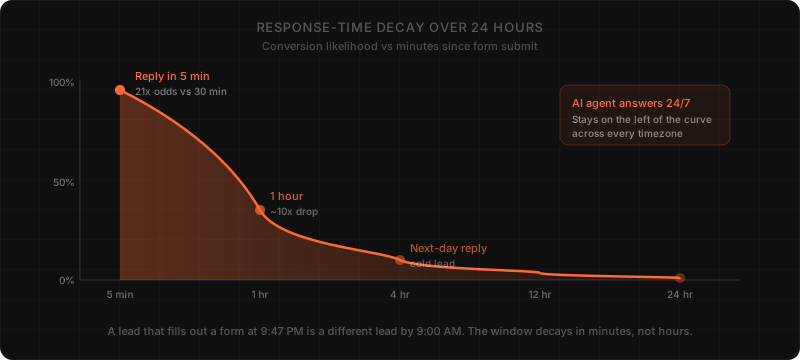
The diagram above shows the response-time decay curve plotted against the 24-hour window and the regions where AI versus human coverage matter. The flat orange band at the top represents AI agent coverage. The steep decay is what happens when a lead waits in queue. The gap between the two is your leaked pipeline.
Why "24/7 chat" used to fail and why it works now
Sales teams have been promised always-on inbound coverage for at least a decade. Drift launched conversational marketing in 2015. Intercom shipped chatbots a year later. Most B2B SaaS teams have either tried 24/7 chat or talked themselves out of it. The reasons it failed historically are specific:
Rule-based bots could not hold a conversation. A keyword tree handles "what is your pricing" but it falls apart on "we use Walnut today and the team hates it, what do you do that's different." Prospects detected the canned response within two messages and bounced.
Round-robin handoffs to overseas SDRs felt off. The few teams that staffed nightshift coverage routed leads to outsourced SDRs who lacked product depth. Conversion was worse than no coverage at all because a bad first impression poisons the next conversation.
Form-replacement was incomplete. Even teams that ran chat on the homepage kept the "Request a Demo" form on every other page, so the prospect submitting at 11 PM still hit the form, not the chat. Coverage in the wrong place is no coverage.
The 2025 to 2026 shift is structural, not incremental. LLM-powered AI agents now hold a B2B sales conversation that is indistinguishable from a junior SDR for the first 5 to 8 minutes. They can ask differentiating questions, react to the prospect's specific phrasing, and run an actual product demo by the end of the conversation. The voice variants (Rayko, Saleo's voice agent, Karumi, and the live-product variants of Drift) extend that coverage from text-only chat to spoken conversation.
This matters for after-hours specifically because the prospect at 9:47 PM Tuesday is not looking for a brochure. They are doing real evaluation work. A live AI conversation that runs the actual product is structurally different from a chatbot that types canned responses, and it is what closes the response-time gap that 2017-era chat tools could not.
What 24/7 AI demo coverage actually looks like
A modern always-on inbound stack has four operating modes, picked dynamically based on traffic conditions. The AI agent does not "go online at 6 PM." It is the default surface, with humans appearing only when the AI escalates.
Mode 1: AI-led capture. The default for the vast majority of inbound traffic, including business hours. The AI engages the visitor within seconds of intent (button click, form submit, page-view depth threshold), runs a 4 to 7 question qualification flow, and either books a meeting, runs a live demo, or drops the lead into nurture. No human involvement at this stage. This handles 60 to 85 percent of inbound conversations end-to-end depending on segment.
Mode 2: AI-led demo. The capture moment becomes the demo. The prospect clicks "Start Demo," the AI greets them, asks 2 or 3 quick context questions ("what tool are you using today, what is your team size, what is the specific pain"), and launches into a live, interactive product walkthrough tuned to their answers. This is the surface where Rayko, Saleo's AI agent, and a handful of voice-first competitors operate. It is structurally different from click-through tools like Storylane, Navattic, Walnut, Arcade, and Supademo because the demo adapts in real time to the prospect's questions.
Mode 3: AI-to-human handoff. Triggered when the conversation hits a known escalation rule (high-fit prospect explicitly requesting a human, deal size above a threshold, named-account match, repeat visitor with prior context). The AI books a meeting on the next-available rep's calendar, attaches the verbatim transcript, and notifies the rep through Slack or email. The handoff happens in seconds. The rep walks into the meeting fully briefed.
Mode 4: Human-only. Reserved for accounts that explicitly request a human at first touch (often enterprise or government), accounts on a named-account list with rep ownership, and edge cases where the AI's confidence falls below a threshold. This is a small minority of inbound traffic in 2026, perhaps 5 to 15 percent.
The architecture is opinionated. The AI is the default, not the fallback. Teams that invert this (humans default, AI as overflow) get the worst of both worlds, because the AI never gets enough volume to be tuned and the humans burn out on low-fit conversations.
How many demos can the AI actually run
The capacity question comes up in every procurement conversation, usually framed as "we get 80 inbound leads a week, can the AI handle that." The answer is yes, and the more interesting question is what happens when traffic spikes 10x because of a launch, an analyst report, or a viral moment.
An AI demo agent runs hundreds of concurrent sessions in parallel. The rate-limit is not the agent itself, it is the upstream LLM provider's tokens-per-minute quota and the underlying browser-automation infrastructure for live-demo variants. Rayko customers routinely run 200 to 1,500 sessions per week on a mid-market deployment, with peak weeks hitting 5,000 or more during product launches.
The constraint that bites first is not capacity, it is demo design quality at scale. If you tuned your inbound flow assuming 50 demos a week and you suddenly run 500, three things break:
-
Routing thresholds are now wrong. A scoring threshold that produced 5 warm leads per week from 50 demos now produces 50 warm leads per week from 500 demos. If your rep team has not grown 10x, you have over-routed and rep capacity becomes the bottleneck. Tune the threshold up.
-
Nurture sequences flood. The lukewarm and cold buckets, which used to land 30 leads in the marketing nurture sequence per week, now drop 300. If your nurture sequences were not designed for that volume, deliverability suffers and unsubscribe rates spike.
-
CRM hygiene degrades. Duplicate records, missing fields, and broken enrichment lookups all surface at scale. A workflow that was 99 percent reliable at 50 leads per week becomes the source of 50 errors per week at 5,000 leads per week.
The fix is to instrument rejection at every stage and watch the bottom 10 percent of accepted leads and top 10 percent of rejected leads weekly, exactly as we describe in our AI lead qualification and CRM routing guide. Capacity is solved. Tuning is the work.
Multilingual coverage: what the AI handles, what you have to build
The AI conversation layer is multilingual by default in 2026. The major commercial models from OpenAI, Anthropic, Google, and the open-source ecosystem all hold a fluent B2B sales conversation in 25 to 50 languages with quality that varies from native (English, Spanish, French, German, Portuguese, Italian, Dutch) to excellent (Japanese, Korean, Mandarin, Hindi, Arabic) to passable (everything else). The voice models for live AI demo agents have caught up over the last 18 months and now support real-time conversation in roughly the same set.
But multilingual rollout almost never stalls on the AI conversation. It stalls on the localized product content. A Spanish-language demo agent that runs an English UI is jarring. A French conversation that produces English-language email follow-up sequences feels broken. The work that has to happen alongside the AI deployment:
- UI labels and product strings localized for the demo environments the AI walks through
- Scripted product behavior and dummy data localized so that "Acme Corp Q4 revenue" reads "Acme SAS chiffre d'affaires T4"
- Email and CRM follow-up templates localized per language, with the right cultural register (German B2B is more formal than US B2B; Japanese is more formal still)
- Booking widgets and timezone logic that show local timezones, local date formats, and local working-day conventions
- Privacy and consent disclosures translated to satisfy GDPR (EU), LGPD (Brazil), PIPL (China), and similar frameworks in their local language
Most teams underestimate the localization work and overestimate the AI work, then discover six weeks in that the AI is fine and the product strings are the bottleneck. Plan the localization sprint first. The AI deployment is comparatively cheap.
For B2B SaaS sellers operating across multiple regulated regions, see our security and compliance guide for the data-residency, training-data-isolation, and right-to-deletion considerations that show up in every enterprise procurement review.
Timezone-aware routing: the patterns that work
Timezone handling is where most always-on stacks reveal whether they were thought through or stitched together. The patterns that work in production:
Pattern 1: AI engages live in the prospect's local time, books human meeting in rep's local availability. The AI conversation happens immediately regardless of timezone. When the conversation produces a warm lead, the booking widget surfaces times in the prospect's timezone but only shows slots that map to the rep's working hours. A Singapore prospect at 11 PM SGT sees Tuesday 9 AM SGT (which is Monday 6 PM PT for the rep) as the next available slot. Both parties feel native.
Pattern 2: Round-robin within timezone bands. For teams with multiple reps spread across regions, route the warm lead to the rep whose timezone overlap with the prospect is best. A Frankfurt prospect routes to your London-based rep, not your San Francisco rep. The CRM workflow checks rep timezone, working hours, and current pipeline load before assigning.
Pattern 3: Same-business-hour callback. When the AI cannot book a meeting in real time (prospect explicitly wants a human now, but no rep is online), schedule the callback for the next available business hour in the prospect's timezone, send the prospect a confirmation email with the local time, and brief the rep in advance. The trick is to never make the prospect calculate a timezone conversion themselves, that friction loses leads.
Pattern 4: Region-specific demo content. For multi-region SaaS, surface demo content that reflects the prospect's region. A US prospect should see USD pricing and US-centric case studies. An EU prospect should see EUR pricing, GDPR posture, and EU customer references. Detect region from IP at session start and parameterize the demo. This is not localization in the language sense, it is contextual relevance, and it materially affects conversion.
Pattern 5: After-hours framing in the AI's first message. When the AI engages outside business hours, an explicit acknowledgment lands well: "Our team is offline for the next few hours, but I can answer your questions, run a demo, or book you a slot for tomorrow morning." This sets expectations and reads as transparent rather than evasive. Buyers respond well to honest framing about who they are talking to, see our conversational demos buyers prefer talking post for the underlying psychology.
The mistake teams make at this stage is treating timezones as a frontend problem. The routing logic, the CRM workflow, and the rep notification path all need to be timezone-aware. Skipping any of those layers produces a rep getting a Slack ping at 3 AM their local time, which is its own pipeline failure.
The tools landscape for 24/7 inbound coverage
The market for always-on inbound coverage splits into roughly four categories. Pick based on what your buyer expects in the moment of intent.
Conversational marketing platforms. Drift, Intercom Fin, Qualified, Conversica. Strong on chat-based 24/7 coverage with deep CRM integrations. Best fit when the typical inbound interaction is a question rather than a demo, and when most of your inbound traffic is mid-funnel rather than top-funnel. Pricing is in the $1,500 to $10,000 per month band for B2B SaaS use cases.
Live AI demo agents. Rayko, Saleo's AI agent, Karumi, Supersonik. Strong when the prospect's intent is to see the product in action, not just ask questions. Structurally different from chat because the capture moment becomes a real product experience with adaptive conversation. The 24/7 case is particularly strong here because a prospect at 11 PM is often deep into evaluation and wants to see the product, not chat about it. See our AI demo agent buyers guide for the full evaluation framework.
Click-through interactive demo platforms. Storylane, Navattic, Walnut, Consensus, Arcade, Supademo. These are 24/7 by virtue of being self-serve, but they cannot ask questions, qualify, or adapt to the prospect's specific situation. Good for top-of-funnel education. Insufficient as a complete inbound surface because they lose all the qualification signal. See our interactive demo platforms compared post for the full landscape and our best Walnut alternatives writeup for the click-through subcategory specifically.
Lead routing and meeting booking. Chili Piper, RevenueHero, Distribute, Default.com. These are not capture surfaces, they are the routing layer that sits behind whatever capture surface you choose. The 24/7 case for these tools is that they handle round-robin scheduling, territory rules, and instant booking without rep involvement. Pair with one of the capture categories above.
The pattern most successful B2B SaaS teams settle into for 24/7 coverage is: pick one capture-and-qualify tool that runs always-on (live AI demo for product-led teams, conversational AI chat for content-led teams), pair with a routing platform like Chili Piper or RevenueHero, plug into HubSpot or Salesforce as the CRM of record, and add data enrichment via Apollo or Clearbit. No more tools than that until something breaks at scale.
The economics: AI 24/7 versus night-shift SDR coverage
The economic case for AI-led 24/7 coverage versus expanding the SDR team to span timezones is brutal. Consider a B2B SaaS team with 1,200 inbound leads per month, 45 percent after hours, currently leaking the after-hours leads to "we'll be in touch tomorrow."
The night-shift SDR option. Hiring 2 SDRs in a complementary timezone (say, Manila or Krakow) at fully-burdened cost of $40,000 to $80,000 per rep per year, plus tooling, plus management overhead. Total annual cost: $120,000 to $200,000. Coverage: 16 hours a day, 5 days a week, with weekend gaps. Quality: variable, because product depth in an offshore SDR org is harder to maintain. Expected lift in after-hours conversion: 30 to 50 percent of the leaked leads recovered, partially offset by quality issues.
The AI agent option. AI capture-and-qualify tool at $30,000 to $80,000 per year for a mid-market deployment. Coverage: 24 hours a day, 7 days a week, in 25+ languages. Quality: consistent and improvable through transcript review and prompt tuning. Expected lift: 60 to 90 percent of the leaked after-hours leads recovered, with conversion rates often higher than business-hours rates because the AI captures the prospect at peak intent.
| Dimension | Night-shift SDR option | AI agent option |
|---|---|---|
| Annual cost | $120,000 to $200,000 for 2 SDRs plus tooling and overhead | $30,000 to $80,000 for a mid-market deployment |
| Coverage | 16 hours a day, 5 days a week, weekend gaps | 24 hours a day, 7 days a week, 25+ languages |
| Quality | Variable, offshore product depth is harder to maintain | Consistent, improvable via transcript review and tuning |
| Expected after-hours lift | 30 to 50 percent of leaked leads recovered | 60 to 90 percent recovered, often above business-hours rates |
The cost differential is roughly 2x in favor of the AI option, but the structural advantages compound. The AI scales linearly with traffic without hiring; it does not have ramp time, attrition, or PTO; it speaks every language your buyers speak; it captures verbatim transcripts for sales coaching and product-marketing feedback. McKinsey's State of AI research and Forrester's B2B sales trends both flag inbound qualification automation as one of the highest-ROI deployments of generative AI in the 2025 to 2026 cycle, and the after-hours subset is where the math is most lopsided. See our AI demo ROI business case for the full financial model with sensitivity analysis.
The counterargument worth taking seriously is enterprise procurement: some buyers in regulated industries (financial services, defense, healthcare) explicitly require a human at first touch and will not engage with an AI. For those segments, keep human-only routing in place. For everyone else (mid-market SaaS, growth-stage software, most B2B applications), AI-led 24/7 coverage is the default and night-shift SDR coverage is the legacy approach.
Common pitfalls in 24/7 inbound rollouts
We have seen these mistakes repeat across teams adopting always-on AI inbound. They are predictable, avoidable, and almost always traceable to skipping a step in the rollout plan.
Pitfall 1: Deploying the AI without an after-hours specific framing. The AI greets the prospect identically at 2 PM and 2 AM. Buyers notice when the experience does not acknowledge that human reps are offline. Fix: condition the AI's opening message on time of day. "Hi, our team is offline for the next few hours, but I can run a demo, answer your questions, or book you in for tomorrow" reads as transparent rather than evasive.
Pitfall 2: Routing after-hours leads identically to business-hours leads. A warm lead at 11 PM Tuesday should not get a "we'll follow up in 1 to 2 business days" auto-response. Fix: build a separate routing path for after-hours warm leads that attempts an immediate AI-led demo, falls back to a same-business-hour callback, and only emails the prospect after both options have been exhausted. The path must be different from the business-hours path.
Pitfall 3: Letting the AI sound like a chatbot from 2017. Prospects detect canned responses within two messages and bounce. Fix: use a modern LLM-powered agent (not a keyword tree), tune the prompts on real customer transcripts weekly, and read every conversation log for the first 90 days. The transcript review is the single highest-leverage tuning activity. See our why prospects ghost your demos post for the conversational quality bar that prospects expect in 2026.
Pitfall 4: Missing the multilingual layer entirely. A US-headquartered SaaS team deploys English-only AI coverage and discovers six months later that 30 percent of their EMEA inbound bounced because the AI did not speak Spanish or German. Fix: enable the languages your buyer base actually uses from day one. The marginal cost of multilingual AI in 2026 is near-zero; the cost of not doing it is leaked pipeline. See our voice-first buyer experience for B2B post for the global voice-conversation case specifically.
Pitfall 5: Ignoring the buying committee at after-hours touchpoints. A single late-night form-fill is often a champion researching alone before bringing the rest of the buying committee into the evaluation. The AI should ask "who else is involved in evaluating this" exactly as it would during business hours, and the follow-up sequence should be designed to support multi-threading from the start. Our buying committees and AI demos post covers the multi-threading patterns in depth.
Pitfall 6: Treating after-hours as a separate product. Some teams run AI-only at night and human-led during the day, with two different qualification flows, two different CRM workflows, and two different scoring rubrics. Fix: run one unified AI-led capture surface 24/7, with conditional routing rules that adjust based on time of day and rep availability. Two systems compound complexity without compounding quality.
Pitfall 7: Forgetting that the demo itself can run 24/7. AI chat that books a meeting for next week is leaving conversion on the table. The prospect's intent is highest in the moment they engaged. If the AI can run the actual product demo in the same session (as Rayko, Saleo's AI agent, and Karumi all do), the prospect goes from "interested visitor" to "qualified pipeline with a transcript and a booked follow-up" inside a single after-hours conversation. See our voice demos reduce sales cycle post for the full case on demo-in-the-moment conversion.
Implementation: a 21-day rollout plan for after-hours AI coverage
The fastest credible path from "we leak after-hours leads" to "we run a 24/7 AI demo agent in production" is roughly three weeks for a team under 30 reps. The phased plan:
Days 1 to 3: Instrument the baseline. Pull two months of inbound data from your CRM and segment by hour of submission, day of week, and timezone of the prospect (use IP or self-reported country). Calculate the share of inbound that lands outside business hours. Calculate the average time-to-first-meaningful-contact for that segment. Calculate the conversion rate from after-hours form-fill to opportunity. These baselines are what you measure against.
Days 4 to 7: Pick the stack. Choose one AI capture-and-qualify tool. For product-led B2B SaaS where buyers want to see the product, the right answer is usually a live AI demo agent. For content-led B2B where buyers want to ask questions before seeing the product, the right answer is usually a conversational AI chat tool. Pair with the routing platform you already have (or add Chili Piper or RevenueHero if you do not). Confirm CRM and enrichment are ready to receive data.
Days 8 to 14: Build the after-hours flow. Write the AI's qualification questions, the after-hours framing message, the booking widget configuration with timezone-awareness, and the CRM workflow that handles warm, lukewarm, cool, and cold buckets differently after hours than during business hours. Run a rep through the flow ten times to catch awkward phrasings. Stage the deployment behind a 50/50 traffic split before going to 100 percent.
Days 15 to 18: Soft launch. Enable the AI on 25 to 50 percent of after-hours traffic. Compare conversion rates against the business-hours baseline. Read every transcript. Tune the prompts. Watch the routing accuracy metrics, especially the false-negative rate on warm leads.
Days 19 to 21: Scale to 100 percent. Move all after-hours traffic to the AI-led flow. Set up weekly tuning rituals: read the bottom 10 percent of accepted leads, the top 10 percent of rejected leads, and the rep-flagged "this lead was bad" feedback. Tune for the first 60 days, then move to a monthly tuning cadence.
By day 30, the after-hours leak is closed and the team has reclaimed somewhere between 6 and 14 hours per rep per week of low-leverage qualification work. That capacity becomes available for outbound, expansion, and high-conviction enterprise deals.
Metrics that actually matter for 24/7 coverage
Four metrics tell you whether your always-on inbound coverage is working. Anything else is vanity.
Time-to-first-meaningful-contact, after hours. From form-fill or first interaction to first qualified conversation. Target: under 60 seconds for AI-led capture, under 5 minutes if a human is involved. Anything over 5 minutes for an after-hours warm lead is functionally equivalent to no response.
After-hours conversion to opportunity. Of leads that engage outside business hours, what share become opportunities. Target: parity with business-hours conversion (or better). If after-hours converts at half the business-hours rate, your after-hours flow is broken.
Concurrent session capacity headroom. Maximum concurrent AI sessions handled in the past 30 days, divided by your AI agent's capacity ceiling. Target: under 50 percent. If you are routinely above 70 percent, you are about to throttle during a launch and lose pipeline.
Multi-language conversion parity. Conversion from inbound to opportunity, by language. Target: within 20 percent of your English baseline for any language carrying more than 5 percent of inbound traffic. A 50 percent gap means the localization layer is broken, not the AI.
Avoid celebrating "leads captured after hours" as the headline metric. Capture is easy. Conversion at parity is the bar.
What to read next
If you are designing the AI qualification logic itself, our deep dive on AI lead qualification and CRM routing covers the four-stage capture-qualify-route-sync pipeline in detail, with the pitfalls and tooling recommendations that apply equally to 24/7 coverage. The conversational demos buyers prefer talking piece covers the conversational design choices that improve completion rates, which matter even more after hours when the prospect has zero patience for friction. And the self-serve product demos post explains why the buyer behavior driving after-hours form-fills is the same behavior driving the broader shift to self-serve evaluation.
If your after-hours gap is support tickets rather than inbound pipeline, our 24/7 customer support for SaaS guide covers the coverage economics for the post-sale side, with companion tactics in how to reduce support ticket volume and how to scale support without hiring.
For Rayko specifically, the live AI demo agent collapses capture, qualification, and product experience into a single always-on conversation, which is the structural reason it covers the after-hours window without compromise. The public demo runs Rayko on Rayko at 2 AM and 2 PM with the same fidelity, and asks you the same qualifying questions a real prospect would get at any hour.
Always-on inbound coverage is not a feature, it is a structural shift in how B2B sales teams handle demand. The teams that close the after-hours gap with AI in 2026 are compounding a 30 to 80 percent improvement in inbound conversion that their competitors will spend the next two years trying to match by adding SDRs. The math does not favor the SDR option. The buyer expectation does not either.
Is after hours coverage still the highest leverage fix in September 2026?
Yes. As of September 2026, the response time logic cited from the MIT and InsideSales research still points the same way: minutes beat hours by a wide margin, and an always on agent that engages, qualifies, demos, and books in one session removes the overnight queue that scheduled motion cannot cover. Keep the AI as the default surface and use humans for escalation, not the reverse.
The tune up for this month is routing and localization. Confirm timezone aware booking still shows prospect local times mapped to real rep availability, confirm round robin and callback paths do not page reps at 3 AM local, and confirm consent, residency, and disclosure handling still matches the security guide for every region you serve. Then audit one week of transcripts for false negatives on warm leads and for multilingual gaps where product strings, follow up templates, or booking copy lag the conversation layer. Capacity is rarely the constraint. Thresholds, hygiene, and localized content decide whether recovered volume becomes pipeline.
Verdict: Make a 24/7 AI demo the default after hours capture path
After hours inbound converts best when a live AI agent engages in seconds, runs the demo, qualifies against your rules, and books the meeting with transcript attached. That removes the overnight wait that pushes buyers to competitors by morning.
Route warm leads to reps with context, send the rest to nurture, and review rejected leads weekly to catch scoring drift. Confirm timezone aware booking and localized follow up so recovered night volume turns into pipeline.
Frequently asked questions
Can I use AI to answer customer questions 24/7?
Yes, and for most B2B SaaS inbound flows it is now the default. A modern AI demo or chat agent stays online around the clock, holds a structured conversation, captures qualification data, and either books a meeting or routes the lead to a nurture sequence. Drift, Intercom Fin, Qualified, Conversica, and live AI demo agents like Rayko all operate this way. The hard part is not the 24/7 uptime, it is making sure the AI handles the awkward 5 percent of conversations (pricing pushback, deep technical questions, accidental edge cases) without sounding scripted. Pick a tool that lets you read every transcript and tune the flow weekly for the first 90 days.
How many demos can AI handle per week?
A single AI demo agent can run hundreds of concurrent conversations because it is not constrained by human throughput. In practical terms, capacity is a function of your traffic and your tooling cost, not the AI itself. Rayko customers regularly see 200 to 1,500 live demo sessions per week on a mid-market deployment, with some peak-traffic teams pushing past 5,000 a week during launches. The bottleneck shifts from rep capacity to demo design quality. If your inbound flow assumes 50 demos a week and you suddenly run 500, you need rethought routing, scoring thresholds, and CRM hygiene to handle the volume without flooding reps with low-fit leads.
What languages can AI demo systems support?
Modern voice and text AI agents handle 25 to 50 languages with usable quality, including English, Spanish, French, German, Portuguese, Italian, Dutch, Japanese, Korean, Mandarin, and Hindi. Quality varies. English is near-native, the major European languages are excellent, and Asian languages have improved sharply since 2024. The decision is rarely 'can the AI speak this language' and almost always 'is the localized demo content (UI labels, scripted product behavior, error messages) translated and reviewed by a native speaker.' The AI conversation layer scales easily. The product content layer is where most multilingual rollouts stall, so plan that work first.
Can AI agents work in different time zones?
AI agents are timezone-agnostic by design. They run continuously in the cloud, respond to whoever is on the page, and pass localized context (timezone, language, business hours of the responsible rep) into the routing layer. The architectural pattern is: AI handles every inbound interaction live, and the CRM routing layer applies timezone-aware rules to the warm-handoff stage. A prospect in Singapore at 11 PM SGT gets the same instant qualification experience as a prospect in San Francisco at 2 PM PT. The follow-up meeting gets booked with a rep whose territory and working hours match. This is one of the structural reasons AI inbound outperforms SDR-led inbound for global teams.
How do I handle sales leads after hours without hiring more staff?
Three steps. First, replace the static 'Request a Demo' form with a live AI agent (chat, voice, or live demo) that engages the lead in the moment. Second, set qualification rules so the AI books a meeting on the rep's calendar for the next available slot in the prospect's timezone, attaches the conversation transcript, and notifies the rep. Third, build a conditional message that runs only when no rep is online, explicitly tells the prospect they are talking to an AI assistant, and offers either a synchronous AI-led demo or a same-business-hour callback. This pattern handles 80 to 90 percent of after-hours inbound without involving a human, and it preserves response time which is the single biggest predictor of conversion.
How do I stop losing leads to late night website forms?
Late-night form abandonment is rarely a form problem. It is a response-time problem. The MIT and InsideSales lead response study found that the odds of contacting a lead drop by a factor of 10 if you wait one hour instead of five minutes, and the odds of qualifying drop by a factor of 21 if you wait 30 minutes. By morning the prospect has researched two competitors and lost interest. The fix is to remove the queue between submission and engagement. A live AI agent that engages the prospect within seconds of form submit, captures qualification, and books a meeting (or runs the demo in real time) effectively eliminates the after-hours leak. If you only do one thing, replace your form with a live conversation.
What do I do when my sales funnel gets too many leads?
Most teams panic and dilute attention across every lead, which is exactly the wrong response. The right response is to let the AI qualification layer take the first cut, route only warm leads to reps, drop lukewarm leads into nurture, and politely close out cold leads. With a tuned qualification flow, an AI agent can filter 1,500 monthly leads down to 200 to 300 high-conviction conversations a rep should actually take. The supporting move is to instrument rejection: review the bottom 10 percent of accepted leads and the top 10 percent of rejected leads weekly, because that audit catches scoring drift early. See our guide on AI lead qualification and CRM routing for the four-stage pipeline that handles volume without dropping signal.
How do I automate my entire inbound sales pipeline?
An automated inbound pipeline has four stages: capture (live AI agent or interactive demo collects identity and qualification signals), qualify (AI scores fit, intent, and capacity from the conversation plus enrichment data), route (CRM workflow assigns warm leads to reps, lukewarm to nurture, cold to close-out), and sync (verbatim transcript plus structured fields written to Salesforce or HubSpot). The most common stack is one AI capture tool, one routing platform like Chili Piper or RevenueHero, one CRM, and one enrichment provider. Glue them with the CRM's native workflow engine and avoid building a Zapier graph that sales ops cannot read. End-to-end build time for a team under 20 reps is roughly 30 days.
Sources
- Lead Response Management Study, MIT / InsideSales
- State of Sales Report, Salesforce Research
- State of Inbound, HubSpot Research
- B2B Buying Journey Insights, Gartner
- Conversational Marketing Benchmark, Drift
- The State of AI in Business, McKinsey
- B2B Sales Trends and Predictions, Forrester
Cite this article
Utkarsh Agrawal. "2026 After Hours AI Demos: Capture Inbound While You Sleep." RaykoLabs Blog, May 10, 2026. https://raykolabs.com/blog/ai-demos-after-hours-inbound

Utkarsh Agrawal
CTO, RaykoLabs
Utkarsh Agrawal is CTO of RaykoLabs, where he leads engineering on Rayko, the AI demo agent that runs live, voice-enabled product demos in a real browser for B2B SaaS teams. His work spans real-time voice interaction, browser automation with Playwright and Browserbase, speech-model orchestration, and the infrastructure that keeps autonomous demos reliable around the clock. On the RaykoLabs blog he writes practical guides on voice-enabled product demos, demo automation, and what it takes to ship production AI agents for sales: how to qualify prospects mid-demo, how to measure demo performance, and how buying teams actually evaluate demo software. His comparisons of demo platforms are built from hands-on testing and vendor documentation, with trade-offs stated plainly so buyers can decide fit.
See RaykoLabs in action
Watch an AI agent run a live, personalized product demo, no scheduling, no waiting.
START LIVE DEMORelated articles
AI Lead Qualification and CRM Routing: B2B Inbound Guide
How to qualify inbound leads with AI and route warm prospects into your CRM automatically. Tools, workflows, and patterns for B2B sales teams in 2026.
2026 Interactive Demo Mistakes: 9 Fixes That Convert
Find the nine structural mistakes that stall interactive demos, from length to gating to weak CTAs, and how to fix each. Audit your demo today.
Interactive Demo vs Video Demo vs Live Demo (2026)
Interactive demos vs video demos vs live human demos vs AI voice demos. Honest format-by-format comparison with conversion data for B2B sales teams in 2026.