Loading...

Human vs AI Demo: When to Use Which
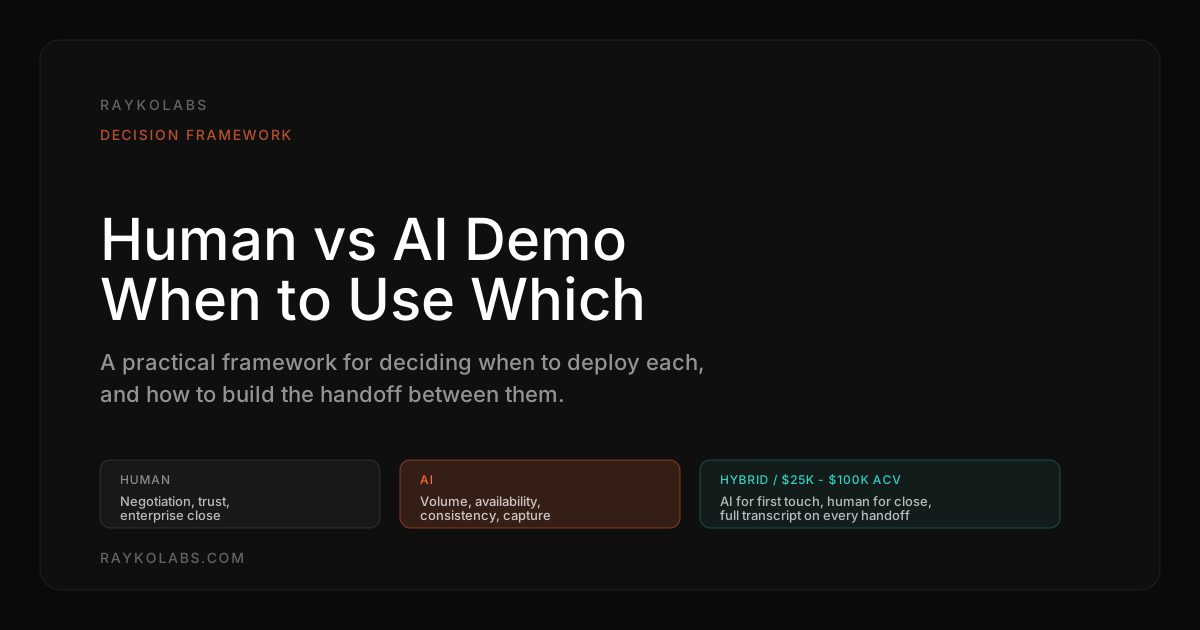
AI demos and human-led demos both have a place. Here is a practical framework for deciding when to use each, and how they work best together.
Quick answer
AI demos and human reps are not competitors but solve different problems. AI wins on volume, 24/7 availability, consistency, and cost: $1 to $5 per session versus $80 to $200 for a human. Human reps win on layered objection handling, trust, deep customization, and enterprise political navigation. The strongest motion is hybrid: AI handles first contact and qualification, then routes by deal size, the main dividing line for human handoff.
Want this running on your product? Rayko demos it live, with your prospects asking questions by voice.
START LIVE DEMOStop asking whether AI will replace your sales team. It is the wrong question, and it leads to the wrong decisions.
Your best AE should not be spending 15 hours a week on first-touch product walkthroughs. Your worst AE is giving inconsistent demos that actively hurt your brand. And your BDRs are burning hours coordinating schedules for meetings where 25% of prospects never show up.
AI demos and human reps are not competitors. They solve different problems. The question is when to deploy each one and how to build the handoff between them.
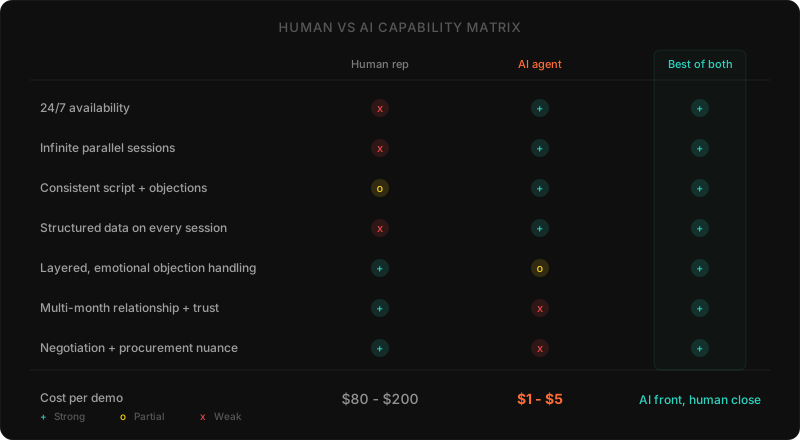
Here is the trade-off at a glance, before the section-by-section detail:
| Dimension | Human-led demo | AI demo | Best of both |
|---|---|---|---|
| Availability | Business hours, by appointment | 24/7/365, unlimited parallel sessions | AI for first contact, human on request |
| Cost per demo | $80 to $200 | $1 to $5 | AI for volume, human for high-ACV deals |
| Consistency | Varies 3x between best and worst rep | Same playbook every session | AI removes variance, human adds nuance |
| Personalization | Improvises and adapts on the fly | Adapts within trained boundaries | AI handles common paths, human handles bespoke |
| Data capture | Subjective notes, sometimes a two-word CRM entry | Structured signals plus full session replay | AI captures the record, human acts on it |
| Objection handling | Strong on layered, emotional objections | Reliable on common objections | AI screens, human handles charged objections |
| Relationship and trust | Builds rapport over time | Personalized, but cannot form relationships | Human owns the relationship |
| Scale | Capped by headcount | Effectively unlimited | AI absorbs volume, human focuses on what matters |
Where AI demos win outright
Volume and availability
An AI demo agent runs unlimited simultaneous demos, 24/7/365. No scheduling, no calendar conflicts, no timezone limitations. When your marketing campaign drives a traffic spike at 2 AM Saturday, the AI agent is there.
A prospect who sees your product within 60 seconds of expressing interest converts at dramatically higher rates than one who waits three days for a scheduled call. This is not a minor advantage. It is the single biggest lever in demo-driven sales.
Consistency
Every AI demo follows your best playbook. It never forgets a key differentiator. It never skips the competitive comparison. It never has an off day. The quality is the same at 9 AM Monday as it is at 11 PM Friday.
Here is a number that should bother every sales leader: the gap between your best rep's demo and your worst rep's demo is probably 3x in conversion rate. AI eliminates that variance entirely.
Data capture that actually happens
AI demos generate structured data from every session, features explored, questions asked, objections raised, time spent per section. RaykoLabs uses rrweb for session recording, so you do not just get a transcript, you get a full replay of exactly what the prospect saw and did.
Compare that to human rep notes: sometimes thorough, sometimes a two-word CRM entry, always subjective. The AI creates a complete, objective record that makes lead scoring, follow-up prioritization, and content strategy more effective.
Cost efficiency
$80-$200 for a human demo versus $1-$5 for an AI session. For high-volume, early-stage product experiences, you can afford to give every prospect a demo, not just the ones who clear your qualification threshold. The full cost breakdown and ROI math is worth reading separately.
Where human reps still win
Humans have capabilities AI cannot replicate today. They matter in specific situations.
Complex objection handling
"We tried a similar tool two years ago and our team refused to adopt it." A skilled rep reads the emotional undercurrent, probes for the real concern, and addresses it with empathy and evidence. AI agents handle common objections with prepared responses but struggle with the layered, emotionally charged objections that arise in serious buying conversations.
Relationship and trust
Trust in B2B sales is still human. The rapport a rep builds over a series of conversations, remembering details, following up on personal mentions, demonstrating genuine understanding, creates a relationship that influences the decision. AI can be personalized. It cannot form relationships.
Deep customization
An enterprise prospect wants to see how the product handles their specific workflow with their specific data in their specific compliance environment. A human rep can improvise and adapt on the fly. AI agents work within the boundaries of their training.
Political navigation and negotiation
In enterprise deals, the product is secondary. The real challenge is navigating internal politics: identifying the economic buyer, managing champions and detractors, building consensus across a committee. When the conversation turns to pricing and terms, the judgment required exceeds what AI delivers reliably.
Here is the contrarian take, though: the list of things only humans can do is shrinking faster than most sales leaders admit. Two years ago, AI could not handle live product navigation. Now platforms like RaykoLabs use Playwright for browser automation and a three-layer navigation system (context detection, navigation planning, LLM integration) to walk prospects through real products in real time. The things on the "humans only" list today will not all be there in 18 months. Build your strategy accordingly.
The hybrid model that actually works
Stage 1: AI handles first contact
Prospect visits your website, clicks a CTA, responds to an outbound campaign, the AI demo agent provides an immediate product experience. No waiting, no scheduling. During the interaction, the AI captures qualification data: company size, role, use case, features of interest, objections raised, engagement depth.
In our session analytics, a typical voice-driven demo captures eight to ten distinct qualification signals, company size, role, primary use case, top three feature interests, two to three explicit objections, and competitive context, versus the two or three a marketing form fill produces (typically just role + company + email + a free-text "what are you looking for"). The intelligence asymmetry is large enough that AEs walking into a follow-up call after an AI demo session start the conversation roughly two stages further along than a cold discovery call does.
Stage 2: Intelligent routing
Based on AI demo data, leads are scored and routed. High-intent leads go to a rep with a full briefing. Lower-intent leads enter a nurture sequence. Disqualified leads get filtered out before consuming any rep time. This routing beats traditional lead scoring because it is based on actual product interaction, not form fills and page views.
Stage 3: Human reps handle what matters
When a rep connects with someone who has completed an AI demo, the conversation starts at a higher level. No product walkthrough needed, the prospect has already seen it. The conversation focuses on their specific needs, how the product addresses their challenges, pricing, implementation, and next steps.
Stage 4: AI stays available between human conversations
The prospect can return to explore more features, bring a colleague through the experience, or revisit sections they want to review. This keeps engagement warm without consuming rep time. It also addresses demo fatigue, the colleague does not need to sit through a fresh 45-minute walkthrough.
Decision framework: use this
By deal size
Under $25K ACV: AI can handle the entire sales process with minimal human involvement. Deploying a $150/hour rep on a $10K deal makes no economic sense when AI delivers an excellent experience at a fraction of the cost.
$25K-$100K: Hybrid model. AI for first touch, human for close.
Over $100K: Human involvement begins early. AI supplements with availability and data capture.
By complexity
Standard demos, core features, basic workflows, are built for AI. The path is predictable and the agent handles common questions. Custom demos with specific technical requirements, integration questions, or compliance needs require human expertise.
By buying stage
Early (awareness/consideration): AI. Speed and availability matter more than depth. The prospect is exploring options and forming impressions.
Mid (evaluation): Hybrid. AI provides ongoing access. Human reps handle specific questions and competitive comparisons.
Late (decision): Human-led. Pricing, terms, implementation planning, stakeholder alignment, these require judgment and relationship.
By persona
Individual contributors and managers prefer self-serve. They want to explore without sales pressure. Voice-enabled AI demos serve this preference well. Senior executives and economic buyers expect human interaction for significant purchases.
How to implement this
Add AI alongside your existing "Book a demo" button
Do not replace the human option. Add the AI option. Let prospects choose. Track which path they prefer and how each performs.
Define the handoff triggers
Engagement score (time spent, features explored, questions asked), firmographic fit (company size, industry), or explicit request ("I would like to talk to someone on your team"), pick your criteria and automate the routing.
Give reps full AI demo context
The transcript, feature interests, questions asked, and objections raised should flow into the CRM automatically. The rep should never ask the prospect to repeat information they already shared with the AI. That is the fastest way to lose the trust the AI just built.
AEs who consistently review the AI demo transcript and intent summary before their first live call report meaningfully shorter discovery conversations, anecdotally 30-50% shorter, because the rep no longer needs to ask the questions the agent already answered. The time saved does not disappear; it gets reinvested in deeper qualification, better objection handling, and the strategic conversations that actually move enterprise deals forward.
Measure and iterate
Track conversion rates, cycle length, deal size, and satisfaction for AI-sourced versus traditionally sourced leads. You will probably find AI handles more complex scenarios than expected. Some segments will strongly prefer human interaction. Let the data guide the allocation, not assumptions about what AI "should" be able to do.
The point
The best sales organizations will not be the ones that automate the most or the ones that resist automation. They will be the ones that deploy each approach where it creates the most value.
AI demos make your sales motion faster, more scalable, and more consistent. Human reps make it deeper, more adaptive, and more relational. Together, they create a buyer experience that neither can deliver alone.
We built RaykoLabs with this hybrid model in mind. The AI agent handles the first touch, using Deepgram for speech-to-text, Cartesia for text-to-speech, and Playwright for live browser automation, so that when the human rep picks up the conversation, they are starting from context, not cold. The result is not fewer human conversations. It is better ones.
Do buyers trust an AI demo as much as a human led demo
Buyers trust an AI demo when it shows the real product, states its limits plainly, answers questions accurately, and hands off cleanly to a human when stakes rise. Trust in this context comes less from who delivers the walkthrough and more from whether the experience feels honest, consistent, and useful for the specific decision the buyer is trying to make right now.
Research on modern B2B buying supports this framing. Gartner research on the B2B buying journey describes buyers who prefer to progress independently through much of the evaluation and value timely, relevant help over a guided pitch. Salesforce Research on the state of sales reports the same shift toward buyer led exploration paired with high expectations for rep follow through. In that environment, an AI first touch that provides immediate product access earns trust by respecting buyer time, while a forced wait for a scheduled call can erode it before any conversation begins. See the Gartner B2B buying journey collection (https://www.gartner.com/en/sales/insights/b2b-buying-journey) and the Salesforce State of Sales report (https://www.salesforce.com/resources/research-reports/state-of-sales/) for the underlying buyer behavior context.
Trust also depends on consistency and follow through. Stanford HAI work on AI capabilities (https://aiindex.stanford.edu/report/) and McKinsey research on AI in operations (https://www.mckinsey.com/capabilities/quantumblack/our-insights) both point to the same practical lesson: systems earn confidence when they behave predictably, disclose how they work, and keep a clear path to human judgment. For demos, that means the same accurate walkthrough every time, clear disclosure that the guide is an AI agent, and a handoff where the rep already knows what was shown and asked.
Practical ways to earn that trust:
- Disclose the AI role at the start in plain language and explain what it can and cannot do, including when a human will step in.
- Run the demo on the live product rather than captures or mockups so buyers see real behavior, not a rehearsal.
- Keep claims narrow and checkable. Show the workflow, name the limitation, and offer to connect the buyer with a specialist for edge cases.
- Preserve context across the handoff. When the rep opens with knowledge of what the buyer explored, buyers feel heard rather than processed. Bridge Group research on SDR follow up (https://www.bridgegroupinc.com/research) underscores why speed plus context in that handoff matters for credibility.
How do you keep an AI demo authentic instead of feeling staged
You keep an AI demo authentic by letting the buyer direct the path, grounding every answer in the live product, admitting gaps without deflection, and preserving a natural conversational rhythm. Authenticity here does not mean sounding human at all costs. It means behaving like a knowledgeable guide whose goal is to help the buyer reach a clear decision, including a decision not to proceed.
Start with buyer control. An authentic demo opens with a question about what the buyer wants to see and then goes there, rather than running a fixed script while the buyer waits for a turn to speak. Voice led exploration helps because interruption and redirection feel normal in conversation and awkward in a click path. When the buyer chooses the order, the session feels like working through a problem together rather than sitting through a presentation.
Ground claims in visible action. When the agent describes a workflow, it should perform it in the product while explaining, so the buyer can connect words to behavior. When a request falls outside the configured scope, the honest move is to say so, capture the exact question, and route it to the right person. That candor builds more confidence than a polished deflection, and it gives product and sales teams a clean record of what buyers actually asked.
Watch the details that signal staging:
- Overly smooth narration that never pauses, never clarifies, and never asks a follow up question can feel less trustworthy than a measured exchange with brief confirmations.
- Generic examples weaken credibility. Use believable sample data and role relevant scenarios so technical reviewers and operators each see something close to their world.
- Silent failures damage trust fastest. If the agent cannot complete a step, it should name the issue and suggest the next path rather than moving on as if nothing happened.
- Follow up should reference the actual session. A rep who cites the workflows explored and the questions raised shows the buyer that the AI touch was part of one continuous conversation, not a separate novelty act. This is where the hybrid pattern in our implementation playbook pays off in perceived honesty as well as efficiency.
Frequently asked questions
What happens when AI can't answer a customer question?
A well-designed AI demo agent does three things when it hits a question outside its knowledge. First, it acknowledges the limit honestly rather than hallucinating. Second, it captures the question verbatim and tags the conversation for human follow-up. Third, it offers an immediate handoff to a rep, either by booking a meeting on the spot or by routing the conversation to live chat. Tools like Rayko, Drift, and Intercom Fin all support this pattern. The failure mode to avoid is silent fallback, where the AI guesses and the prospect leaves with wrong information. Audit your AI's unanswered-question log weekly during the first 60 days and feed the gaps back into the knowledge base.
How realistic do AI demos sound to customers?
Modern AI voice agents using providers like ElevenLabs, Cartesia, and Deepgram sound conversational enough that most prospects do not flag them as robotic, especially for sessions under 10 minutes. The remaining tells are pacing artifacts and overly polished phrasing rather than voice quality. The honest answer: prospects know they are talking to an AI when you disclose it, and disclosure is best practice under GDPR and the EU AI Act anyway. Disclosed AI demos still see completion rates 4 to 6x higher than recorded videos because the interactivity matters more than the human-versus-AI question. The realistic-sounding voice is table stakes; the value is in the conversation, not the timbre.
Can AI handle objections in sales demos?
Yes for common objections, no for novel ones. AI demo agents trained on your top 20 objection patterns handle pricing pushback, competitive comparisons, security questions, and integration concerns reliably. Tools like Rayko, Saleo, and Supersonik let you script objection responses and adapt them to the prospect's role. Where AI struggles is unique objections tied to a specific buyer's situation, like a regulatory constraint specific to their industry or a procurement quirk inside their org. For those, the AI should acknowledge the objection, capture it, and route to a human within 60 seconds. The Gartner B2B buying journey research confirms that buyers value timely answers over perfect ones, so a fast handoff beats a slow human.
Can AI really answer sales calls for my business?
Yes for inbound qualification calls, with caveats. AI voice agents from Rayko, Supersonik, and similar vendors handle the first 5 to 15 minutes of an inbound call: greeting, qualification, demo delivery, and meeting booking. They are reliable enough to deploy as the front door for most B2B SaaS teams, especially for deals under $50,000 ARR where buyers expect efficiency over white-glove treatment. For high-ACV enterprise deals over $100,000 ARR, buyers still expect a human at first touch, so use AI for triage and route to a human within 60 seconds. The wrong question is whether AI can answer every call. The right question is which calls AI should answer and which need a rep.
Do AI sales callers actually qualify leads better than humans?
Better at consistency, worse at intuition. AI sales callers ask the same qualification questions every time, score them against the same rubric, and never skip steps because they are tired or distracted. That consistency is why most B2B SaaS teams see qualification accuracy improve 20 to 40 percent after switching from SDR-led to AI-led first-touch. Where humans still win is intuitive judgment, the moment when a buyer says something offhand that signals a real opportunity an AI would miss. The right pattern combines both: AI handles structured qualification at scale, and humans handle the warm handoff where intuition matters. The MIT InsideSales response-time study shows the speed advantage alone is worth more than the intuition gap for most teams.
Sources
- AI Index Report, Stanford HAI
- State of AI, McKinsey
- State of Sales, Salesforce Research
- The B2B Buying Journey, Gartner
- SaaS Sales Development Metrics & Trends, Bridge Group
Cite this article
Utkarsh Agrawal. "Human vs AI Demo: When to Use Which." RaykoLabs Blog, February 12, 2026. https://raykolabs.com/blog/human-vs-ai-demo

Utkarsh Agrawal is CTO of RaykoLabs, where he leads engineering on Rayko, the AI demo agent that runs live, voice-enabled product demos in a real browser for B2B SaaS teams. His work spans real-time voice interaction, browser automation with Playwright and Browserbase, speech-model orchestration, and the infrastructure that keeps autonomous demos reliable around the clock. On the RaykoLabs blog he writes practical guides on voice-enabled product demos, demo automation, and what it takes to ship production AI agents for sales: how to qualify prospects mid-demo, how to measure demo performance, and how buying teams actually evaluate demo software. His comparisons of demo platforms are built from hands-on testing and vendor documentation, with trade-offs stated plainly so buyers can decide fit.
See RaykoLabs in action
Watch an AI agent run a live, personalized product demo, no scheduling, no waiting.
START LIVE DEMO