Loading...

2026 AI Voice Demos: Cut B2B Sales Cycles by 30%
2026 guide to AI voice demos that cut B2B sales cycles: remove scheduling delays, end no-shows and pre-qualify leads to close deals faster.
Quick answer
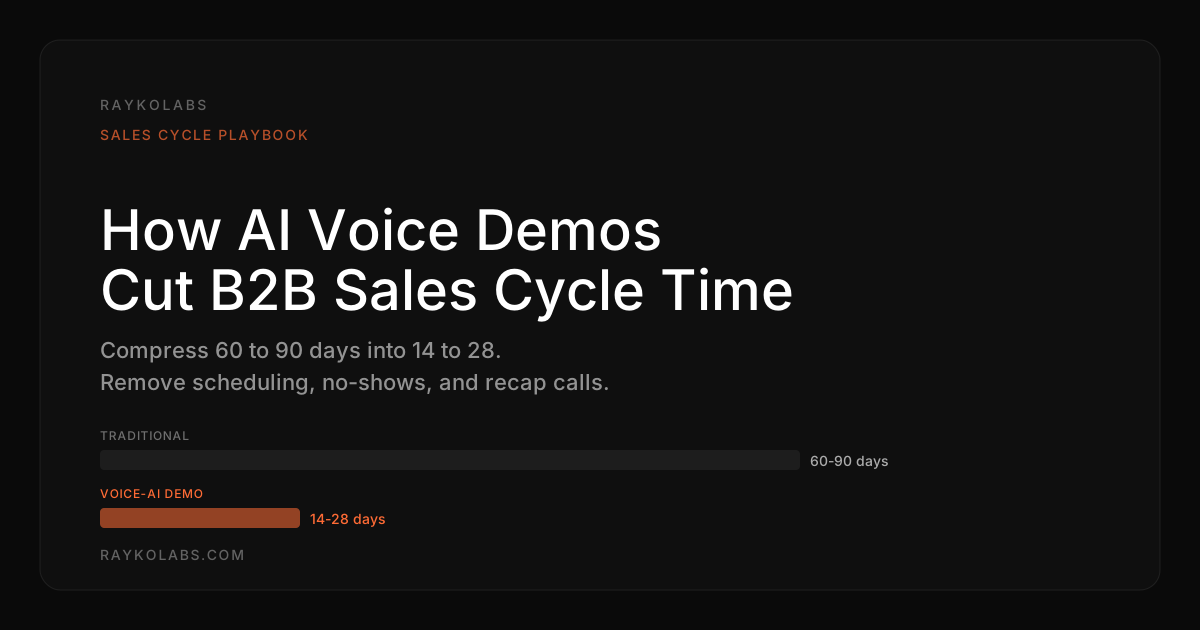
AI voice demos cut B2B sales cycle time through three mechanisms: prospects run a demo on demand, removing the 5 to 10 day scheduling delay; no-shows disappear with no scheduled call to miss; and qualified leads arrive pre-educated, shortening discovery. The longest part of a cycle is often not selling, it is scheduling and the silence before the product. Cumulatively, cycles compress 15 to 30 percent in early customer data.
Want this running on your product? Rayko demos it live, with your prospects asking questions by voice.
START LIVE DEMOWhat if the longest part of your sales cycle isn't selling, it's scheduling?
The average B2B sales cycle runs 60 to 90 days. For enterprise deals, it stretches past six months. Sales leaders have tried everything to shorten it: better qualification frameworks, tighter follow-up cadences, streamlined proposals. But the biggest time sink has been hiding in plain sight.
The product demo. Not the demo itself, but everything surrounding it: the scheduling, the rescheduling, the no-shows, the follow-up calls to recap what was shown, and the days of silence between a prospect expressing interest and actually seeing the product.
AI voice demos compress this entire sequence. Here's how each stage of the sales cycle changes when prospects can talk to your product on demand.
Why sales cycles are long in the first place
Before looking at the fix, let's trace where time actually disappears in a typical B2B sales cycle.
How long is the average B2B sales cycle?
The average B2B sales cycle runs about 60 to 90 days for mid-market deals and longer than six months for enterprise purchases. Early stages carry most of the avoidable delay through scheduling, discovery calls, no-shows, and follow-up gaps. Salesforce State of Sales research tracks how these coordination costs compound across stakeholders.
That breakdown matters because cycle compression comes from removing logistics. Faster access to the product shortens the front of the cycle even when procurement and security review stay fixed.
Scheduling delays
A prospect fills out a demo request form. A BDR picks it up, sends an email, and proposes times. The prospect responds a day later. They go back and forth until a slot works for both sides. By the time the demo happens, three to five business days have passed since the initial request.
That's three to five days where the prospect's interest is cooling, competitors are reaching out, and internal priorities are shifting.
Discovery and qualification overhead
Most sales teams run a discovery call before the demo. That adds another scheduling cycle and another week of elapsed time. The discovery call matters, reps need to understand the prospect's situation to tailor the demo, but it adds friction and delay that compounds across every deal.
No-shows and reschedules
Industry data puts the B2B demo no-show rate between 20 and 30 percent. Every no-show resets the clock. The rep reaches back out, proposes new times, and waits again. A single no-show can add a week or more to the cycle.
Post-demo follow-up lag
After the demo, the rep sends a follow-up email, often with a recap deck or recording. The prospect shares it with stakeholders who were not on the call. Those stakeholders have questions. Another call gets scheduled. More days pass.
Each of these stages is a point where momentum dies.
How voice demos compress each stage
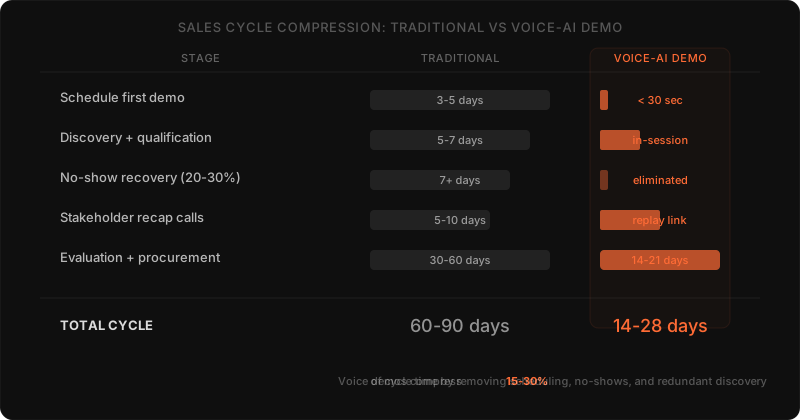
AI voice demos don't improve one part of the funnel. They compress multiple stages simultaneously.
| Sales cycle stage | Traditional demo flow | AI voice demo |
|---|---|---|
| Getting to the demo | Three to five business days of form, BDR reply, and calendar back and forth | Starts on demand, scheduling phase drops to zero |
| Discovery | Separate discovery call adds another scheduling cycle | Merged into the session, profile captured as the prospect explores |
| No-shows | 20 to 30 percent no-show rate, each one resets the clock | Structurally impossible, the demo starts when the prospect wants it |
| Post-demo follow-up | Generic recap email, new call scheduled for stakeholders | Proactive and informed, rep gets transcript, features explored, and objections raised |
Instant access replaces scheduling
When a prospect lands on your website and wants to see the product, a voice-enabled AI demo agent can start the experience immediately. No form to fill out, no calendar to coordinate, no three-day wait.
The prospect says "Show me how reporting works" and the agent walks them through it in real time, navigating the actual product using Playwright for browser automation and Browserbase for cloud-hosted sessions. The entire scheduling phase, which typically consumes three to seven days, drops to zero.
In our internal latency benchmarks, the time from a prospect clicking the demo CTA to the agent's first spoken response averages under two seconds, bounded by an 800ms target on the voice pipeline (Deepgram streaming speech-to-text, Cartesia streaming text-to-speech, both over WebSocket). Set against a three-to-seven business day scheduling average, the practical gap is closer to six orders of magnitude than a percentage improvement.
Discovery happens inside the demo
Traditional sales processes separate discovery from demo. AI voice demos merge them. As the prospect asks questions and explores features, the agent captures what matters to them: which pain points they mention, which features they spend time on, which competitors they reference. Every session is recorded via rrweb so your team can replay the exact experience the prospect had.
By the end of the session, your sales team has a complete discovery profile without needing a separate call. One scheduling cycle eliminated.
No-shows become structurally impossible
You cannot no-show a demo that starts the moment you want it. On-demand voice demos remove the no-show problem entirely. Every interested prospect gets the experience at peak intent, which is the exact moment they are on your website exploring solutions.
Follow-up becomes proactive and informed
After an AI voice demo, your reps don't send generic follow-up. They receive a full transcript (powered by Deepgram's speech-to-text), a list of features explored, questions asked, and objections raised. The follow-up email references exactly what the prospect cared about. When the rep connects live, the conversation picks up where the AI left off, no recap needed.
We've heard from early teams using this approach that the quality of the first human conversation improves dramatically. Reps stop asking "so what are you looking for?" and start with "I saw you spent time on the API integration workflow, let me show you how that connects to your specific stack."
The data: instant access vs. the three-day wait
The impact of removing scheduling delay is significant because buyer intent is perishable, more perishable than most sales teams realize.
Research from InsideSales and Harvard Business Review has shown that response time is one of the strongest predictors of conversion. Leads contacted within five minutes are dramatically more likely to convert than those contacted after 30 minutes. The same principle applies to demos.
Consider two scenarios:
Scenario A: Traditional demo flow. Prospect requests a demo on Monday. BDR responds Tuesday. Demo is scheduled for Thursday. The prospect has three days to lose interest, talk to competitors, or get pulled into other priorities.
Scenario B: AI voice demo. Prospect clicks "Try a demo" on Monday. Within seconds, they are talking to an AI agent walking them through the product. Ten minutes later, they have seen the key features, asked their questions, and received answers.
In Scenario B, the prospect reaches the "I have seen the product" milestone three to five days faster. That time savings compounds across every deal in your pipeline.
Impact on pipeline velocity
Pipeline velocity is calculated as:
Pipeline Velocity = (Number of Deals x Average Deal Value x Win Rate) / Sales Cycle Length
AI voice demos improve this equation on multiple fronts.
More deals enter the pipeline
When demos are available on demand, more prospects actually complete one. The friction reduction alone increases the number of people who see your product.
Across our pilot deployments, the lift on demo completion is the most reliable metric we see. Teams that previously routed all demo requests through scheduled calls, facing the 20-30% no-show rate cited above plus the silent attrition between request and showtime, typically see two to four times as many prospects reach an actual product experience once on-demand voice demos are live. Most of that gain comes from prospects who would never have made it onto a calendar at all: late-night browsers, time-zone mismatches, and executives who treat the scheduling round-trip as a soft "no."
Win rate increases
Prospects who experience an AI voice demo arrive at the human sales conversation better informed and more engaged. They've already seen the product work. The rep can focus on value, not features. This higher-quality interaction lifts win rates.
Sales cycle length shrinks
By eliminating scheduling delays, no-shows, and redundant discovery calls, the time from first touch to close compresses.
Rep capacity increases
When reps aren't spending 4+ hours per week on early-stage demos, discovery calls, and rescheduling logistics, they focus on deals that need human attention. This increases the number of deals each rep can manage, another multiplier on pipeline velocity.
Here's a contrarian opinion that won't be popular with demo automation vendors: the biggest ROI from AI voice demos isn't the demo itself, it's the data. A 10-minute voice conversation generates more qualified lead intelligence than a 50-field form, a content download, and three website visits combined. The sales cycle compression is the headline metric, but the intelligence layer is what compounds over time.
Measuring the improvement
If you're considering AI voice demos, here's a framework for measuring their impact on your sales cycle. For the broader business case, see our AI demo ROI guide.
Baseline metrics to capture first
Before deployment, document your current numbers:
- Average days from demo request to demo completion. This is your scheduling overhead.
- Demo no-show rate. Track both first-time no-shows and total reschedules.
- Average days from first touch to closed-won. This is your full cycle length.
- Number of demos per rep per week. This establishes your capacity baseline.
- Discovery-to-demo ratio. How many separate calls happen before a prospect sees the product?
Post-deployment metrics to track
After deploying AI voice demos, monitor these on a weekly and monthly basis:
- Time to first product experience. This should drop from days to minutes.
- Total demos delivered per week. This should increase without adding headcount.
- AI-to-human handoff rate. What percentage of AI demo sessions result in a request for a live conversation? This is your new qualification metric.
- Cycle length for AI-demo-sourced leads vs. traditional leads. Compare cohorts directly.
- Pipeline velocity before and after. Use the formula above to quantify the business impact.
- Conversation depth. How many turns does the average prospect take? Deeper conversations correlate with higher intent.
- Feature coverage per session. Are prospects seeing the features that matter for conversion?
In the first 30 days of deployment, most teams see time-to-demo collapse from a three-to-five-business-day average down to under five minutes, limited mostly by how long the prospect actually wants to spend exploring. Demo volume in the same window typically lifts three to five times without any added headcount, because the on-demand path captures the inbound traffic that previously evaporated in the gap between "I want to see this" and a scheduled slot.
What good looks like
Strong performance indicators include time-to-demo dropping below five minutes and demo volume increasing by three to five times without new hires. But the metric that matters most is whether AI-sourced leads convert at equal or higher rates than traditionally sourced leads, if they do, you've built a scalable pipeline machine.
How do you measure sales cycle reduction from AI demos?
Compare matched cohorts on days from first touch to demo completion, demo to qualified meeting, and first touch to closed-won. Track time to first product experience, no-show elimination, handoff rate, and pipeline velocity alongside those cycle lengths. See the AI demo ROI guide for the full measurement framework.
Run the comparison for at least one full sales cycle. Short-window lifts in demo volume are directional, while closed-won timing shows whether early speed survived procurement and committee review.
Where this fits in your sales motion
AI voice demos are not a replacement for your sales team. They are a force multiplier. The most effective implementation uses AI demos as the first touch, the moment a prospect encounters your product, and human reps for the high-value conversations that close deals.
Do AI voice demos replace SDRs or AEs?
No, they remove the scheduling and first-touch demo workload so SDRs and AEs focus on qualification, multi-stakeholder selling, and closing. SDRs still handle outbound and cold-lead nurture, while AEs still run discovery depth, negotiation, and procurement. The AI handles on-demand inbound evaluation and captures transcripts, questions, and objections for handoff.
Teams typically shift human time toward outbound and late-stage deals after deployment rather than cutting headcount, because inbound volume rises without added calendar load.
For teams selling into specific verticals, the value compounds further. A cybersecurity company can let prospects explore compliance dashboards on demand. A fintech platform can demo audit trail features at midnight. An HR tech vendor can walk prospects through employee onboarding flows without a single sales engineer involved.
The result is a faster, more efficient pipeline where no lead waits, no demo gets skipped, and every rep walks into a conversation already knowing what the prospect cares about. To understand the technology powering this, see our complete guide to voice-enabled product demos or the full AI demo automation guide.
The sales cycle doesn't need to be 60 to 90 days. Much of that time is logistics, not selling. Remove the logistics, and you find out how fast your product can actually close.
Frequently asked questions
How do AI voice demos reduce B2B sales cycle time?
Three mechanisms: (1) prospects can run a demo the moment they want one, eliminating the typical 5-10 day scheduling delay; (2) no-shows disappear because there is no scheduled call to miss; (3) qualified leads arrive at the AE pre-educated, shortening discovery and accelerating evaluation. Cumulatively, sales cycles compress 15-30% in early customer data.
Do AI voice demos work for enterprise sales cycles?
Yes, with caveats. Enterprise cycles are limited by buying-committee dynamics, security review, and procurement, not first-touch demos. AI voice demos compress the early-stage cycle (awareness to first qualified meeting) significantly, but procurement and security review timelines are unchanged. For deals where first-touch-to-meeting is the bottleneck, AI voice demos help. For deals where security review is the bottleneck, they don't move the needle.
How quickly do prospects engage with AI voice demos vs scheduled calls?
Time-to-first-engagement for AI voice demos is typically under 30 seconds (page load to first voice exchange). Time-to-first-engagement for scheduled demos is 5-10 days (booking lag plus calendar coordination). For inbound traffic, this 100x time compression is the largest single contributor to cycle reduction.
What types of products benefit most from AI voice demos for sales cycle compression?
Products with: (a) high question density during evaluation (security tools, dev tooling, complex platforms); (b) inbound-heavy traffic that converts on first-touch; (c) sales motions where the first demo is the largest funnel stage by drop-off. Products with low question density or where the first demo is not the bottleneck see less impact.
Do AI voice demos replace SDRs?
Not directly. SDRs qualify leads and book meetings; AI voice demos eliminate the meeting-booking step for inbound traffic that's ready to evaluate. The two are complementary: SDRs still handle outbound and qualification of cold leads, while AI voice demos handle inbound product evaluation. Some teams shift SDR headcount toward outbound after deploying AI voice demos because inbound is now self-serve.
Sources
- SaaS Sales Development Metrics, Bridge Group
- State of Sales, Salesforce Research
- State of Video, Wistia
- Sales Statistics and Benchmarks, HubSpot
- The B2B Buying Journey, Gartner
Cite this article
Utkarsh Agrawal. "2026 AI Voice Demos: Cut B2B Sales Cycles by 30%." RaykoLabs Blog, February 22, 2026. https://raykolabs.com/blog/ai-voice-demos-reduce-sales-cycle

Utkarsh Agrawal is CTO of RaykoLabs, where he leads engineering on Rayko, the AI demo agent that runs live, voice-enabled product demos in a real browser for B2B SaaS teams. His work spans real-time voice interaction, browser automation with Playwright and Browserbase, speech-model orchestration, and the infrastructure that keeps autonomous demos reliable around the clock. On the RaykoLabs blog he writes practical guides on voice-enabled product demos, demo automation, and what it takes to ship production AI agents for sales: how to qualify prospects mid-demo, how to measure demo performance, and how buying teams actually evaluate demo software. His comparisons of demo platforms are built from hands-on testing and vendor documentation, with trade-offs stated plainly so buyers can decide fit.
See RaykoLabs in action
Watch an AI agent run a live, personalized product demo, no scheduling, no waiting.
START LIVE DEMO