Loading...

Interactive Demo Platforms Compared: 9 Tools Tested (2026)
We tested 9 interactive demo platforms, Navattic, Storylane, Walnut, Arcade, Saleo, Consensus, and AI voice agents. Honest trade-offs for B2B sales teams.
Quick answer
There is no single best interactive demo platform because the tools split into three generations that solve different problems. Generation 1 click-through tours like Storylane and Navattic suit awareness-stage marketing. Generation 2 video and sandbox demos like Consensus and Arcade fit async evaluation. Generation 3 voice-interactive AI agents like Rayko handle live questions on the real product. Match the generation to your product's question density and sales motion.
Want this running on your product? Rayko demos it live, with your prospects asking questions by voice.
START LIVE DEMOThe demo tool market has a taxonomy problem. Every G2 grid, every analyst report, every "best demo software" listicle lumps together products that do wildly different things. A Navattic click-through tour and a Consensus video board and a RaykoLabs voice-driven AI demo all land in the same category, "demo platforms", as if a bicycle, a sedan, and a helicopter all belong in "transportation vehicles" with no further distinction.
This matters because buyers make bad purchasing decisions when they compare tools across generations without realizing the tools solve different problems. A marketing team evaluating embeddable product tours does not need the same thing as a sales team trying to automate live discovery calls. Treating them as substitutes leads to months of wasted implementation, frustrated teams, and shelf-ware.
Reading guide: this post ranks tools by generation. If you want AI agents only, start with our best AI demo agents for 2026; if you want the broadest category listicle, see best demo automation software. This post introduces a three-generation framework for thinking about interactive demo platforms. Each generation has real strengths. Each has real limitations. The goal is not to declare a winner, it is to help you understand what you are actually buying.
For the format-level view behind these tool picks, see interactive demo vs video vs live.
The three generations of demo platforms
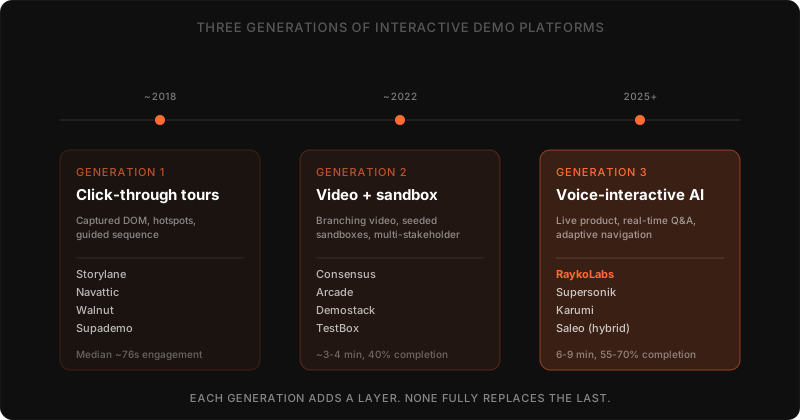
Here is the framework. It is not based on when the companies were founded, Demostack and Navattic launched around the same time, but on the type of experience the prospect receives.
Generation 1: Click-through tours. The prospect clicks highlighted UI elements to advance through a pre-built path. The product is represented by captured screenshots or HTML clones. Examples: Navattic, Storylane, Walnut, Supademo.
Generation 2: Video and sandbox demos. The prospect watches pre-recorded video segments (sometimes choosing which segments to watch) or interacts with a sandbox environment seeded with sample data. Examples: Consensus, Arcade, Demostack, TestBox.
Generation 3: Voice-interactive AI demos. An AI agent navigates the live product in real time, talks to the prospect, answers questions, and adapts the walkthrough based on the conversation. Examples: RaykoLabs, Supersonik, Karumi, Saleo.
Each generation did not replace the one before it. Click-through tours are not going away, they are becoming table stakes, like having a website. Every SaaS company will eventually embed some form of product tour. The question is whether that tour is the only demo experience you offer, or whether it sits alongside something more capable.
Generation 1: Click-through tours
Click-through demos were the first attempt to put product experiences in the hands of prospects without involving a sales rep. The concept is simple: capture your product's UI, overlay interactive hotspots, and let prospects advance through a guided sequence.
The players
Navattic built its reputation on HTML capture. You install a Chrome extension, navigate through your product, and Navattic captures the rendered DOM. The result is a clone of your interface that prospects can click through. Marketing teams love it for website embeds. See our full Navattic comparison and alternatives roundup.
Storylane took a similar approach but optimized for speed and ease of use. Their no-code editor lets you build a basic demo in under an hour. Flexible publishing options, embeds, standalone links, gated access, make it popular for campaign-driven teams. Our Storylane comparison covers the details.
Walnut skews toward sales rather than marketing. Reps capture product environments and customize them per prospect, swapping text, images, and data to match a specific account. The personalization features are strong for deal-specific leave-behinds. More in our Walnut comparison.
Supademo offers a lightweight screenshot-based alternative with AI-generated annotations. Fast to create, less control over fine details.
Where click-through tours genuinely work
They are excellent at one thing: giving website visitors a low-friction taste of the product. No signup, no form fill, no waiting. A well-built click-through tour embedded on a pricing page or feature page converts anonymous traffic into engaged visitors at rates that outperform static screenshots and product videos.
Navattic's annual benchmark reports show embedded interactive tours converting at roughly four to six times the rate of static product screenshots on equivalent pages, with completion rates landing in the 30-50% range on well-built tours. The email-capture lift is typically two to three times. Storylane's published case studies tell a similar story. Both vendors note the gap is most pronounced on pricing and feature pages, the highest-intent traffic on a B2B site.
They are also cheap and fast to build. A product marketer with no engineering background can produce a tour in an afternoon. For startups with no dedicated sales engineer, this is the fastest path to something interactive.
And they are deterministic. The same clicks produce the same output every time. There is no risk of an AI hallucinating incorrect product information or navigating to the wrong screen. For compliance-sensitive industries, that predictability matters.
Where they fall short
The limitation is structural, not a quality issue: click-through tours cannot respond to what a prospect actually wants to know. If a CTO lands on your tour wanting to understand API rate limits and your tour covers the dashboard overview, there is no path for them. They click through your story or they leave.
Maintenance is the other problem nobody talks about in the sales pitch. Every time your product ships a UI update, every affected tour needs a re-capture. Teams that ship weekly find themselves spending half a day per sprint maintaining demos instead of building them. If you ship fast, the tours are always slightly out of date.
Finally, the analytics tell you what prospects clicked, but not why. You know someone dropped off at step 7 of 12. You have no idea what question they had that the tour could not answer.
Generation 2: Video and sandbox demos
The second generation tried to solve the depth problem. If click-through tours are too shallow, give prospects a richer experience, either through curated video content or through sandbox environments with real data.
The players
Consensus pioneered the video demo board. Prospects receive a collection of video segments organized by topic, role, or use case. They choose which segments to watch. The platform tracks engagement across stakeholders, which is genuinely valuable for multi-threaded enterprise deals. See our Consensus comparison and alternatives analysis.
Arcade blends screen recording with interactive overlays. Record your product walkthrough, then layer in annotations, callouts, and branching paths. The output feels more polished than a raw Loom video and more dynamic than a click-through tour.
Demostack takes the sandbox approach. Clone your product into an isolated environment, seed it with demo-quality data, and let prospects (or reps) interact with a functional replica. The experience is closer to actual product usage.
TestBox goes further with sandboxes, they maintain live, pre-configured instances of real products. Prospects evaluate actual working software, which is powerful for competitive bake-offs.
Where video and sandbox demos work
Consensus-style video demos are strong in one specific motion: enterprise committee selling. When six stakeholders need to evaluate your product and only two of them will attend a live call, Demolytics-style tracking that shows which VP watched the security segment and which director re-watched the integration section is actionable sales intelligence. The complete guide to demo analytics covers why this data matters.
Sandbox demos solve a different problem entirely. For products where "feel" matters, where the prospect needs to type, drag, configure, or explore, no amount of screenshots or narration substitutes for hands-on interaction. Developer tools, design software, and analytics platforms all benefit from sandboxes.
Arcade fills a middle ground that is underrated: creating polished, embeddable video-like content that marketing teams can produce without a video editor. For content marketing and social distribution, this format works.
Where they fall short
Video is a monologue. Even with branching and chapter selection, the prospect is watching someone else use the product. They cannot ask "What happens if I click that?" They cannot say "Skip ahead, I already know this part." Video completion rates tell the story, most demo videos lose half their audience before the midpoint.
Wistia's annual State of Video report puts average completion rates for business videos in the three-to-fifteen-minute range, the typical demo video length, at roughly 40-50%. Vidyard's data tells a similar story. The drop-off accelerates sharply past five minutes; by minute eight, you have lost half your audience even on a well-targeted video.
Sandboxes have a different problem: they are expensive to maintain and they dump the prospect into an unfamiliar product with no guidance. The assumption that prospects will explore on their own and discover value is often wrong. Most sandbox sessions are short, shallow, and concentrated on whatever feature was most visible on the landing page. Without a guide, human or AI, prospects do not know what to look at or how to evaluate what they find.
Both formats also share the maintenance problem of Generation 1. Consensus video libraries need re-recording when the UI changes. Demostack clones need refreshing. The maintenance burden is not eliminated, it is just moved.
What is the difference between a click-through tour and a sandbox demo?
A click-through tour replays captured screenshots or HTML clones along a fixed path with hotspots and tooltips. A sandbox demo provides a working product environment with sample data where prospects can type, configure, and explore freely. Tours guide, sandboxes let prospects drive, but sandboxes need guidance to convert.
Tours suit awareness-stage questions like what the product looks like. Sandboxes suit evaluation-stage questions where feel matters, such as developer tools and analytics platforms. Many teams pair a tour for top of funnel with a sandbox or voice agent for deeper evaluation.
Generation 3: Voice-interactive AI demos
The third generation inverts the model. Instead of building a static asset and hoping it matches what each prospect wants, an AI agent conducts a live demo that adapts to the prospect in real time.
The players
RaykoLabs builds AI demo agents that navigate the live product while having a voice conversation with the prospect. The architecture runs Playwright for browser automation on Browserbase's cloud-hosted browsers, Deepgram for speech-to-text, and Cartesia for text-to-speech. A three-layer navigation system, context detection, navigation planning, and LLM integration, lets the agent handle open-ended requests like "Show me how an admin would set up SSO for 500 users." Sessions get recorded via rrweb, producing full-fidelity replays for the sales team. For the technical breakdown, see how browser automation powers live AI demos and the complete guide to AI demo agents.
Supersonik takes a conversational AI approach with a focus on mid-market SaaS. Their agent handles text and voice interactions, though the product navigation layer is less transparent in its architecture.
Karumi focuses on AI-assisted demo preparation and delivery, bridging the gap between fully autonomous agents and human-led demos. Their tools help reps prepare personalized demos faster rather than replacing reps entirely.
Saleo approaches from the data side, overlaying realistic, personalized data on top of your product during live demos. It enhances human-led demos rather than automating them, which makes it a hybrid between Gen 2 and Gen 3.
Where voice-interactive demos work
The use case where this generation shines is the one that no other format can handle: the prospect who has a specific question and wants an answer now. When a VP of Engineering lands on your site at 10 PM and wants to know if your API supports webhook retries with exponential backoff, a click-through tour showing the dashboard overview is useless. A video about "key features" is worse. A voice AI agent that hears the question, navigates to the API configuration panel, and demonstrates the retry settings while explaining the behavior, that is a different category of experience. We cover this use case in depth in our piece on voice-enabled product demos.
They also produce better data. Instead of "prospect clicked 8 of 12 hotspots," you get a transcript of every question asked, the navigation path the agent took, the features that held attention, and the objections that came up. This is demo analytics that your sales team can actually use in follow-up.
And maintenance disappears as a category. The agent runs against your live product. Ship a new feature on Tuesday, and Wednesday's demos include it automatically. No re-capture, no re-recording, no sandbox refresh.
Where they fall short, honestly
Latency is the hard engineering constraint. A voice interaction needs to feel conversational, which means the full loop, speech recognition, LLM reasoning, browser navigation, speech synthesis, has to complete fast enough that the prospect does not feel like they are waiting. At RaykoLabs we target 800ms end-to-end, and hitting that target consistently across varying product complexity and network conditions is an active engineering problem, not a solved one.
Here's what that looks like in practice. The speech-to-text layer (Deepgram) streams the transcript as the prospect speaks. The LLM processes the intent and determines the navigation action in parallel with the final words arriving. Playwright executes the browser action. Cartesia generates the voice response. Each stage is optimized independently, and the three-layer navigation system, where context detection identifies the current page state before the navigation planner determines the action sequence before the LLM decides how to narrate it, adds coordination overhead that we are continuously working to compress. When everything aligns, it feels like talking to a fast-thinking colleague. When a page loads slowly or the product has an unexpected modal, the gap is noticeable.
AI agents can also get things wrong. A click-through tour will never navigate to the wrong page or misstate a feature, because every frame is human-authored. An AI agent operating on a live product can misinterpret a DOM element, take an unexpected path, or generate a response that is technically inaccurate. The quality floor is lower than scripted content even when the quality ceiling is far higher.
Finally, Generation 3 tools are newer. The ecosystem of integrations, templates, and best practices is less mature than what Navattic or Consensus have built over years. Teams adopting voice-interactive demos are early adopters with the benefits and risks that implies.
How does a voice-interactive AI demo work?
A voice-interactive demo pairs a live browser session with speech recognition, language model reasoning, and speech synthesis. The prospect speaks a request, the system transcribes it, plans navigation steps, operates the real product interface, and narrates the result aloud. Sessions are recorded for sales review.
The practical difference from earlier generations is Q&A. Click-through and video formats cannot answer an unscripted question. A voice agent can navigate to the relevant screen, demonstrate the behavior, and explain it, which is why this format fits evaluation-stage decisions with high question density.
What does Reddit recommend as the best interactive demo platform?
Reddit threads do not converge on one winner because the use cases differ. Commenters tend to recommend Storylane and Navattic for fast embeddable tours, Arcade and Supademo for lightweight captures, and Consensus for enterprise video boards. Voice agents come up for live Q&A on the real product.
The useful takeaway from those threads matches the generation framework above. Pick the format that fits your sales motion first, then compare vendors inside that format. Buying across generations without naming the job, awareness content versus evaluation versus live answers, is what produces shelf-ware.
Comparison matrix
Here is how the three generations compare across the dimensions that matter most for a buying decision.
| Dimension | Gen 1: Click-Through | Gen 2: Video / Sandbox | Gen 3: Voice-Interactive AI |
|---|---|---|---|
| Prospect experience | Guided clicking through static UI | Watching video or exploring sandbox | Voice conversation with live product |
| Personalization | Per-tour customization by reps | Branch selection or seeded data | Real-time adaptation per question |
| Can answer questions | No | No (video) / Partially (sandbox) | Yes, open-ended Q&A |
| Maintenance burden | Re-capture on every UI change | Re-record or refresh data | None, runs on live product |
| Setup speed | Hours to build a tour | Hours to days per video/sandbox | Days to weeks for initial agent config |
| Analytics depth | Clicks, completion, drop-off | Watch time, segment views | Full transcript, intent, navigation path |
| Best for funnel stage | Top of funnel / awareness | Mid-funnel / evaluation | Mid-to-bottom / evaluation and qualification |
| Risk of inaccuracy | None (human-authored) | None (pre-recorded) | Possible (AI-generated responses) |
| 24/7 availability | Yes | Yes | Yes |
| Feels like talking to a person | No | No | Yes |
No single row determines the right choice. The matrix is a starting point for weighting what matters to your team.
How much does an interactive demo platform cost?
Click-through tools like Storylane and Navattic typically charge per seat per month, while enterprise video and sandbox tools like Consensus and Demostack use annual sales-led pricing. Voice AI agents typically bill per completed demo with no seat minimums. Total cost depends on seats, volume, and maintenance time.
When comparing quotes, model cost at your demo volume rather than list price alone. Per-seat plans scale with team size, per-demo plans scale with usage, and capture-based tools add re-capture labor every time the product UI changes.
Which generation fits your sales motion?
The right demo platform depends less on the tool and more on how you sell. Here is a decision framework based on company type and sales motion.
You are a product-led growth company with high website traffic
Start with Generation 1. Embed click-through tours on your highest-traffic pages, pricing, features, use-case pages. The goal is conversion: turn anonymous visitors into signups or demo requests. Navattic and Storylane are built for this. If you are already running self-serve demos, you may already have this covered.
Add Generation 3 when you are ready to convert the visitors who have questions the tour cannot answer. The click-through tour becomes the top of a funnel where the AI demo agent handles the middle.
You sell to enterprise buying committees with 4+ stakeholders
Generation 2 has a genuine edge here. Consensus stakeholder tracking and video board model was designed for exactly this motion, which is why Gartner B2B buying journey research on multi-stakeholder evaluation is worth reading before you pick a format. Being able to see that the CISO watched the security section three times while the VP of Product skipped it entirely is intel that changes how your AE runs the next call.
Consider layering Generation 3 on top, let stakeholders who want a deeper dive talk to the AI agent rather than re-watching a video segment. The two formats complement each other.
You have a technical product and your buyers are engineers
Skip straight to Generation 3 or a sandbox. Engineers do not want to click through annotated screenshots. They want to poke at the product. A sandbox (TestBox, Demostack) or a voice-interactive agent that can answer technical questions in real time and demonstrate actual behavior will resonate far more than polished marketing content.
You are early stage with limited resources
Generation 1, no question. A product marketer can build a Storylane tour in a day. That is the highest ROI demo investment at the stage where you have more important things to build than demo infrastructure.
You have a large inbound volume and not enough AEs to cover it
This is the core use case for Generation 3. When you are getting 500 demo requests a month and your team can run 80 live demos, the other 420 prospects are either waiting, getting a generic video, or leaving. An AI demo agent handles the overflow with a quality level that sits between a generic video and a good AE, and it captures enough data that the AE who follows up knows exactly what the prospect cares about.
At a typical 20-30% B2B demo no-show rate and a fully-loaded demo cost of $150-250 per session, a team running 500 booked demos a month is burning $20,000 to $35,000 monthly on demos that never happen. That is before accounting for the AE's wasted prep time, the calendar slot lost to a competitor, and the prospect who quietly went cold while the rep waited for them on Zoom.
Where this is heading
The three-generation framework will not hold forever. The lines between formats are already blurring. Navattic has started adding AI-generated annotations. Consensus is moving toward AI assistants. The convergence is toward more intelligence embedded in every demo format, not a clean replacement of one generation by the next.
But the underlying dynamic is clear: prospects want to ask questions and get answers, not click through someone else's script. The tools that let them do that, whether through voice, text, or some future modality, will win the next wave of this market.
The contrarian take: the biggest winner from Generation 3 AI demo tools might not be the prospects. It might be the sales engineers who currently spend 60% of their time running repetitive demos that an agent handles better. Freeing those SEs to work on complex, high-value deals where human judgment actually matters could be the most impactful outcome of this entire category.
Pick the generation that matches how you sell today. Plan for the one that matches how your buyers want to buy tomorrow.
For further reading: our AI demo agents complete guide covers the technology in depth, and the best Navattic alternatives and best Consensus alternatives posts give head-to-head comparisons if you are evaluating specific vendors.
Comparing specific vendors? See our Arcade alternatives and Supademo alternatives roundups.
What is interactive demo software?
Interactive demo software lets prospects experience your product without booking a live call. It includes click through tours, video boards, sandbox environments, and AI agents that run the live product. The goal is self serve evaluation that fits the buyer schedule.
Those formats are not interchangeable. A click through tour built with tools like Navattic or Storylane replays captured screens along a fixed path and embeds well on pricing pages. A video board built with tools like Consensus organizes recorded segments by role. A sandbox offers hands on exploration. A voice agent runs the live product and answers follow up questions.
Use the table below to match the format to the buying question.
| Format | How the prospect experiences it | When it fits best |
|---|---|---|
| Click through tour | Guided clicks through captured screens with hotspots and tooltips | Awareness stage orientation on high traffic pages |
| Video board | Self selected recorded segments by topic or role | Multi stakeholder deals where members review on their own time |
| Sandbox environment | Hands on exploration with sample data and real controls | Technical evaluation where feel and configuration matter |
| Voice interactive agent | Spoken conversation while the agent operates the live product | Evaluation stage questions that do not follow a script |
Pick one format as your entry point, then add a second for the next funnel stage. Many teams pair a tour for awareness with a sandbox or voice agent for evaluation. Name the primary job for this surface and choose the format that serves that job before comparing vendors inside it.
How should sales teams evaluate sales demo automation software?
Sales demo automation software should be compared by question handling, maintenance load, personalization without extra builds, and analytics that help follow up. Fit depends on sales motion, product complexity, and demo volume, not on editor polish in a short trial.
Trials reward tools that are easy to start. Ownership rewards tools that are easy to keep current. Capture based tools like Walnut, Arcade, and Supademo shine in a first session because a marketer can capture screens and publish quickly. The ongoing cost shows up later, when each product change forces a fresh capture plus reapplied annotations. Video libraries need re records for affected segments. Live product approaches, including overlays like Saleo and voice agents that run the real interface, avoid that rebuild cycle because each session reads the current product.
Evaluate with the checks below before you commit.
| Check | What good looks like | Why it matters for sales |
|---|---|---|
| Question handling | Prospect can ask an unscripted question and get a relevant answer | Prevents drop off when the script misses the buyer need |
| Maintenance path | Vendor can describe the update path in plain steps | Protects the team from rebuild work after each release |
| Personalization model | One asset adapts by persona or account without duplicating builds | Keeps the library small as segments grow |
| Follow up data | Session yields explored areas, asked questions, and replay context | Gives the rep a concrete reason to follow up |
Name your primary surface first, such as website embed, outbound leave behind, or live call support. Then score vendors against those four checks on that surface only. Keep maintained assets small, define which topics route to a human, and confirm session data flows to your CRM without manual export.
Frequently asked questions
What is the best interactive demo platform in 2026?
There is no single best platform. Click-through tours (Storylane, Navattic) work for low-question-density products. Video automation (Consensus) suits async buying committees. Live AI voice agents (Rayko) handle ad-hoc questions and run on real products. The best platform is the one whose architecture matches your product's question density and your sales motion.
How do AI voice demos compare to click-through tours?
Click-through tours capture screenshots and replay them as a guided path. They cannot answer questions, adapt to a prospect's specific use case, or handle live product state. AI voice demos run on the actual product, respond to questions in real time, and navigate dynamically. Click-through tours suit awareness-stage content. Voice demos suit evaluation-stage decisions.
Which interactive demo platforms work for B2B SaaS?
Navattic, Storylane, Walnut, Arcade, Consensus, Saleo, Supademo, and AI voice agents (Rayko, Saleo's AI agent, Supersonik, Karumi) are all designed for B2B SaaS. Storylane and Navattic are most common for marketing-led demos. Walnut and Saleo are favored by sales-led teams. Voice agents are emerging for product-led growth motions.
How much does an interactive demo platform cost?
Per-seat platforms (Storylane, Navattic, Walnut, Arcade) typically range from $300 to $2,500 per seat per month. Enterprise-only platforms (Consensus, Saleo) use sales-led pricing. Live AI voice agents (Rayko) bill per completed demo, typically $9 per session, with no per-seat minimums.
What's the conversion rate of interactive demos vs traditional demos?
Industry research shows interactive demos convert 4-6x better than recorded videos and 30-50% better than scheduled live demos for top-of-funnel traffic. Email capture rates lift 2-3x when prospects can engage with the product before a sales call. The gap widens further when AI agents can answer prospect questions in real time.
What's the best AI tool for creating product demos?
It depends on what you mean by best. For click-through tour generation, Storylane and Navattic are the most polished tools, with Supademo and Arcade close behind. For sandbox-style demos with personalization, Walnut and Saleo lead the category. For live AI voice demos that run on the actual product and answer questions in real time, Rayko, Supersonik, and Saleo's AI agent are the active players. The honest answer: the best tool is the one that matches your sales motion. Marketing-led teams pick click-through. Sales-led teams pick sandbox. Product-led growth teams pick voice agents. Buying the wrong category is more expensive than buying the wrong vendor inside the right category.
What are the best AI sales tools that don't replace my team?
Tools that augment first-touch qualification and free reps for closing work. Drift, Qualified, and Intercom Fin handle inbound chat without removing reps from the loop. Conversica handles email-based lead nurture and re-engagement. Rayko handles live AI demos and qualification but routes warm prospects to human reps within 60 seconds. The pattern is consistent: AI handles repetitive front-of-funnel work like answering FAQs, qualifying fit, and running first-touch walkthroughs. Reps handle the work that compounds with skill, like multi-stakeholder buying, negotiation, and complex committees. Tools that try to fully automate the close almost always disappoint, because closing is where human judgment still wins.
What are the best automation tools for small teams managing multiple channels?
For small teams under 10 reps, the right pattern is one tool per channel layered on top of HubSpot or Salesforce. For inbound chat, pick Drift or Intercom Fin. For demos, pick Storylane (click-through) or Rayko (live AI). For outbound, pick Apollo or Outreach. For meeting booking, pick Chili Piper or RevenueHero. For enrichment, pick Clearbit or Apollo. Resist all-in-one platforms that promise to handle every channel, they consistently underperform best-in-class tools at each layer. Glue them together with HubSpot Workflows or Salesforce Flow rather than dedicated middleware. Total monthly spend for a 5-person team running this stack lands around $1,500 to $4,000 depending on volume.
How do I choose between AI sales tools?
Start with the question your buyers ask most often. If buyers ask product-fit questions, you need a tool that can answer them in real time, which points to live AI demo agents like Rayko or chat tools like Drift and Qualified. If buyers want to self-serve a tour without talking, click-through tools like Storylane and Navattic win. If buyers need stakeholder alignment, async video tools like Consensus fit. After picking the category, evaluate three things: integration depth with your CRM, time-to-deploy under 30 days, and per-session or per-seat economics that match your traffic volume. Skip vendors that require a 6-month implementation. The category moves too fast for that timeline.
How does Pendo compare to Walkme and other interactive demo platforms?
Pendo and Walkme are not interactive demo platforms in the marketing sense. They are digital adoption platforms designed for in-product user onboarding and feature discovery, not for top-of-funnel prospect demos. Pendo focuses on product analytics and in-app guides for existing users. Walkme focuses on enterprise digital adoption with overlay-based walkthroughs. Both are heavy implementations that target customer success and product teams, not marketing or sales. For top-of-funnel prospect demos, choose Storylane, Navattic, Walnut, or Arcade for click-through, or Rayko, Supersonik, or Saleo for live AI demos. Comparing Pendo to Storylane is comparing onboarding software to demo software, they solve adjacent but distinct problems.
Sources
- Navattic, Interactive product demos, Navattic
- Storylane, Interactive demo platform, Storylane
- Walnut, Interactive demo software, Walnut
- Arcade, Create interactive demos, Arcade
- Consensus, Demo automation platform, Consensus
- Saleo, Live demo experience platform, Saleo
- Supademo, Interactive product demos, Supademo
- State of Sales Report, Salesforce Research
- B2B Buying Journey Insights, Gartner
Cite this article
Utkarsh Agrawal. "Interactive Demo Platforms Compared: 9 Tools Tested (2026)." RaykoLabs Blog, March 15, 2026. https://raykolabs.com/blog/interactive-demo-platforms-compared

Utkarsh Agrawal is CTO of RaykoLabs, where he leads engineering on Rayko, the AI demo agent that runs live, voice-enabled product demos in a real browser for B2B SaaS teams. His work spans real-time voice interaction, browser automation with Playwright and Browserbase, speech-model orchestration, and the infrastructure that keeps autonomous demos reliable around the clock. On the RaykoLabs blog he writes practical guides on voice-enabled product demos, demo automation, and what it takes to ship production AI agents for sales: how to qualify prospects mid-demo, how to measure demo performance, and how buying teams actually evaluate demo software. His comparisons of demo platforms are built from hands-on testing and vendor documentation, with trade-offs stated plainly so buyers can decide fit.
See RaykoLabs in action
Watch an AI agent run a live, personalized product demo, no scheduling, no waiting.
START LIVE DEMO