Loading...

2026 Demo Fatigue: Fix Overload and Lift Replies
Learn what demo fatigue is, why overload keeps growing, and how self-serve demos restore attention. See fixes that shorten cycles. Read more.
Quick answer
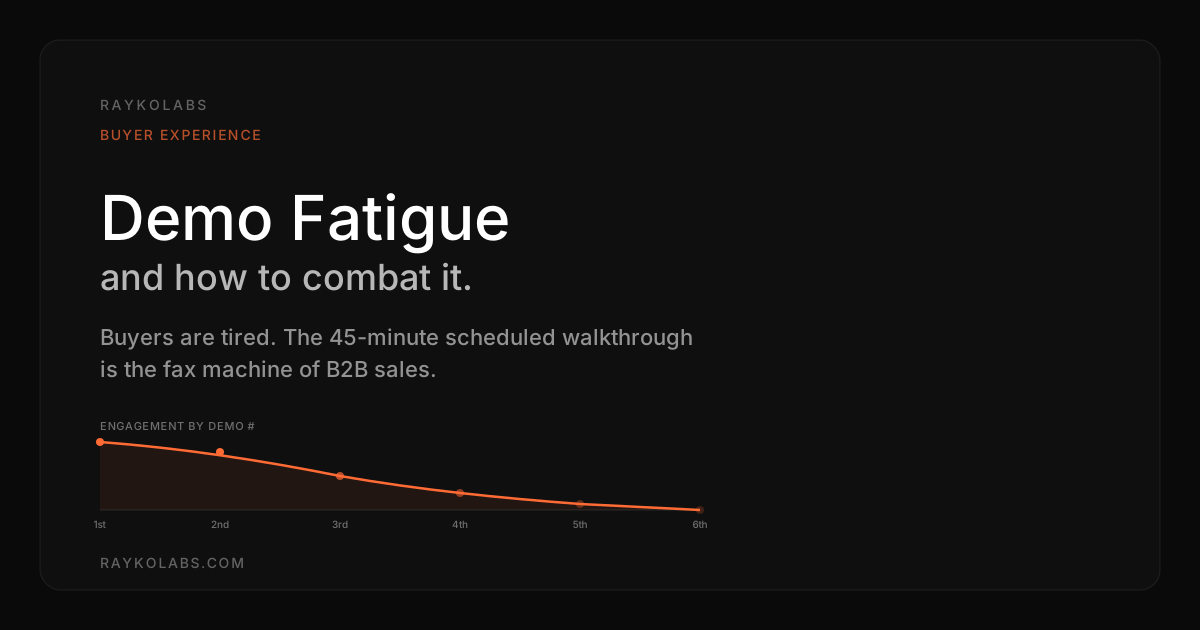
Demo fatigue is the progressive decline in a buyer's engagement and willingness to sit through product demonstrations as they evaluate multiple vendors. It is a rational response to a repetitive, scheduled, feature-narration process, not laziness. It is worse than five years ago because of more vendors per category, larger buying committees, and screen fatigue, and you fix it by making demos self-serve, interactive, and available the moment buyers are ready.
Want this running on your product? Rayko demos it live, with your prospects asking questions by voice.
START LIVE DEMOYou are the IT director evaluating project management tools. It is Wednesday. You have already sat through three vendor demos this week. Each one opened with "Let me tell you a little about our company," followed by 40 minutes of feature narration you did not ask for, capped off with "What questions do you have?" You have four more demos booked through Friday. By Thursday morning, you start canceling them. Not because you found the right product, but because you cannot sit through another one.
You are not a bad buyer. You are a rational person responding to an irrational process.
Much of that irrational process is tour design: check these interactive demo conversion mistakes alongside the fixes below. This is demo fatigue.
What demo fatigue actually is
Demo fatigue is the progressive decline in a buyer's engagement, attention, and willingness to sit through product demonstrations as they evaluate multiple vendors. It is not laziness. It is a rational response to an overwhelming, repetitive process.
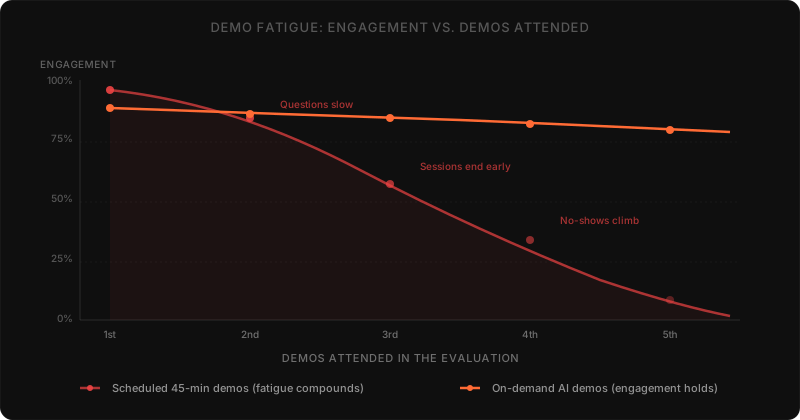
The symptoms are measurable: declining attendance rates across the buying cycle, shorter session durations as evaluation progresses, fewer questions asked during later demos, and a growing tendency to skip demos entirely in favor of G2 reviews, peer recommendations, or free trials.
Here is what makes demo fatigue dangerous for sellers: when a prospect is fatigued, they default to the vendor that requires the least effort to evaluate. Not the best product. Not the best price. The easiest one to buy. If your prospects are ghosting your demos, fatigue is probably why.
Why demo fatigue is worse than five years ago
More vendors per category
The average software category has dozens of viable competitors. CRM is not a two-vendor race, it is fifteen. Even a narrowed shortlist of four vendors means four scheduled demos, each an hour long, spread across two to three weeks.
Buying committees keep growing
The average B2B buying committee is six to ten stakeholders. The champion sees the first demo, brings in the IT lead for a second, then the finance stakeholder for a third. The vendor gives the same demo three times to the same account. The champion sits through every one.
Screen fatigue compounds it
Demos moved from conference rooms to Zoom calls. Easier to schedule, easier to disengage from. Buyers already spend 8-10 hours a day on video calls. A 45-minute vendor demo on top of back-to-back meetings is a genuine cognitive burden.
The format has not changed in twenty years
Scheduled meeting. Screen share. Rep talks through features. Q&A at the end. This format was designed when software categories had three vendors and buying committees had two people. It does not scale to the current reality, and yet almost every B2B company still uses it.
Hot take: the 45-minute scheduled demo is the fax machine of B2B sales. Everyone knows it is outdated. Nobody wants to be the first to stop using it. The companies that break from this format, by offering on-demand AI demos, shorter sessions, and buyer-directed exploration, will have a structural advantage over everyone still clinging to the calendar invite.
Signs your prospects have demo fatigue
Rising no-show rates
The prospect wanted to see your product when they booked the demo. By the time the date arrived, they had sat through two other vendor presentations and lost the energy to attend yours. If no-show rates are climbing, especially among initially interested prospects, fatigue is the cause.
Declining session duration
Track how long demos actually last versus scheduled time. Consistently ending 15-20 minutes early because the prospect says "I think I have a good sense of things"? That is fatigue, not satisfaction.
Silence during demos
An engaged prospect asks questions. A fatigued one sits quietly and waits for it to end. If reps are noticing fewer questions and more passive viewing, you have a fatigue problem.
Interactive tour drop-offs
Check your completion rates. A steep drop-off after 2-3 screens means prospects arrive with low engagement energy and the format cannot sustain their attention. Traditional click-through alternatives like Navattic, Storylane, and Walnut all suffer from this.
Longer decision timelines
Fatigued buyers delay decisions. A three-week evaluation stretches to eight, not because the product is wrong, but because the process is exhausting. Fatigue creates inertia. Inertia kills deals.
How demo fatigue kills your pipeline
Lower win rates
Fatigued buyers make satisficing decisions, good enough rather than best. If your product is genuinely superior but your demo lands on a day when the prospect is burned out from three other presentations, your differentiation does not register. You lose on experience, not on product.
Snap judgments
Fatigued buyers watch the first ten minutes, form a judgment, and move on. Features that would have impressed them fresh get skipped. You are being judged on a fraction of your product.
Champion burnout
Your internal champion has to attend every vendor demo, often multiple times with different stakeholders. By the end of the process, their advocacy energy is gone. A tired champion is a weak champion.
The narrative shifts outside your control
When buyers skip demos, they turn to G2 reviews, analyst reports, and peer opinions. These can help, but they are outside your control. You lose the ability to shape how your product is understood.
Buyer-preference research from TrustRadius and 6sense lands at consistent numbers here: a meaningful majority of B2B buyers report having chosen a vendor at least partly because the evaluation process was easier, not necessarily because the product was demonstrably better. The signal is so durable across different surveys (TrustRadius's annual B2B Buying Disconnect, Gartner's tracking of buyer preferences, our own informal customer interviews) that "we made it easier to evaluate us" has become a competitive moat in its own right.
How to fix it
Make the demo available on demand
This is the single most impactful change. Stop requiring scheduled meetings. Let prospects experience the product when they want, for as long as they want, exploring what they want.
AI-powered demo agents make this possible. A prospect lands on your site at 8 PM. Instead of filling out a form and waiting three days, they start a conversational demo immediately. They explore features that matter to them, ask questions, and leave with a clear understanding, in ten to fifteen minutes on their schedule.
We watched session recordings (captured via rrweb) of prospects interacting with early RaykoLabs demos. The pattern was consistent: prospects who started a demo at off-hours, evenings, weekends, lunch breaks, had higher engagement scores than those who took scheduled demos during business hours. Why? No Zoom fatigue. No calendar pressure. They were exploring because they wanted to, not because a meeting was booked.
Cut human demos to 15-20 minutes
The 45-60 minute walkthrough is a fatigue machine. Instead, offer focused sessions: "See how our reporting works," "Walk through our integration setup." Shorter demos are easier to attend and easier to remember.
Personalize with AI
Generic demos, where every prospect sees the same walkthrough, make all vendors feel interchangeable. AI agents tailor the experience by industry, role, and stated priorities. A marketing director sees marketing workflows. A CTO sees technical architecture and security features. The demo feels relevant, which sustains engagement.
Offer async options
Not every experience needs to be synchronous. Let prospects receive a personalized walkthrough they can watch on their own time, pause, rewind, share with stakeholders. Combine with an AI agent that answers questions asynchronously via chat or voice.
Let the buyer drive
"What would you like to explore?" is a better opening than "Let me start by telling you about our company." Voice-enabled AI demos are particularly strong here, the prospect says what they want to see, and the agent navigates there using Playwright browser automation against your live product. The experience feels like conversation, not presentation.
Stop repeating demos for each stakeholder
When multiple stakeholders need to see the product, do not make the champion sit through it again. Let stakeholders access the AI demo agent independently. Provide shareable session recordings. Each touchpoint should add new value, not repeat what was already covered.
Measuring whether your changes work
Demo request-to-completion rate
What percentage of prospects who express interest actually complete a demo? Below 60%? Friction and fatigue are significant factors. On-demand AI demos can push this above 80%.
In our deployment data, request-to-completion rates for AI voice demos average 65-80%, well above the 50-65% rate we see on equivalent scheduled-demo flows once you net out the no-show rate. The gap reflects a simple truth about demo fatigue: the friction-free path produces fewer fatigued buyers, because there is less wasted time to feel fatigued by.
Engagement depth
For interactive tours: completion rate. For AI demos: session duration, features explored, questions asked. For live demos: ratio of scheduled time to actual time used.
Prospect-initiated follow-up
After the demo, what percentage of prospects proactively reach out versus requiring rep follow-up? Higher prospect-initiated rates indicate genuine engagement, not polite attendance.
Multi-stakeholder reach
How many stakeholders in the buying committee have experienced the product? If only the champion has seen a demo, the deal is vulnerable. AI agents that stakeholders access independently improve this metric.
Time to decision
Are your changes compressing or extending the evaluation timeline? Anti-fatigue measures should shorten time from first product experience to buying decision. If they are not, something is wrong with the implementation, not the strategy.
The demo is not the problem
Buyers are not tired of seeing products. They are tired of the way products are shown to them: scheduled, scripted, one-size-fits-all, and repetitive. The demo remains one of the most powerful conversion tools in B2B sales.
The fix is not fewer demos. It is better demos, on the buyer's terms, personalized to their needs, available when they want them, and short enough to respect their time. The ROI of making this shift is measurable and large.
Demo fatigue is a symptom. The disease is a demo process designed for the seller's convenience. Cure the process, and the fatigue disappears. The organizations that figure this out first, replacing "Let me know what times work next week" with "Talk to our product right now", will close deals their competitors never even knew they were losing.
Which engagement signals show fatigue is lifting
Fatigue is lifting when more prospects reach the product without scheduling, stay long enough to explore on their own terms, ask substantive questions, and bring colleagues back voluntarily. No single metric proves this shift, so track a small set of engagement signals together and look for steady improvement across the set rather than a spike in any one number.
Signals worth watching:
- Request to completion rate, meaning the share of interested prospects who actually experience the product rather than stopping at a form or a booked slot. Rising completion suggests friction is falling.
- Depth per session, such as product areas explored, questions asked, and follow up topics raised. Deeper sessions suggest the demo feels relevant rather than obligatory. Compare these patterns with common interactive demo conversion mistakes to separate content issues from fatigue issues.
- Prospect initiated follow up, where the buyer asks for a next step without heavy chasing. This is a stronger sign than attendance alone because it reflects intent formed during the experience.
- Multi stakeholder reach, meaning whether people beyond the first contact explore the product independently. When colleagues self serve instead of waiting for a repeated group walkthrough, champion load drops and deals keep moving.
- Time from first product view to next meaningful step. Shorter gaps suggest momentum survived the demo instead of dissipating after it.
Review these signals as a group. If completion rises but depth stays flat, access improved while relevance still lags. If depth rises but multi stakeholder reach stays flat, the experience works for champions but remains hard to share.
How to run a simple weekly demo review that reduces fatigue
A simple weekly demo review reduces fatigue by turning session observations into one small fix at a time, owned by one person and shipped before the next review. The goal is steady removal of friction, not a large redesign, because fatigue usually comes from several small burdens that accumulate across the buying journey.
A repeatable agenda that fits in half an hour:
- Start with drop points. Note where prospects leave, which screens get skipped, and which questions recur without clear answers. Session replays help more than opinion here because they show what buyers actually did.
- Pick one friction to remove. Examples include shortening an intro, clarifying the opening question, splitting one long path into role based entries, or adding a direct link from a ghost prone scheduled flow to an on demand option.
- Assign an owner and a ship date within the week. Small changes that go live beat large plans that wait for resourcing.
- Confirm the handoff still helps reps. Check that transcripts, product areas explored, and open questions reach the CRM in usable form so follow up builds on what the prospect already saw.
- Close the loop by noting what changed in buyer language. When reps report that follow up calls start further along, with fewer repeat explanations and more specific questions, the review is working.
Keep a running log of changes and observed effects. Over a quarter, that log becomes your playbook for what your buyers actually find tiring and what restores their attention, which is far more useful than a generic best practice list.
Verdict: Replace long scheduled walkthroughs with short self serve demos buyers control
Demo fatigue is best fixed by making demos shorter, self serve, and available on demand. Open with the buyer problem, branch by role, keep each path focused on one workflow, and let prospects ask questions instead of watching fixed narration.
Audit where attention drops, cut intros, and split one long tour into role based entries. Pair each demo with a clear next step and send transcripts to sales so follow up builds on what the buyer already explored.
Frequently asked questions
How do I make my interactive demo engaging and not boring?
Three rules. First, open with the buyer's problem in the buyer's words, not your company introduction. Static tours that start with 'Welcome to ProductName' lose 40 percent of viewers in the first 15 seconds, per Pendo's product engagement benchmarks. Second, branch the demo by persona, the CTO, the VP Sales, and the end user need different proof points, and a single linear flow bores at least two of them. Third, allow live questions. Click-through tours from Storylane and Navattic feel like brochures because the prospect cannot ask anything. AI voice demo agents like Rayko answer ad-hoc questions in real time, which keeps the prospect leaning forward instead of skimming. Engagement is structurally a question of whether the prospect drives the demo or watches it happen to them.
How long should my interactive demo be?
Aim for four to seven minutes of active prospect engagement, not absolute runtime. The more useful metric is questions asked: a session with 8 to 15 prospect questions converts dramatically better than a 12-minute monologue regardless of total length. For static click-through tours, keep it under five screens, completion rate drops sharply past that. For AI voice or interactive demos, let the prospect drive the length, the AI ends the session when the prospect's questions slow down rather than running through a fixed script. Pendo and TrustRadius buyer-research data both consistently show that perceived value, not runtime, predicts whether a prospect books a follow-up. Length is downstream of engagement.
Why do prospects skip interactive demos?
Three failure modes account for almost every skip. The demo asks for an email before delivering value, prospects close the tab. The demo opens with feature narration rather than the prospect's pain, prospects skim past the first two screens. The demo is a static click-through that cannot answer the prospect's actual evaluation question, prospects either book a sales call (slow path) or leave (worse). TrustRadius research shows nearly all B2B buyers want to self-serve at least part of the buying journey, so the friction of a demo that does not let them is felt acutely. Tools like Rayko, Storylane, and Navattic all reduce these failure modes when configured well, the meta-fix is removing pre-value gates and over-scripted intros.
How do I personalize one demo for different buying roles without recording five versions?
Branch by persona inside one live surface instead of producing parallel assets. Define two or three role paths with distinct proof points, for example technical depth for engineering, workflow value for operators, and risk and compliance for security, then let the prospect choose or let the AI route by their first questions. AI demo agents do this at run time by adapting navigation and answers per prospect, while click through tours need explicit branches per persona. The metric is whether each role sees its proof within the first two minutes.
What should I do when a prospect abandons an interactive demo halfway?
Treat abandonment as a signal about the demo, not the prospect. First, check where the drop happened, because exits cluster at gated forms, long intros, and screens with no clear next action. Second, follow up with the exact value left unseen, such as a one minute clip of the skipped workflow plus an offer to answer the specific question live. Third, feed the exit point back into the demo design by shortening the path to that value. Teams that review drop off weekly and remove one friction point per cycle see completion recover faster than teams that add more content.
Sources
- The B2B Buying Journey, Gartner
- B2B Buyer Insights, TrustRadius
- State of Sales, Salesforce Research
- B2B Marketing and Sales Research, Forrester
- SaaS Sales Development Metrics, Bridge Group
Cite this article
Utkarsh Agrawal. "2026 Demo Fatigue: Fix Overload and Lift Replies." RaykoLabs Blog, February 8, 2026. https://raykolabs.com/blog/demo-fatigue-how-to-combat

Utkarsh Agrawal is CTO of RaykoLabs, where he leads engineering on Rayko, the AI demo agent that runs live, voice-enabled product demos in a real browser for B2B SaaS teams. His work spans real-time voice interaction, browser automation with Playwright and Browserbase, speech-model orchestration, and the infrastructure that keeps autonomous demos reliable around the clock. On the RaykoLabs blog he writes practical guides on voice-enabled product demos, demo automation, and what it takes to ship production AI agents for sales: how to qualify prospects mid-demo, how to measure demo performance, and how buying teams actually evaluate demo software. His comparisons of demo platforms are built from hands-on testing and vendor documentation, with trade-offs stated plainly so buyers can decide fit.
See RaykoLabs in action
Watch an AI agent run a live, personalized product demo, no scheduling, no waiting.
START LIVE DEMO