Loading...

2026 AI Demo ROI: Build a Business Case That Closes
Learn the costs, savings, and revenue impact of AI demo agents versus scheduled demos. See how to model payback. Build your case now.
Quick answer
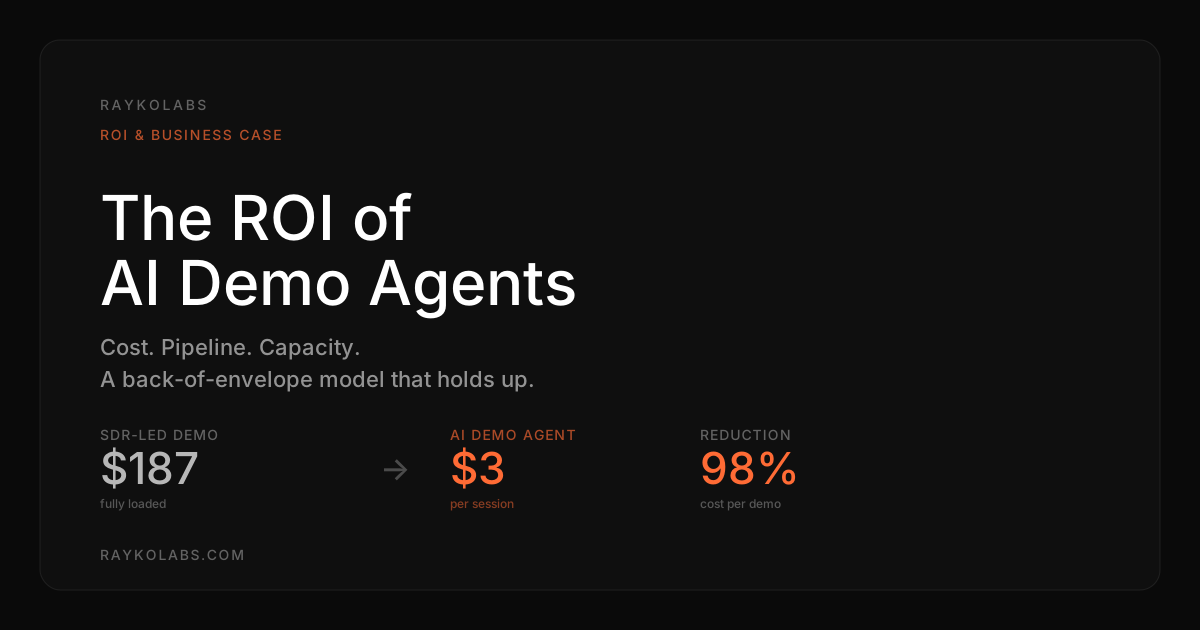
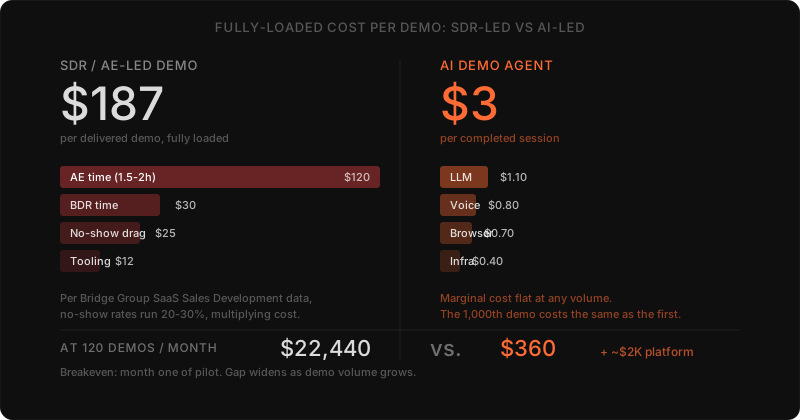
The ROI of AI demo automation has three layers. The fully loaded cost of one 30-minute human demo at a mid-market B2B SaaS company runs roughly $187, about $22,440 a month at 120 demos. An AI demo session costs $1 to $5. Direct cost savings are obvious; the larger numbers come from revenue acceleration and rep time redirected to closing. Breakeven typically lands in the first pilot month.
Want this running on your product? Rayko demos it live, with your prospects asking questions by voice.
START LIVE DEMO$187. That is the fully-loaded cost of a single 30-minute demo at a mid-market B2B SaaS company, including rep prep time, the demo itself, CRM logging, follow-up email, and the overhead nobody accounts for. Multiply that by 120 demos a month and you are spending $22,440 monthly just to show people your product.
We ran this math on our own pipeline before building RaykoLabs. That $187 number haunted us. Not because it was high, but because most of those demos were repetitive first-touch walkthroughs that followed the same script every time.
An AI demo session costs $1 to $5. The ROI case writes itself, but only if you measure it correctly. Direct cost savings are the obvious part. The bigger numbers come from revenue acceleration (more pipeline) and recovered rep time redirected to closing.
What your demos actually cost (you are probably not counting everything)
Most organizations think demos are free because reps are on salary. Here is the real breakdown:
- Scheduling and coordination: 15-30 minutes across BDR and AE time, email exchanges, calendar wrangling, CRM updates
- Preparation: 15-30 minutes for the AE to review the prospect's background, customize the demo environment, build talking points
- The demo itself: 30-60 minutes of AE time
- Follow-up: 15-30 minutes for recap email, CRM notes, internal handoff
- No-show recovery: When 20-30% of scheduled demos no-show (Bridge Group SaaS Sales Development Metrics), add the wasted prep time back in
- Opportunity cost: Every hour your best closer spends on a first-touch walkthrough is an hour they are not spending on a deal in negotiation
Total time per demo: 75 to 150 minutes. An AE earning $150,000 in total compensation costs about $75/hour fully loaded. A demo consuming 1.5-2 hours of AE time costs $110-$150 in rep time alone. Add BDR time ($20-$40) and tool costs.
The fully loaded cost of a single B2B demo: $80 to $200.
For a team doing 100 demos per month, that is $8,000-$20,000 in monthly demo costs. And no-shows, running 20-30% per Bridge Group's SaaS Sales Development research, add another $1,600 to $6,000 in wasted effort. Your prospects are ghosting you and each ghost costs real money.
In our pre-deployment audits with new customers, typically a Series B-to-C SaaS company in the $5M-$50M ARR band, the fully-loaded per-demo number lands somewhere between $130 and $180 once you include AE and SDR salary load, demo-engineering prep on complex products, demo-data refresh, and the long tail of follow-up cycles. The teams that have actually measured the unit economics tend to be surprised; the ones running on intuition almost always understate the cost by 30-40%.
The cost model for AI demos
AI demo agents operate on a completely different cost structure.
Per-session costs
An AI voice demo session costs $1-$5 depending on session length and compute requirements. That covers LLM processing, speech-to-text (Deepgram), text-to-speech (Cartesia), browser automation (Playwright on Browserbase), and infrastructure.
At $3 per session, 100 demos cost $300. Compare that to $8,000-$20,000 for the same volume delivered by humans. That is a 95%+ cost reduction per demo.
Platform costs
AI demo platforms charge $500-$3,000/month for mid-market teams. Even at the high end, platform cost plus per-session fees stay well below human-delivered demo costs.
Scale is free
This is where the economics break in your favor. The 101st AI demo costs the same as the first. The 1,000th costs the same as the 100th. No hiring, no training, no ramp time. When demand spikes after a product launch or a conference, the AI agent handles the volume without additional cost.
| Cost line | Human-led demo | AI demo agent |
|---|---|---|
| Scheduling and coordination | 15 to 30 min of BDR and AE time | None, prospect starts on demand |
| Preparation | 15 to 30 min of AE time | None, agent is always ready |
| The demo itself | 30 to 60 min of AE time | Included in per-session compute |
| Follow-up | 15 to 30 min for recap and CRM notes | Transcript and signals captured automatically |
| No-show drag | 20 to 30 percent of prep wasted | Zero, cannot no-show an on-demand demo |
| Per-unit cost | $80 to $200 fully loaded per demo | $1 to $5 per session plus $500 to $3,000 monthly platform |
| Cost to scale volume | Linear, more demos need more reps | Flat, the 1,000th demo costs the same as the first |
Revenue impact: more demos, more pipeline
Cost savings are the easy part. The revenue impact is where the real numbers live.
Volume effect
When demos are available on demand, more prospects take them. No scheduling, no waiting, no calendar coordination. Salesforce's State of Sales finds reps spend less than 30% of their week actually selling, the rest is administrative work and meeting coordination, demo automation reclaims this time directly. If your website gets 10,000 visitors per month and 2% request a demo (200 requests), your team delivers maybe 140-160 after no-shows and scheduling friction. An AI demo agent available on every page might convert 3-5% of visitors into demo sessions, 300-500 per month. Double to triple the volume without adding a single rep.
Hot take: most companies do not have a demo quality problem. They have a demo access problem. The demo itself is fine. The product is good. The rep is solid. The problem is that 70% of interested buyers never get to see it because the process requires scheduling a meeting. Fix access and you fix pipeline.
Speed effect
Prospects who see the product immediately, at peak interest, convert at higher rates than those who wait 3-5 days. The intent decay that occurs during the scheduling gap is real and measurable. Gartner's B2B Buying Journey research finds that buyers spend only 17% of their evaluation time meeting with potential suppliers, removing the scheduling gap captures more of this scarce attention window. Voice demos reduce sales cycles precisely because they eliminate this delay.
Coverage effect
AI demos run 24/7 across every timezone. Prospects in markets your team cannot cover during business hours now get the same experience as those in your primary market.
Qualification effect
Every AI demo session generates structured data: features explored, questions asked, objections raised, time spent per section. RaykoLabs uses rrweb for session recording, which means you can replay exactly what happened, not just read a transcript, but watch the prospect's actual journey through your product. Better qualification means reps spend time on deals more likely to close.
Rep time saved: the capacity multiplier
Your most experienced reps should be spending time on complex, high-value conversations, not on first-touch walkthroughs that follow the same script for the twentieth time this week.
Quantifying the time savings
If each rep does 8-12 demos per week at 1.5-2 hours each (including prep and follow-up), that is 12-24 hours per week on demos. In a 40-hour week, that is 30-60% of their capacity consumed by an activity AI can handle.
When AI takes first-touch demos, reps reclaim 4-8 hours per week. For a team of 10, that is 40-80 hours per week, the equivalent of 1-2 additional full-time reps without a single new hire.
What reps do with recovered time
The recovered hours go to activities that move revenue:
- Follow-up conversations with qualified, AI-demo-sourced leads who already have product context
- Deeper engagement on complex enterprise opportunities
- Faster proposal and negotiation cycles
This time reallocation often produces as much revenue impact as the demo automation itself. Reps stop being demo machines and start being closers.
No-show elimination
You cannot no-show a demo that starts the moment you want it.
If your team schedules 100 demos per month with a 25% no-show rate, that is 25 wasted prep cycles. At $50-$100 in wasted prep per no-show, eliminating them saves $1,250-$2,500 monthly. For larger teams, the number scales proportionally.
Beyond direct cost, eliminating no-shows removes the operational drag: blocked calendar slots, rescheduling cycles, and the lead cooling that happens between a no-show and the rescheduled meeting.
ROI calculation framework
Here is a framework for estimating ROI based on your team's specific numbers.
Direct cost savings
(Current demo cost per month) minus (AI demo cost per month) = Monthly savings
Example: A team doing 150 demos per month at $120 fully loaded cost ($18,000) switching to AI demos at $3 per session plus a $2,000 platform fee ($2,450 total) saves $15,550 per month, or $186,600 per year.
Revenue from additional demos
(Additional demos per month from AI) x (Demo-to-opportunity conversion rate) x (Average deal value) x (Win rate) = Additional annual revenue
Example: 200 additional AI demos per month, 15 percent convert to opportunities (30 new opportunities), $50,000 average deal value, 20 percent win rate = 6 additional closed deals per month = $300,000 per month in additional revenue.
Value of recovered rep time
(Hours saved per rep per week) x (Number of reps) x (Weeks per year) x (Hourly fully loaded cost) = Annual value of recovered time
Example: 6 hours saved per rep, 10 reps, 50 weeks, $75 per hour = $225,000 in recovered capacity per year.
Total ROI
Add direct savings, additional revenue, and recovered capacity. Subtract the AI platform cost. Divide by the platform cost.
In the example above: ($186,600 + $3,600,000 + $225,000 - $24,000) / $24,000 = 166x ROI.
Even if the revenue impact is half of the estimate, the ROI remains overwhelming.
When AI demos make sense, and when they do not
AI demos work well when
- Your product runs in a web browser
- You have a repeatable demo flow that covers most prospect needs
- Demo requests outpace your team's capacity
- Scheduling delays and no-shows are bleeding your pipeline
- You sell across multiple timezones and segments
- Your demo process causes fatigue for buyers evaluating multiple vendors
AI demos are the wrong fit when
- Your entire market is 15 enterprise accounts where every interaction is bespoke
- Your product cannot be demonstrated in a browser environment
That second list is shorter than you expect. Even products requiring moderate customization work well with AI demos, the agent adapts the flow based on what the prospect asks for. And with platforms like RaykoLabs running your actual product via Playwright browser automation (not screenshots), the demo is real enough to satisfy technical evaluators.
For most B2B SaaS companies with an inbound motion, the math works at small team sizes and gets more compelling as volume grows.
Building the business case
When presenting to leadership, anchor on three numbers: cost saved, pipeline gained, rep capacity freed. Use your actual data for current demo costs, no-show rates, and conversion rates. Model the AI scenario conservatively, the real numbers will exceed the model.
Across our launch cohort, the typical 90-day picture lands in the 2-4x ROI range when measured against direct demo costs and recovered AE hours alone, and that is before counting incremental pipeline from prospects who would never have made it onto a calendar. The teams that benchmark conservatively and let the data speak for itself usually find that the conservative model underestimates the real ROI by a meaningful margin within six months, primarily because the "revenue from prospects you never knew you were losing" line item is structurally invisible until you start measuring it.
The strongest business cases are not theoretical. Run a 30-day pilot with an AI demo agent alongside your existing process. Measure real engagement, lead quality, and cycle time. Then project the full-year impact from actual data.
One last thing: the ROI calculation above does not include the revenue from deals you never knew you were losing. The prospect who visited your site at 10 PM and left because they could not see the product. The buyer in a timezone your team does not cover. The evaluator with accessibility needs your clickthrough tour could not accommodate. Those are invisible losses that AI demos make visible, and they are often larger than the cost savings you can measure directly.
Does the ROI math still hold in September 2026?
Yes. As of September 2026, the structure of the business case is unchanged: fully loaded human demos cost one to two orders of magnitude more per unit than per session AI compute, no show drag still taxes scheduled motion, and the larger return still comes from volume, speed, coverage, and rep time redirected to closing. Use your own fully loaded cost, no show rate, conversion rate, and cycle length rather than borrowing the worked examples.
The refresh to run this month is conservative modeling. Recalculate per demo cost with current AE and BDR load, prep time, CRM hygiene, and follow up, then compare against platform fee plus per session usage at your projected volume. Keep the four guardrail metrics from the FAQ in view: per demo cost down, throughput up, demo to pipeline flat or up, and cycle length flat or down. If pipeline conversion falls by more than cost falls, rebalance toward human led deep dives. A short pilot alongside the existing motion, measured on real engagement and lead quality, remains the cleanest way to set the full year case.
Verdict: AI demos pay back when they cut delivery cost without hurting pipeline conversion
AI demo ROI comes from lower cost per session, recovered no show volume, faster coverage across time zones, and rep hours shifted from repeat walkthroughs to closing. Pilot against your current motion and track cost, throughput, conversion, and cycle length together.
Model your fully loaded human cost with prep, no shows, and follow up, then compare against platform plus per session usage at your volume. Keep pipeline conversion flat or up. If conversion falls, rebalance toward human led deep dives.
Frequently asked questions
What is the ROI of AI demo automation?
Mid-market B2B SaaS teams running 120 demos per month spend roughly $22,000 monthly on demo delivery, including rep prep, the call, CRM hygiene, and follow-up. AI demo agents at $9 per completed demo eliminate the per-demo human-rep cost and recover the 20-30% lost to no-shows. Typical breakeven is the first month of pilot.
How do I calculate demo cost at my company?
Multiply (rep hourly cost x demo duration in hours) x (1 + prep multiplier) x (1 / no-show-adjusted attendance rate). For a $200/hour SE running 30-minute demos with 60 minutes prep and a 75% attendance rate, fully-loaded cost per delivered demo is roughly $200 (1.5 hours) / 0.75 = $400. At 120 demos per month, that is $48,000 in delivery cost alone, before any infrastructure or follow-up time.
What metrics should I track to measure demo automation ROI?
Four metrics matter: per-demo cost (down), demo throughput (up), demo-to-pipeline conversion rate (flat or up), and average sales cycle length (flat or down). If automation reduces cost without reducing pipeline conversion, it pays back. If pipeline conversion drops more than cost falls, automation is hurting revenue and you should rebalance.
Does AI demo automation replace sales reps?
No. It replaces the repetitive first-touch walkthrough, the part of the sales cycle where reps are giving the same demo to the same persona for the tenth time that week. Reps still own discovery, multi-stakeholder buying, negotiation, and complex committees. AI demo agents free up rep time so they spend more of it on revenue-generating activities.
How long does it take to see ROI from AI demo automation?
If demo cost is your dominant variable cost, breakeven is typically the first 30 days of pilot. If demo cost is small relative to your CAC (e.g., enterprise deals where CAC is $50K+), the ROI shows up as cycle compression and pipeline coverage rather than direct cost savings, usually visible at 90-day intervals.
How much does an AI demo system cost?
Most AI demo platforms split costs into a platform fee plus per-session usage. Platform fees for mid-market teams run $500 to $3,000 per month. Per-session costs land at $1 to $9 per completed demo depending on session length, voice quality, and infrastructure. Rayko bills around $9 per completed demo with no per-seat minimums. Click-through alternatives like Storylane and Navattic charge $300 to $2,500 per seat per month with unlimited views. For a team running 200 demos a month, total spend usually lands between $1,800 and $4,500 per month, which is 90 percent below the $20,000-plus cost of running the same volume with human reps at fully-loaded rates.
Can small businesses afford AI automation?
Yes. The pricing structure of modern AI demo tools favors small teams more than enterprise teams. Per-session billing means a 5-person sales org running 30 demos a month spends $90 to $270 monthly, not the $1,500 to $10,000 enterprise teams pay for chat platforms like Drift or Qualified. Many tools, including Rayko, have no per-seat minimums, so a single founder can deploy them. The threshold question is not affordability, it is whether you have enough inbound traffic to justify automating qualification. Below 50 inbound leads per month, manual handling still wins. Above that, the math flips fast.
What's the ROI of using AI for sales demos?
ROI shows up in three places: cost per demo (down 90 to 95 percent), demo throughput (up 5 to 10x with no hiring), and response time (down from hours to under 60 seconds). The MIT InsideSales lead-response study found that contacting a lead within 5 minutes makes you 9x more likely to qualify them than waiting 30 minutes. AI demos hit that window automatically. Combine the cost reduction with the response-time lift and most B2B SaaS teams see pipeline conversion improve 30 to 60 percent within 90 days. Breakeven on the platform investment is typically the first month.
How much can my sales team grow with automation?
Without changing headcount, most teams see effective capacity grow 3 to 5x once AI handles first-touch qualification and demos. A team of 5 reps that previously handled 200 inbound leads a month can handle 800 to 1,000 with the same headcount, because each rep stops spending 6 to 12 hours per week on repetitive walkthroughs. The cap is not rep capacity, it is the quality of warm leads being routed to them. If your AI qualification flow is well-tuned, the bottleneck shifts to closing skill rather than top-of-funnel throughput. This is the structural change Salesforce flagged in the State of Sales report.
How do I scale a sales team without scaling my hiring budget?
Replace the front of the funnel with automation, not the close. SDR ramp time is 4 to 6 months and burdened cost is $80,000 to $150,000 per rep. Every SDR hire is a 6-month bet that may or may not pay off. AI demo and qualification tools (Drift, Qualified, Intercom Fin, Rayko) replace the first-touch layer for $30,000 to $60,000 per year total, scale linearly with traffic, and require zero ramp. Keep your AEs and reduce the SDR layer. Reps focus on warm-handoff closing where their skill compounds, not on running the same first demo for the 50th time.
How quickly can I see results from AI automation?
Faster than most teams expect. Response-time and demo-cost improvements are visible within the first week of launch because they are direct mechanical effects, not behavioral changes. Conversion-rate lift takes 30 to 60 days to surface because you need enough sample size to compare against baseline. Pipeline impact shows up at 60 to 90 days as the warm leads from week one start converting to opportunities. The full cycle-compression benefit, where deals close faster because prospects engaged earlier, takes 90 to 180 days to reach steady state. If you are not seeing daily-level cost and response-time wins by week two, the deployment is broken, not slow.
How long does it take to see results from sales automation?
It depends on which results. Operational metrics like response time, demos delivered per week, and rep hours reclaimed move within 7 to 14 days of launch. Conversion-rate improvements need 30 to 60 days of data to validate against your baseline. Revenue impact, the number that finance cares about, takes a full sales cycle to read cleanly. For a B2B SaaS team with a 60-day sales cycle, that means 90 to 120 days from launch to a defensible ROI claim. Teams that try to call the win or kill the project before 60 days are reading noise. Set a 90-day evaluation horizon and tune the qualification flow weekly during that period.
Sources
- SaaS Sales Development Metrics & Trends, Bridge Group
- State of Sales, Salesforce Research
- The B2B Buying Journey, Gartner
- B2B Marketing and Sales Research, Forrester
- Sales Statistics and Benchmarks, HubSpot
Cite this article
Utkarsh Agrawal. "2026 AI Demo ROI: Build a Business Case That Closes." RaykoLabs Blog, February 14, 2026. https://raykolabs.com/blog/ai-demo-roi-business-case

Utkarsh Agrawal is CTO of RaykoLabs, where he leads engineering on Rayko, the AI demo agent that runs live, voice-enabled product demos in a real browser for B2B SaaS teams. His work spans real-time voice interaction, browser automation with Playwright and Browserbase, speech-model orchestration, and the infrastructure that keeps autonomous demos reliable around the clock. On the RaykoLabs blog he writes practical guides on voice-enabled product demos, demo automation, and what it takes to ship production AI agents for sales: how to qualify prospects mid-demo, how to measure demo performance, and how buying teams actually evaluate demo software. His comparisons of demo platforms are built from hands-on testing and vendor documentation, with trade-offs stated plainly so buyers can decide fit.
See RaykoLabs in action
Watch an AI agent run a live, personalized product demo, no scheduling, no waiting.
START LIVE DEMO