Loading...

Demo Analytics: The Complete Guide for B2B Sales
The definitive guide to demo analytics: what to measure, which metrics drive pipeline, how demo formats compare, and how to turn demo data into revenue.
Quick answer
Demo analytics should measure pipeline outcomes, not vanity metrics like view count, completion rate, or time-on-screen. The metrics that matter fall into three tiers: pipeline metrics tied to revenue, engagement metrics that signal intent, and operational metrics. Build a framework that maps a demo-to-pipeline path, sets baselines before optimizing, segments and compares formats fairly, and feeds the data back into sales.
Want this running on your product? Rayko demos it live, with your prospects asking questions by voice.
START LIVE DEMOYour demo dashboard shows 500 views this month. How many led to pipeline? If you cannot answer that in under ten seconds, your analytics are decoration.
Most demo analytics dashboards track the wrong things. Completion rate is vanity. View count is vanity. Time-on-screen is vanity dressed up with a decimal point. The metrics that matter, the ones that tell you whether demos are generating revenue, are buried, ignored, or never captured in the first place.
This guide breaks down what demo analytics should measure, how to build a framework that connects demo activity to pipeline, where different demo formats fall short (and where one format captures data the others miss entirely), and what to do with the numbers once you have them.
Why demo analytics matter right now
The product demo is the single highest-leverage moment in B2B sales. It is where a prospect shifts from reading about your product to experiencing it. And yet, most organizations know less about what happens during a demo than they know about which blog posts get read.
Digital sales rooms are where that demo data pays off: see what AI demos add to digital sales rooms. Three forces are making demo analytics urgent.
The demo format mix is fracturing. Companies now run a mix of live rep demos, click-through tours, recorded walkthroughs, and AI-powered voice demos. Each format captures different data at different levels of depth. Without a unified analytics approach, you end up with fragmented numbers that cannot be compared across formats.
Buyer behavior has shifted to self-service. Gartner has been beating this drum for years, buyers want to evaluate products on their own terms, on their own schedule. When self-serve demos happen without a rep in the room, the only way to understand what happened is through analytics. No rep means no anecdotal debrief. The data is all you have.
Cost pressure on sales teams is real. When every demo costs $80 to $200 in fully loaded rep time, leadership wants to know which demos generate returns and which are burning budget. "We did 150 demos last quarter" is not a useful report. "47 of those demos influenced $1.2M in pipeline" is.
Forrester's and TrustRadius's research on B2B sales tooling has tracked demo analytics adoption climbing steadily, from a niche capability used by fewer than one in five mid-market sales teams a few years ago to a near-default expectation today, especially among teams selling six-figure-plus deals. The categorical shift in 2025-26 was driven by AI tooling making rich demo analytics cheaper to capture; the bottleneck used to be cost, not desire.
The metrics that actually matter
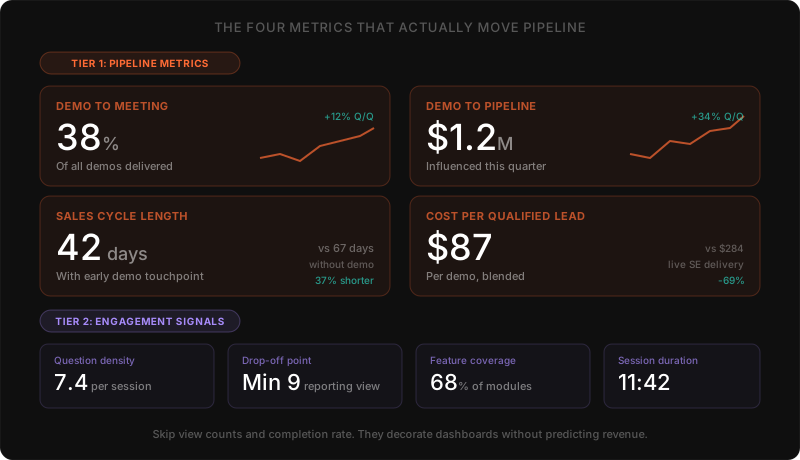
Not all demo metrics carry equal weight. Organizing them into tiers prevents teams from drowning in data while missing the signals that drive decisions.
Tier 1: Pipeline metrics
These are the numbers your VP of Sales and CFO care about. Everything else is in service of moving these.
Demo-to-opportunity conversion rate. Of all demos delivered, what percentage result in a qualified opportunity? This is the single most important demo metric. Industry benchmarks vary wildly by segment, SMB self-serve demos might convert at 5-10%, while enterprise rep-led demos convert at 30-50%. The number matters less than the trend. If conversion is declining quarter over quarter, something in the demo experience is broken.
Pipeline influenced by demos. Total dollar value of open pipeline where a demo touchpoint exists in the buyer journey. This requires connecting your demo platform to your CRM, which sounds simple and is not. Tracking pipeline influence tells you whether demos are pulling their weight relative to other activities like content, events, or outbound.
Sales cycle impact. Compare cycle length for deals that included an early demo versus those that did not. If demos shorten the cycle, that is a dollar value you can quantify. If they don't, you are running demos for comfort rather than impact.
Tier 2: Engagement metrics
These tell you what is happening inside the demo, the behavioral signals that predict whether a prospect will convert.
Session duration. How long did the prospect stay? But be careful, longer is not always better. A 45-minute session could mean deep engagement or it could mean the prospect was confused and stuck. Session duration only means something in context.
Feature coverage. Which product areas did the prospect explore? If every prospect skips your reporting module and goes straight to integrations, that tells you what buyers actually care about, regardless of what your positioning says.
Question depth and frequency. This one is underrated and most platforms cannot measure it. In a text-based or voice-enabled demo, tracking how many questions a prospect asks, and what they ask about, is a direct signal of buying intent. A prospect who asks three questions about SSO configuration and compliance certifications is further down the funnel than one who asks "so what does this do?"
Completion rate. Yes, after calling it vanity, there is a place for completion rate, but only as a diagnostic tool. Low completion rates tell you that something in the demo experience is losing people. It does not tell you whether the demo is working. A prospect who drops off at minute two after seeing enough to book a call is more valuable than one who watches the entire thing and never returns.
Tier 3: Operational metrics
Operational metrics answer a different question: is your demo machine running efficiently?
Time-to-demo. How long between a prospect expressing interest and actually experiencing the product? For scheduled demos, this averages three to seven business days. For on-demand AI demos, it is zero. The gap between these two numbers is where pipeline leaks.
Demos per rep per week. A capacity metric. If reps are maxed at five demos a day and demand exceeds that, you have a coverage problem, and reps start burning out, leading to demo fatigue on both sides of the call. Track this alongside conversion rate, more demos per rep often correlates with lower quality per session.
Cost per demo. Combine rep time, tool costs, and overhead to arrive at a per-session cost. Then divide pipeline influenced by total demo cost to get your demo ROI. If the number looks bad, the answer is either fewer, better demos, or a lower-cost delivery method.
No-show rate. The percentage of scheduled demos where the prospect does not appear. Industry average runs 20-30%. Every no-show is a wasted prep cycle. If your no-show rate exceeds 25%, the scheduling process itself is the problem, prospects are not ghosting you because they lost interest, they are ghosting because the gap between intent and demo is too long.
What different demo formats can measure
Here is the part that most demo analytics content ignores: the format determines the ceiling on what you can measure. Not every demo type captures the same data, and pretending otherwise leads to bad comparisons.
| Demo format | Best for | Limited by |
|---|---|---|
| Click-through product tours | Drop-off points, A/B testing tour flows, which features draw initial interest | No conversational data, no intent signals, cannot tell engaged attention from passive clicking |
| Recorded video demos | Content optimization, which segments hold attention, distribution effectiveness | Passive medium, no interaction data, no qualification signals |
| Live rep-delivered demos | Nuanced qualification, relationship context, competitive intelligence, if reps log it | Inconsistent capture, rep-dependent quality, hard to standardize or benchmark |
| AI voice demos | Full recording, complete transcripts, intent signals, behavioral patterns, question analysis | Captures everything, the gap to other formats is closer to an order of magnitude |
Click-through product tours
Platforms like Navattic and Storylane capture click-level data, which hotspot the prospect clicked, how far through the tour they progressed, and where they dropped off. The data is clean but shallow. You know what they clicked. You do not know why. You cannot tell whether a prospect paused on a screen because they were reading carefully or because they got distracted by Slack. And since the experience is linear, "engagement" really just means "kept clicking."
Best for: measuring drop-off points, A/B testing tour flows, identifying which features draw initial interest.
Limited by: no conversational data, no intent signals, no way to distinguish engaged attention from passive clicking.
Recorded video demos
Video platforms provide play rate, watch time, drop-off curves, and sometimes heatmaps of which segments get replayed. This is useful for optimizing the video itself but tells you almost nothing about the viewer's intent or readiness to buy. Someone who watches your entire demo video might be a serious buyer or a competitor doing research. The analytics cannot distinguish between the two.
Best for: content optimization, identifying which segments hold attention, measuring distribution effectiveness.
Limited by: passive medium with no interaction data, no qualification signals, no way to capture what the viewer actually wanted to learn.
Live rep-delivered demos
Paradoxically, the highest-touch demo format often produces the worst analytics. What gets captured depends on the rep's CRM discipline, demo notes, call recordings if the platform allows it, and whatever the rep remembers to log. Some organizations use conversation intelligence tools like Gong or Chorus to analyze calls, which adds a layer of data. But the analytics are retrospective and inconsistent. Every rep captures different things at different levels of detail.
Best for: nuanced qualification signals (if reps log them), relationship context, competitive intelligence from live objection handling.
Limited by: inconsistent capture, rep-dependent quality, difficult to standardize or benchmark.
AI voice demos
This is where the data gap gets interesting. An AI demo agent that runs on live browser automation, Playwright driving a real browser session through Browserbase, captures everything. And I mean everything:
- Full session recording via rrweb, every click, scroll, navigation action, and page state change, replayable frame by frame
- Complete conversation transcripts, speech-to-text via Deepgram captures every question the prospect asked and every answer the agent gave, with millisecond timestamps
- Intent signals, what features the prospect asked to see, in what order, and how deeply they explored each one
- Behavioral patterns, did the prospect interrupt the agent to jump ahead? Did they ask to revisit something? Did they go quiet after seeing pricing?
- Question analysis, natural language processing on the transcript reveals whether questions were exploratory ("what can this do?") or evaluative ("does this integrate with Salesforce?") or procurement-focused ("what are your compliance certifications?")
The contrast is stark. A click-through tour tells you someone viewed five screens. An AI voice demo tells you that a Director of IT at a 500-person company spent four minutes asking about SSO, interrupted the agent to see the admin panel, asked a specific question about SOC 2 compliance, and then asked "what would implementation look like for a team our size?" That second dataset is not just analytics, it is a sales brief.
A clean comparison across formats: click-through tours capture which steps a prospect clicked and where they dropped off, but no signal on intent or questions. Video demos add watch-time per segment and rewatch behavior, with the same blindness on intent. Live rep demos capture whatever the rep manually logs in CRM, typically a paragraph after the call, filtered through the rep's interpretation. AI voice demos capture all of the above plus a full conversation transcript, the questions actually asked (verbatim), the features explored in priority order, the objections raised, the competitors mentioned, and the navigation path the agent took. The intelligence gap between the formats is not 2x, it is closer to an order of magnitude.
Building a demo analytics framework
Collecting data is not the same as having a framework. Here is a four-step approach that connects demo activity to business outcomes.
Step 1: Define your demo-to-pipeline path
Before touching a dashboard, map the journey from demo to closed deal. For most B2B companies, it looks something like:
Demo session → Follow-up action (meeting booked, trial started, content downloaded) → Qualified opportunity → Pipeline stage progression → Closed-won
Every step in this path needs a tracking mechanism. The most common failure point is the handoff between "demo happened" and "opportunity created." If those two systems do not talk to each other, you will never connect demo activity to revenue.
For AI-powered demos, this handoff can be automated, the demo agent passes session data, transcript highlights, and qualification signals directly to the CRM. For rep-delivered demos, it depends on the rep logging the right fields.
Step 2: Establish baselines before optimizing
You cannot improve what you have not baselined. Spend 30 days collecting data without changing anything. Measure:
- How many demos are delivered per week, by format
- Conversion rate from demo to next stage
- Average session duration
- Feature coverage distribution
- Drop-off points (for self-serve formats)
Resist the urge to optimize during this phase. The purpose is to understand your current state, not to fix it yet. Teams that skip baselining end up chasing improvements against imaginary benchmarks.
Step 3: Segment and compare
Aggregate numbers hide the real story. Slice your demo data by:
- Prospect segment, enterprise vs. mid-market vs. SMB. Demo behavior and conversion rates vary dramatically across segments.
- Demo format, if you run multiple formats, compare them on the same metrics. Which format produces higher demo-to-opportunity conversion? Which captures richer data for reps?
- Entry point, did the prospect come from a paid ad, an organic search, a sales email, or a partner referral? Entry point predicts intent, and intent predicts demo outcomes.
- Time of engagement, when are prospects taking demos? If your AI demos show peak usage at 9 PM on Tuesdays, that tells you something about your buyers that no survey would surface.
Step 4: Build feedback loops
Analytics that sit in a dashboard are worthless. The data needs to flow into three places:
Sales enablement. Demo transcripts and behavioral data should inform how reps prepare for follow-up conversations. If the prospect spent eight minutes on reporting and zero minutes on integrations during their AI demo, the rep should open with reporting.
Product marketing. Aggregate demo data reveals what prospects care about in practice, not in theory. If 70% of prospects ask about a feature that gets three lines in your marketing copy, that is a positioning gap.
Product development. Feature coverage data shows which parts of the product generate interest and which get skipped. This is a direct signal for roadmap prioritization, more reliable than feature requests because it reflects actual exploration behavior rather than stated preferences.
Common analytics mistakes
After working with demo data across different formats and team sizes, these are the patterns that keep showing up.
Tracking activity instead of outcomes
The most popular demo dashboard in the world is a count of demos delivered. It feels productive. It tells you nothing about whether those demos generated value. A team that delivers 200 demos and creates 10 opportunities is performing worse than a team that delivers 50 and creates 15. Activity metrics belong in Tier 3, not on the executive slide.
Ignoring the data you already have
Plenty of teams running Consensus or other demo platforms have years of engagement data sitting untouched. They bought the tool, set it up, and never built the reporting layer. If you already capture demo data, audit what exists before buying something new.
Comparing formats on the wrong metrics
Click-through tour completion rate and live demo conversion rate are not comparable metrics. They measure different things at different stages of the funnel. Comparing them is like comparing email open rate to close rate, technically both are percentages, but the analogy stops there.
A better approach: compare formats on downstream impact. Which format produces more qualified opportunities per 100 sessions? Which results in faster time-to-close? Those are apples-to-apples comparisons.
Measuring demos in isolation
Demos do not happen in a vacuum. A prospect who watches two competitor demos before yours will behave differently from one who comes in fresh. Attribution models that give full credit to the demo ignore every other touchpoint that shaped the buyer's journey. Use multi-touch attribution or, at minimum, acknowledge that demo metrics are part of a larger system.
Over-indexing on completion rate
We said it at the top and it bears repeating. A prospect who watches 100% of a demo and never converts is less valuable than one who watches 30%, gets excited, and books a meeting. Completion rate measures endurance, not intent. Use it as a diagnostic for experience quality, not as a KPI.
Advanced: Using demo data to improve sales conversations
Here is where the real value lives, and where AI demos create a feedback loop that other formats cannot match.
When a prospect completes an AI voice demo, the system generates a session package: a replayable recording, a full transcript, tagged intent signals, and a summary of what the prospect explored and asked about. Because the entire session runs over a WebSocket connection with an 800ms latency target for voice responses, the conversation data is captured in real time, there is no post-processing delay. This package goes to the assigned rep before the follow-up call.
Pre-call intelligence
Instead of opening with "Tell me about your current setup," the rep already knows:
- Which features the prospect explored and for how long
- Specific questions they asked (verbatim from the transcript)
- Where they seemed confused or disengaged
- Whether they asked about pricing, compliance, integrations, or implementation timeline
- How their exploration pattern compares to other prospects in the same segment
This turns a cold follow-up into a warm, informed conversation. The rep can say: "I saw you spent some time looking at our reporting module and asked about custom dashboards, want me to walk you through a few examples that match what you described?" That is a different conversation from "So, what did you think of the demo?"
Coaching from aggregate patterns
When you have hundreds of AI demo transcripts, patterns emerge that no single rep would notice:
- Questions that correlate with high conversion ("What does implementation look like?" is usually a stronger signal than "How much does it cost?")
- Feature exploration sequences that predict deal size
- Objections that appear early in winning deals versus losing ones
- Specific language patterns that indicate a prospect is in active evaluation versus casual browsing
A paragraph of honesty here: we built RaykoLabs because we were frustrated by how little data traditional demos produced. A rep does a great demo, the deal closes, and nobody can tell you exactly what happened during that demo that made the difference. Was it the reporting walkthrough? The competitive comparison? The answer to that one question about API limits? With AI demo agents, every session is instrumented. We can tell you that prospects who ask about integrations within the first three minutes convert at 2x the rate of those who don't. That kind of signal was invisible before because nobody was recording and analyzing every demo interaction at scale.
Feeding insights back into the demo itself
The best part of having rich demo analytics is that the data improves the demo over time. If analytics show that 60% of prospects drop off during the onboarding walkthrough, you shorten it. If a specific question keeps appearing in transcripts, you add the answer to the agent's knowledge base so it handles it proactively. If enterprise prospects consistently ask about SSO before anything else, you create a demo path that leads with SSO for enterprise segments.
This creates a compounding effect. Better demos produce better data. Better data produces better demos. Over quarters, the gap between an analytics-informed demo experience and one running on gut feel becomes enormous.
A representative anonymized example from a recent deployment: a Series B B2B SaaS customer reviewed the first 200 voice demo transcripts and noticed that 60% of prospects were asking about a specific integration the marketing site barely mentioned. They moved that integration to the homepage hero, added a dedicated /integrations page, and re-tuned the agent to surface that capability earlier in the demo flow. Within 30 days, demo-to-opportunity conversion lifted by roughly 35%, and the qualified-pipeline number for that integration's adjacent feature set roughly doubled. The intelligence layer paid back in weeks, not quarters, because the data made an invisible problem visible.
Closing: measure what moves pipeline
The demo analytics space is still early. Most teams are either measuring nothing or measuring everything without a framework to make it useful. The gap between those two states is where pipeline goes to die.
Here is the opinion: within two years, demo analytics will be as mature and expected as marketing attribution. The companies building that muscle now, tracking demo-to-pipeline conversion, segmenting by format and persona, using AI demo transcripts as sales intelligence, will have a structural advantage over those who are still counting demo views and calling it a metric.
Stop measuring whether prospects watched. Start measuring whether demos made them buy.
The tools exist. The frameworks are here. The only question is whether your team will use them, or keep staring at a dashboard that shows 500 views and tells you nothing about what happened next.
For a deeper look at how AI demos work under the hood, start with our guide to AI demo agents. To understand the economics behind different demo approaches, read the ROI breakdown. And if you want to see what analytics-rich demos look like in practice, see how RaykoLabs works.
September 2026 check: what should teams revalidate in demo analytics?
Revalidate the pipeline link, not the dashboard polish. Demo to meeting, demo to pipeline, cycle length with demo influence, and qualified lead cost per demo remain the decisions that matter. Engagement signals still serve pipeline metrics, and completion rate still works only as a diagnostic.
We rechecked the cited hubs in September 2026, including the Pendo resources hub, the Salesforce State of Sales hub, the Gartner buying journey hub, the Forrester research hub, and the HubSpot sales hub. They remain sound background for self serve behavior and cost pressure on sales teams. The format ceilings in this post also hold. Click tours still show steps without intent, video still shows watch time without questions, rep notes still vary by discipline, and voice demos still capture transcripts and exploration order.
Keep the four step framework as written. Map demo to closed won before touching dashboards, baseline for 30 days without optimizing, segment by prospect type and entry point, and feed transcripts into pre call briefs and content gaps. No metric definition in this post required removal in September 2026.
Frequently asked questions
Do interactive demos actually convert leads into customers?
Yes, but the conversion rate depends heavily on demo format and stage placement. Industry data from Navattic, Storylane, and Arcade benchmarks shows interactive demos convert 4 to 6x better than recorded videos and 30 to 50 percent better than scheduled live demos for top-of-funnel traffic. Email capture rates lift 2 to 3x when prospects can engage with the product before talking to sales. The honest caveat: this is a top-of-funnel improvement. Closed-won conversion still depends on rep skill, ICP fit, and pricing. Interactive demos increase the volume and quality of warm leads entering the pipeline. They do not close deals on their own.
How do I measure interactive demo performance and ROI?
Measure four things: demo-to-meeting conversion rate, demo-to-pipeline conversion rate, average sales cycle length when a demo is in the path, and qualified-lead-cost per demo. ROI math is (incremental pipeline value from demos minus platform cost) divided by platform cost. For a team running Storylane at $1,200 per month that drives 30 incremental opportunities per quarter at a $30,000 average ACV with 20 percent close rate, incremental revenue is $180,000 per quarter against $3,600 in platform cost. Avoid measuring views, time-on-screen, or completion rate as ROI proxies. They are vanity metrics that decorate dashboards without predicting revenue.
What interactive demo analytics metrics actually matter?
Four metrics drive pipeline decisions. Demo-to-meeting conversion rate tells you whether the demo is qualifying or repelling. Demo-to-pipeline conversion rate tells you whether qualified prospects are actually buyers. Sales cycle length with versus without demo influence tells you whether demos are speeding deals or just adding friction. Qualified-lead-cost per demo tells you whether traffic to the demo is paying back. Skip view count, completion rate, and time-on-screen for ROI work. They correlate weakly with revenue and tempt teams to optimize for engagement that does not translate to closed business.
How do I measure success with AI demo software?
Define success before launch, not after. The three baseline metrics to capture pre-launch are average time from form-fill to first rep contact, conversion rate from form-fill to discovery call, and conversion rate from discovery call to opportunity. After launching AI demo software like Rayko, Saleo, or Supersonik, track the same three metrics weekly for 90 days. Successful deployments hit response time under 60 seconds, lift form-to-discovery conversion 30 to 60 percent, and hold or improve discovery-to-opportunity conversion. If the AI is reducing cost but tanking discovery-to-opportunity rates, the qualification flow is misconfigured. Tune the questions, not the tool.
What sales metrics improve most with automation?
Three metrics show the biggest delta. Response time drops from hours or days to under 60 seconds, which the MIT InsideSales study showed is a 9x lift in qualification odds versus a 30-minute wait. Rep capacity increases 3 to 5x because reps stop spending 6 to 12 hours per week on first-touch walkthroughs. Cost per opportunity falls 50 to 70 percent because automation scales without hiring. Conversion rates improve too, but more modestly, typically 20 to 40 percent within 90 days. The metric that does not improve much from automation is closed-won rate, which still depends on rep closing skill, pricing, and ICP fit. Automation feeds the funnel; humans close the deals.
Sources
- Product Engagement Benchmarks, Pendo
- State of Sales, Salesforce Research
- The B2B Buying Journey, Gartner
- Marketing Attribution Research, Forrester
- Sales Statistics and Benchmarks, HubSpot
Cite this article
Utkarsh Agrawal. "Demo Analytics: The Complete Guide for B2B Sales." RaykoLabs Blog, March 13, 2026. https://raykolabs.com/blog/demo-analytics-complete-guide

Utkarsh Agrawal is CTO of RaykoLabs, where he leads engineering on Rayko, the AI demo agent that runs live, voice-enabled product demos in a real browser for B2B SaaS teams. His work spans real-time voice interaction, browser automation with Playwright and Browserbase, speech-model orchestration, and the infrastructure that keeps autonomous demos reliable around the clock. On the RaykoLabs blog he writes practical guides on voice-enabled product demos, demo automation, and what it takes to ship production AI agents for sales: how to qualify prospects mid-demo, how to measure demo performance, and how buying teams actually evaluate demo software. His comparisons of demo platforms are built from hands-on testing and vendor documentation, with trade-offs stated plainly so buyers can decide fit.
See RaykoLabs in action
Watch an AI agent run a live, personalized product demo, no scheduling, no waiting.
START LIVE DEMO