Loading...

2026 Demo No-Shows: Stop Ghosting, Book More Demos
Learn why prospects ghost scheduled demos and how on-demand AI demos remove the wait. See the playbook that protects pipeline. Read the guide now.
Quick answer
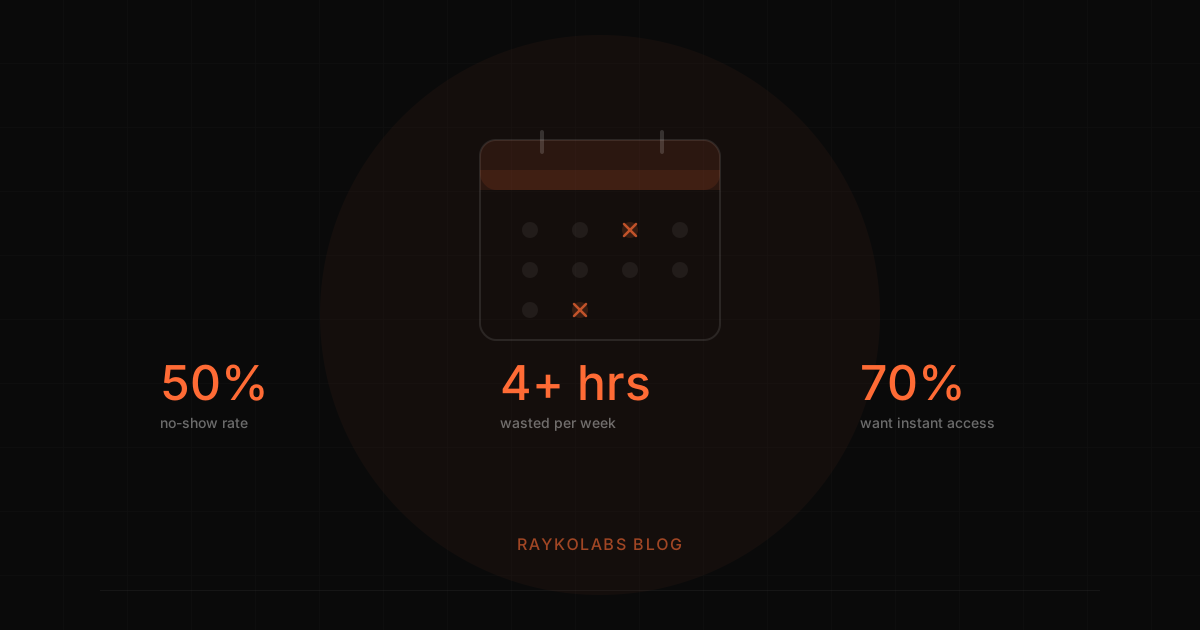
Prospects ghost scheduled demos because the traditional model makes them wait when they want to act. 30 to 50 percent of scheduled demos end in no-shows, and 70 percent of demo requesters want the product now, not in three days. The causes: timing gap, calendar friction, commitment anxiety, the problem solving itself, and format mismatch. The fix is not better reminders but on-demand product access that removes the wait.
Want this running on your product? Rayko demos it live, with your prospects asking questions by voice.
START LIVE DEMOWe built RaykoLabs because we watched our own sales team lose 40% of scheduled demos to no-shows. The math was brutal: five demos booked, three actually happened, and only one converted. That means for every closed deal, four time slots were wasted on dead air.
This is not a RaykoLabs-specific problem. It is the default state of B2B sales.
The no-show problem by the numbers
- 30 to 50% of scheduled demos result in no-shows
- The average sales rep spends 4+ hours per week prepping for demos that never happen
- 70% of prospects who request a demo want to see the product right now, not three days later
- Most sales orgs treat no-shows as a scheduling problem. They are not. They are a product access problem.
When the ghosting happens inside a click-through tour rather than on the calendar, compare notes with these interactive demo conversion mistakes. In our first 90 days of production traffic, on-demand AI demos average a 65-80% completion rate (a session counted as complete once the prospect engages for at least three meaningful turns and explores at least two product areas). Scheduled rep-led demos, by contrast, attend at 70-80% but only after netting out the 20-30% no-show rate that Bridge Group's annual SDR Metrics Report has tracked steadily for the better part of a decade. The difference: an AI demo's "no-show rate" is structurally zero, because there is no time gap to no-show across.
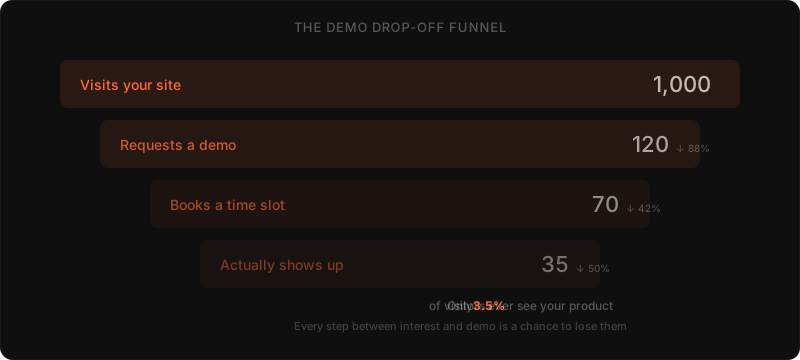
The gap between when a buyer is interested and when they actually get to see your product is where deals go to die. If you are still relying on the book-a-call model, read our complete guide to AI demo automation to understand what the alternative looks like.
Why prospects disappear
1. The timing gap
A prospect visits your site at 10 PM on a Wednesday. They are curious, engaged, and ready to explore. Your form says "Book a demo" and the earliest slot is Thursday afternoon. By then, they have moved on to a competitor who showed them something immediately.
2. Calendar friction
Booking a demo in 2026 still often looks like: fill out a form, wait for an SDR email, click a Calendly link, find a mutual time, get a calendar invite, remember to show up. Six steps. Each one is a drop-off point. We have seen funnels where fewer than 8% of form-fillers actually attend a demo.
3. Commitment anxiety
Here is a take most sales leaders won't like: prospects are right to ghost you. Scheduling a 30-minute call with a sales rep is a bad deal for the buyer. They risk being pitched to, pressured, or added to a relentless follow-up sequence, all before they even know if your product does what they need. The rational move is to poke around on their own first. If your demo model punishes that instinct, you are filtering out your smartest buyers.
4. The problem solved itself
Between requesting the demo and the actual call, the prospect found the answer elsewhere, chose a competitor, or lost interest. The urgency evaporated. This is why voice-enabled demos that launch instantly outperform the scheduled model, they catch people in the moment of intent.
5. They only wanted to see one thing
Not every prospect needs a full 30-minute walkthrough. Some just want to see your reporting dashboard, or check whether you integrate with Salesforce. A scheduled demo is overkill for that. They ghost because the format does not match the question.
Each reason maps to a fix:
| Reason prospects ghost | The fix |
|---|---|
| The timing gap | On-demand product access at the moment of intent |
| Calendar friction | Remove the multi-step booking flow, launch instantly |
| Commitment anxiety | Let buyers explore on their own before any rep call |
| The problem solved itself | Catch the prospect in the moment, no wait to decay |
| They only wanted to see one thing | Self-serve experience that answers the single question |
What high-performing teams do differently
Instant access over scheduled calls
Instead of gating the product behind a calendar, leading companies offer on-demand product experiences. At RaykoLabs, we use Playwright for browser automation and Browserbase for cloud-hosted browser sessions so that a prospect can launch a live demo of your actual product in under two seconds, no scheduling, no waiting. The AI demo agent handles the rest.
Async-first, live-second
The first touch does not need to be a live call. Give prospects a self-serve experience that answers their initial questions. Reserve live rep time for prospects who have already seen the product and have specific, qualified questions. Your reps become closers, not tour guides. See human vs. AI demos for how this division of labor plays out.
Always-on availability
Your best prospects might be in a different timezone or browsing at midnight. If your demo experience requires a human to be online, you are missing windows that never reopen. Voice-first buyer experiences work around the clock.
Reducing no-shows starts with removing friction
The more steps between "I'm interested" and "I can see the product," the more people you lose.
Here is a practical framework:
- Audit your current flow, count every step from first click to product visibility. Each step is a drop-off point.
- Offer an instant option, even if you keep scheduled demos, add an "Explore now" path for people who want to see the product immediately. This is table stakes now, not a differentiator.
- Follow up with context, if a prospect interacted with your product asynchronously, your rep already knows what they cared about. The follow-up call becomes a closing conversation, not a discovery call.
- Track engagement, not just bookings, demo requests are a vanity metric. Track who actually saw your product and what they did with it.
- Measure time-to-demo, not time-to-meeting, the metric that correlates with closed deals is how fast someone sees your product, not how fast an SDR books a slot.
For most teams we have shipped this for, time-to-demo collapses from a three-to-five business-day average down to roughly two to ten seconds, bounded by network latency on the voice pipeline rather than by anything human. The internal benchmark we hold ourselves to on the agent's first response is 800ms end-to-end (Deepgram streaming STT, the LLM reasoning layer, Playwright executing the navigation, and Cartesia streaming the voice response back). When the prospect's question is "show me the audit logs," they hear the agent acknowledge and watch the navigation start before they have finished their next sentence.
After building a three-layer navigation system, context detection, navigation planning, and LLM integration, we learned something counterintuitive about demo no-shows: the problem was never about reminders or calendar hygiene. It was about the entire concept of making someone wait. Once we eliminated the wait, the no-show metric became irrelevant. You cannot ghost a demo that starts the moment you click.
Stop optimizing for attendance. Optimize for access.
Prospects ghost demos because the traditional model asks them to wait when they want to act. The fix is not better reminder emails or more aggressive follow-up. It is giving people what they came for, a look at your product, the moment they show up.
In the cohorts we have measured, two to four times more prospects reach an actual product experience once on-demand voice demos are live, compared to the prior scheduled-only baseline. Most of that gain isn't reps who showed up better; it's the previously-invisible segment of buyers who never made it onto a calendar at all, late-night browsers, time-zone mismatches, executives who treat the scheduling round-trip as a soft "no." Removing the wait turns out to be the highest-leverage demo metric a B2B team can move.
If you want to see how AI demo agents reduce the sales cycle, start by rethinking whether your no-show problem is a symptom of a deeper access problem. It almost always is.
What to do when budget and timing stall the demo
When budget and timing stall a demo, treat it as a prioritization problem rather than a rejection and offer a low commitment next step that preserves access. Keep the product visible on demand, agree on a concrete revisit trigger tied to planning cycles, and equip the contact with a short recap they can share internally without booking another call.
Budget stalls rarely mean the problem went away. They usually mean another initiative won this quarter, the owner of the budget has not yet felt the pain, or the buyer cannot yet describe the return in language finance accepts. Pushing for a close in that moment creates ghosting. Offering a smaller path forward keeps you in the room.
Practical moves that help:
- Replace the next full demo with a focused review of one workflow tied to a cost the buyer already tracks, such as hours spent on manual setup, rework after handoffs, or delays waiting for specialist help.
- Agree on a revisit trigger in writing, such as the next planning review, a headcount change, or the renewal date of a workaround tool, and set the follow up around that event rather than around a vague check in.
- Leave behind an on demand path so the evaluation can continue without a calendar commitment. An on demand product experience lets a skeptical stakeholder explore privately, which is often what unlocks budget faster than another group call.
- Send a one page recap the contact can forward, covering the problem in their words, the workflow shown, open questions, and suggested next step. Champions lose momentum when they must re explain your value from memory.
What to do when your champion quits mid cycle
When your champion quits mid cycle, protect the deal by mapping the full buying group early and keeping product knowledge outside any single inbox. Rebuild quickly around the remaining stakeholders, re confirm the business problem in their language, and offer a short re orientation so the new contact does not inherit a stale thread and go quiet.
Single threaded deals die on job changes. The fix starts before anyone leaves. From the first call, ask who else feels the pain, who owns the budget, and who would block a change. Capture notes, transcripts, and session context where the next rep or the next champion can find them, not only in private messages.
If the departure already happened:
- Ask the outgoing champion for a warm introduction to the person inheriting the problem, plus a plain language summary of what was agreed and what remained open.
- Re qualify the problem with the new contact rather than replaying the old demo verbatim. Priorities often shift with ownership, and repeating the same walkthrough signals that you were selling a person, not solving a problem.
- Offer a brief catch up demo that the new stakeholder can drive. Let them name the workflows they care about, and use a voice led walkthrough or a short live review so they build their own understanding instead of watching a recording of someone else's questions.
- Confirm access to the product experience stays live for the account so evaluation does not pause while you rebuild the thread. Continuity of access matters more than continuity of meetings.
How to break a no decision stall after a good demo
When a good demo ends in no decision, narrow the choice, name the cost of standing still, and propose a reversible next step with a clear owner and date. Prospects stall when every option feels risky and doing nothing feels safe, so your job is to make the next move small, concrete, and easy to defend internally.
No decision is different from losing to a competitor. The buyer liked the product but could not build consensus, could not picture rollout, or feared the internal effort more than they valued the gain. More features will not fix that. Clarity about scope and effort will.
Ways to restart movement:
- Summarize the decision in one paragraph: the problem agreed, the workflow validated, the open concern, and the single next action with a name and date. Vague next steps produce vague outcomes.
- Offer a bounded pilot scoped to one team, one workflow, or one time window, with success criteria written before it starts. A pilot that anyone can explain is easier to approve than a broad rollout that no one can picture.
- Bring the missing stakeholder into the product directly instead of through slides. A finance lead, security reviewer, or operations owner who explores the relevant area firsthand raises fewer late objections than one who only saw a forwarded summary. See how buying committees use AI demos for ways to give each role its own path.
- Name the status quo cost in the buyer's own terms, such as repeated manual work, slow handoffs, or reliance on one specialist. Avoid pressure tactics. A calm statement of what continues if nothing changes helps a cautious group choose a small step over indefinite delay.
Verdict: Give buyers instant product access or keep losing scheduled demos to ghosting
Prospects ghost demos because scheduling forces a wait when they want to see the product now. The reliable fix is an on demand AI demo next to the booking form, with live calls reserved for qualified buyers with specific questions.
Keep reminders and calendar hygiene, but do not rely on them alone. Access removes the timing gap and commitment pressure that cause most no shows. Track time to first product view alongside attendance to see the lift.
Frequently asked questions
How common are demo no-shows in B2B sales?
Between 30 and 50 percent of scheduled demos result in no-shows, and the average sales rep spends four or more hours per week prepping for demos that never happen. Bridge Group's annual SDR Metrics Report has tracked a steady 20 to 30 percent no-show rate for the better part of a decade. Most sales orgs treat no-shows as a scheduling problem, but they are not, they are a product access problem: 70 percent of prospects who request a demo want to see the product right now, not three days later. The gap between when a buyer is interested and when they actually get to see your product is where deals go to die.
Why do prospects disappear after requesting a demo?
Five reasons. The timing gap: a prospect visits at 10 PM ready to explore, but the earliest slot is tomorrow afternoon and by then they have moved to a competitor. Calendar friction: booking still means fill a form, wait for an SDR email, click a Calendly link, find a mutual time, get an invite, and remember to show up, with each step a drop-off point, and some funnels see fewer than 8 percent of form-fillers attend. Commitment anxiety: scheduling a call with a rep risks being pitched and pressured before they know the product fits. The problem solved itself between request and call. And they only wanted to see one thing, so a 30-minute walkthrough is overkill.
Are prospects right to ghost a scheduled demo?
Often, yes. Scheduling a 30-minute call with a sales rep is a bad deal for the buyer: they risk being pitched, pressured, or added to a relentless follow-up sequence, all before they even know whether the product does what they need. The rational move is to poke around on their own first. If your demo model punishes that instinct, you are filtering out your smartest buyers. The traditional model forces a wait when the buyer wants to act, and the loss is largely invisible because you never get a notification for the prospect who never made it onto a calendar at all.
What do high-performing teams do differently about no-shows?
Three things. Instant access over scheduled calls: instead of gating the product behind a calendar, they offer on-demand product experiences where a prospect can launch a live demo of the actual product in seconds with no scheduling or waiting. Async-first, live-second: the first touch is a self-serve experience that answers initial questions, and live rep time is reserved for prospects who have already seen the product and have specific qualified questions, so reps become closers rather than tour guides. And always-on availability, because best prospects are often in a different timezone or browsing at midnight, and a demo that requires a human online misses windows that never reopen.
How do I reduce demo no-shows in practice?
Follow a five-step framework. Audit your current flow and count every step from first click to product visibility, since each step is a drop-off point. Offer an instant option, an Explore now path for people who want to see the product immediately, which is now table stakes rather than a differentiator. Follow up with context, because if a prospect interacted with your product asynchronously the rep already knows what they cared about and the call becomes a closing conversation. Track engagement, not just bookings, since demo requests are a vanity metric. And measure time-to-demo, not time-to-meeting, because how fast someone sees your product is the metric that correlates with closed deals.
Sources
- SaaS Sales Development Metrics, Bridge Group
- State of Sales, Salesforce Research
- The B2B Buying Journey, Gartner
- B2B Marketing and Sales Research, Forrester
- Sales Statistics and Benchmarks, HubSpot
Cite this article
Utkarsh Agrawal. "2026 Demo No-Shows: Stop Ghosting, Book More Demos." RaykoLabs Blog, March 3, 2026. https://raykolabs.com/blog/why-prospects-ghost-your-demos

Utkarsh Agrawal is CTO of RaykoLabs, where he leads engineering on Rayko, the AI demo agent that runs live, voice-enabled product demos in a real browser for B2B SaaS teams. His work spans real-time voice interaction, browser automation with Playwright and Browserbase, speech-model orchestration, and the infrastructure that keeps autonomous demos reliable around the clock. On the RaykoLabs blog he writes practical guides on voice-enabled product demos, demo automation, and what it takes to ship production AI agents for sales: how to qualify prospects mid-demo, how to measure demo performance, and how buying teams actually evaluate demo software. His comparisons of demo platforms are built from hands-on testing and vendor documentation, with trade-offs stated plainly so buyers can decide fit.
See RaykoLabs in action
Watch an AI agent run a live, personalized product demo, no scheduling, no waiting.
START LIVE DEMO