Loading...

AI Demo Security and Compliance: What You Need to Know
Security and compliance questions about AI demo agents, data handling, SOC 2, GDPR, session isolation, and how to evaluate AI demo vendors.
Quick answer
AI demo security depends on the surrounding architecture, not the AI itself. Verify three things: session isolation, where each prospect's demo runs in a dedicated cloud browser tenant; data handling, where transcripts use configurable retention, voice audio is never persisted, and customer conversations are contractually excluded from model training; and enterprise posture, including SOC 2 Type II, a DPA, and GDPR data residency. Always get the vendor's data-flow diagram first.
Want this running on your product? Rayko demos it live, with your prospects asking questions by voice.
START LIVE DEMOThe first question every enterprise security team asks us: "Where does the data go?"
Not "how does the AI work" or "what can the agent demo." The data question. Every single time.
We lost a deal to a competitor once because we couldn't answer the CISO's question about session data isolation on the spot. That conversation redesigned our architecture. Now session isolation is enforced at the infrastructure level using Browserbase cloud browsers, each demo gets its own container with process-level, network-level, and memory-level isolation. When the session ends, the container is destroyed. Nothing persists unless explicitly configured.
This post covers the security and compliance questions that AI demo agents must answer, how we address them at RaykoLabs, and what to ask when evaluating any vendor in this space.
Common security concerns
Does prospect data go to the LLM?
When a prospect interacts with an AI demo agent, asking questions, providing context about their company, describing their use case, that conversational data is processed by a large language model to generate responses.
Three questions matter: Is that data persisted? Is it used for model training? Who has access to it?
Responsible AI demo platforms use LLM providers with enterprise data agreements that exclude customer data from model training. Conversational data is processed in real time and retained only as long as needed for the session, with configurable retention policies for analytics.
In our own deployments, the LLM layer runs on enterprise-tier API contracts that explicitly carve customer prompts out of any training data set. Session transcripts default to a 30-day retention window, long enough for the customer's sales team to review conversations, short enough that nothing lingers, and customers in regulated industries can set retention to as low as zero, in which case nothing past the live session window persists at all. The voice audio itself is never stored: Deepgram's streaming endpoint discards the raw audio after transcription, and Cartesia generates output speech without any persistent buffer.
What about the product data visible in the browser?
The AI agent analyzes page content to understand where it is in the product and what it is showing. If the demo environment contains sensitive data, that content could be sent to the LLM as part of the context window.
The mitigation is straightforward: demo environments should use synthetic data exclusively. No real customer records, no production credentials, no sensitive business information. The demo instance of your product should be a clean, purpose-built environment populated with realistic but fictional data. This is not just a security best practice, fintech and cybersecurity buyers will specifically test for this during evaluation.
How are demo sessions isolated?
When multiple prospects are running demos simultaneously, each session must be fully independent. One prospect should never see another's interactions, data, or session state.
At RaykoLabs, session isolation is enforced at multiple levels: separate Browserbase cloud browser instances per session, independent authentication contexts, isolated memory and conversation state, and no shared application state between concurrent demos. The browser automation layer creates and destroys containers on a per-session basis, there is nothing to leak because there is nothing that persists.
Session isolation via cloud browsers
Cloud browser infrastructure is the backbone of secure session isolation. Each demo session spins up a dedicated browser instance in an isolated container or virtual machine.
Process isolation. Each browser runs in its own process space. A crash or error in one session cannot affect another.
Network isolation. Each session's browser has its own network context. Cookies, local storage, and session tokens are not shared.
Resource isolation. CPU, memory, and bandwidth are allocated per session. One unusually active demo cannot starve resources from another.
Lifecycle management. When a demo session ends, the browser instance is destroyed completely, memory is freed, cookies are cleared, no residual state remains.
| Isolation layer | What it guarantees |
|---|---|
| Process | Each browser runs in its own process space, a crash in one session cannot affect another |
| Network | Each session has its own network context, cookies, local storage, and session tokens are not shared |
| Resource | CPU, memory, and bandwidth allocated per session, one active demo cannot starve another |
| Lifecycle | On session end the instance is destroyed, memory freed, cookies cleared, no residual state |
This architecture is far more secure than running demos on a shared server where sessions are separated only by application-level logic. Infrastructure-level isolation eliminates entire categories of session leakage vulnerabilities.
Here is something most vendors will not tell you: application-level session isolation (same server, different user contexts) is what most demo platforms actually use. It is cheaper. It is also one misconfigured cookie scope away from leaking session data across prospects. If your vendor cannot explain their isolation model at the infrastructure level, that is your answer.
GDPR considerations
For companies operating in or selling to the European Union, GDPR compliance adds specific requirements to AI demo deployments.
Recording consent
If the demo session is recorded, whether as a video, transcript, or interaction log, the prospect must be informed and given the opportunity to consent. This applies to both voice recordings (processed via speech-to-text services like Deepgram) and text-based interaction logs that could identify an individual.
Present a clear notice at the start of the demo session explaining what is recorded and why. Consent should be affirmative (opt-in), not buried in terms of service. At RaykoLabs, we use rrweb for session recording, which captures DOM mutations rather than screen video, this distinction matters for GDPR because the data captured is structurally different from a video recording.
Data retention
GDPR requires that personal data be retained only as long as necessary for its stated purpose. For demo sessions, this means setting clear retention policies: how long are transcripts kept, when are interaction logs purged, and how is data deleted when a prospect requests it.
AI demo platforms should provide configurable retention periods and automated deletion workflows. A prospect who requests deletion under GDPR Article 17 (right to erasure) should be able to have their demo data removed promptly and completely.
Data processing agreements
If the AI demo vendor processes personal data on your behalf, a Data Processing Agreement (DPA) is required under GDPR. This agreement defines the scope of processing, security measures, sub-processor usage, breach notification procedures, and data subject rights handling.
Evaluate whether your AI demo vendor offers a standard DPA and whether their sub-processors (LLM providers, cloud infrastructure, analytics services) are covered.
Cross-border data transfers
If demo data is processed outside the EU, for example, if the LLM inference runs in US-based data centers, appropriate transfer mechanisms must be in place. Standard Contractual Clauses (SCCs) or adequacy decisions are the most common approaches.
SOC 2 and enterprise readiness
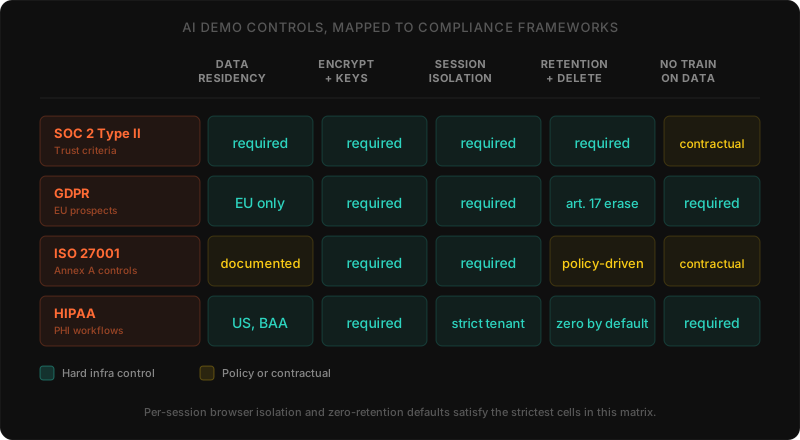
SOC 2 compliance is a baseline expectation for enterprise SaaS vendors. For AI demo platforms, the relevant trust service criteria include:
Security. Access controls, encryption, vulnerability management, and incident response. The platform should encrypt data in transit (TLS 1.2+) and at rest (AES-256 or equivalent), enforce role-based access controls, and maintain an incident response plan.
Availability. Uptime commitments, redundancy, and disaster recovery. Demo infrastructure should have defined SLAs and failover capabilities.
Confidentiality. Controls over how confidential information is collected, stored, and disposed of. This is particularly relevant for demo content that may include product information under NDA.
Processing integrity. Assurance that the system processes data accurately and completely. For AI demos, this means the agent represents the product faithfully and does not fabricate features or capabilities.
When evaluating an AI demo vendor's SOC 2 report, look for a Type II report (which covers a sustained period of operation, not just a point-in-time assessment) and review any noted exceptions or qualifications.
Vendor evaluation checklist
When assessing an AI demo platform's security posture, these are the questions your security team should ask:
1. How is conversational data handled?
Where is it processed? Is it persisted? For how long? Is it used for model training by the LLM provider? What enterprise data agreements are in place?
2. What LLM providers are used, and under what terms?
Which models process demo data? Are enterprise-grade data agreements in place that exclude data from training? Can you choose or restrict which LLM providers are used?
3. How are demo sessions isolated?
Is isolation enforced at the infrastructure level (separate containers/VMs) or only at the application level? How are session artifacts cleaned up after completion?
4. Where is data stored geographically?
Can you specify data residency requirements? Are there options for EU-only or region-specific data processing?
5. What compliance certifications does the vendor hold?
SOC 2 Type II? ISO 27001? GDPR DPA availability? Any industry-specific certifications relevant to your sector?
6. How are demo environment credentials managed?
Where are credentials stored? How are they rotated? What access scope do demo accounts have? Are credentials ever exposed to the LLM or the prospect?
7. What access controls exist for the platform?
Role-based access control? SSO integration? Audit logging? Multi-factor authentication?
8. How is the AI agent's output controlled?
What guardrails prevent the agent from making inaccurate claims? How is hallucination minimized? Can you review and approve the agent's knowledge base?
9. What is the incident response process?
How are security incidents detected, reported, and resolved? What is the notification timeline? Is there a published security contact or bug bounty program?
10. Can the platform be deployed in a private or single-tenant configuration?
For organizations with strict data isolation requirements, is a dedicated deployment option available?
Best practices for deploying AI demos securely
Beyond vendor evaluation, your own deployment practices matter.
Use a dedicated demo environment. Never point the AI agent at your production application. Create a separate instance with synthetic data, limited permissions, and no access to real customer information.
Scope demo credentials narrowly. The account the AI agent uses to log into your product should have the minimum permissions necessary to show the demo workflow. No admin access, no data export capabilities, no ability to modify system settings.
Review the agent's knowledge base. The information you provide to the AI agent becomes what it can share with prospects. Audit this content to ensure it does not include internal-only information, pricing that should not be public, or competitive intelligence you do not want disclosed.
Configure data retention policies. Decide how long demo transcripts and interaction data should be retained. Align this with your broader data retention policy and any regulatory requirements.
Monitor demo sessions. Implement logging and monitoring for demo activity. Unusual patterns, excessive sessions from a single IP, attempts to navigate outside the demo scope, or probing questions that suggest security testing, should trigger alerts.
Establish a review cadence. Review your AI demo deployment quarterly: update credentials, refresh synthetic data, audit the knowledge base, and verify that compliance certifications remain current.
Do not skip the voice pipeline. If your AI demo uses voice interaction, the audio data path needs the same scrutiny as the text path. Speech-to-text providers process audio in real time, confirm that the provider does not retain audio samples for training. At RaykoLabs, our Deepgram integration uses streaming WebSocket connections with no audio persistence.
Customers configure retention anywhere from zero to 90 days. The distribution skews shorter than we initially expected: roughly half of enterprise customers choose 30 days or less, and a meaningful slice of regulated-industry customers (healthcare, fintech, government-adjacent) operate at zero by default and only enable transcripts on demand for specific deals. Long retention is the exception, not the norm, most teams want enough recall to brief a follow-up call and nothing more.
Security as a competitive advantage
For companies selling to enterprise buyers, the security posture of every tool in the sales stack matters. An AI demo platform that handles security and compliance rigorously does not just reduce risk, it accelerates enterprise deals by satisfying procurement requirements before they become blockers.
In our enterprise sales conversations, the security architecture is named as a primary or secondary factor in the buying decision more often than not, by our rough count, the majority of deals over $50K ARR pass through a security review where the demo platform's data-handling posture is itself a line item on the buyer's checklist. The teams that win those reviews tend to lead with infrastructure-level isolation (per-session browsers, no shared model context) rather than with policy documents.
At RaykoLabs, security is a core product requirement. Our architecture, Playwright for browser automation, Browserbase for isolated cloud browsers, FastAPI backend with WebSocket connections for real-time communication, was designed with session isolation and data handling as first-class concerns. When your AI demo agent is the first interaction a prospect has with your company, the trust it builds, or breaks, sets the tone for everything that follows.
For a deeper look at how these security principles apply to specific verticals, see our guides on cybersecurity demos and fintech demo automation.
What should security teams reverify in September 2026?
The control list in this guide is unchanged as of September 2026: infrastructure level session isolation with destruction on close, synthetic only demo data, least privilege demo credentials, configurable transcript retention with prompt deletion, no voice audio persistence, contractual training data exclusion, plus SOC 2 Type II evidence, DPA with subprocessor coverage, and GDPR consent, residency, and erasure handling. Ask for the current data flow diagram first and walk it end to end.
The September refresh is documentation, not architecture. Confirm the SOC 2 report window is current, the subprocessor list still names the LLM, browser, voice, and analytics providers in use, and retention settings match policy, especially zero or short retention for regulated deals. Reconfirm that demo credentials remain narrowly scoped and rotated, that the knowledge base contains no internal only pricing or competitive notes, and that monitoring still flags scope probing and unusual session volume. Teams that lead enterprise reviews with isolation evidence and deletion workflows, rather than trust page copy, still clear procurement fastest.
Frequently asked questions
Is AI demo software secure for sensitive information?
It depends on the architecture, not on the AI itself. Three things to verify. First, session isolation: each prospect's demo runs in a dedicated browser tenant that cannot see other sessions. Second, data residency: the conversation transcript and any captured form data are stored in the region your security team requires, with EU residency available for European prospects. Third, training-data isolation: the vendor must contractually commit that customer conversation data does not train its models. Tools like Rayko, Saleo, and Drift offer SOC 2 Type II reports and explicit DPAs covering all three. The risk is rarely the AI capability, it is the surrounding tenant architecture, which most vendors will walk through if you ask for the data-flow diagram.
Is the data on interactive demo platforms safe?
Reputable platforms follow standard SaaS security baselines (SOC 2 Type II, ISO 27001, encryption at rest and in transit) plus a few demo-specific controls. The demo-specific controls matter most. Real-product demo agents need to authenticate as a service account on your application, which means least-privilege scoping is non-negotiable. Cloned-frontend platforms like Walnut do not touch your production system, which sidesteps that risk entirely. Verifying the vendor's penetration test cadence, breach notification SLA, and subprocessor list is more telling than the marketing copy on the trust page. Verizon's Data Breach Investigations Report consistently shows that vendor mismanagement, not vendor architecture, drives most third-party incidents.
How do AI demo agents handle GDPR and customer data?
Standard GDPR obligations apply: lawful basis, purpose limitation, data minimization, storage limitation, and the data subject rights (access, rectification, deletion). Strong vendors implement five things. Plain-language disclosure that the prospect is talking to an AI and the conversation is recorded. Programmatic deletion APIs that propagate to the CRM and any subprocessors. EU data residency for European prospects. A signed DPA with Standard Contractual Clauses for cross-border transfers. SOC 2 evidence that training-data isolation is enforced technically, not just contractually. Ask for the vendor's DPA, subprocessor list, and the specifics of their right-to-deletion implementation. If any of those answers are vague, the GDPR posture is too.
What SOC 2 evidence should I request from an AI demo vendor?
Request the SOC 2 Type II report covering the last 12 months, not a Type I point in time letter. Read the auditor opinion and any noted exceptions, confirm the trust criteria in scope include security, availability, and confidentiality, and ask which subprocessors are covered. Confirm encryption standards for data in transit and at rest, access control and logging practices, and the breach notification timeline. If the vendor cannot share the report under NDA or cannot name subprocessors, treat that as a gap.
Do AI demo vendors use prospect conversations to train models?
Reputable vendors do not, and they prove it two ways. Contractually, the DPA and the LLM provider enterprise agreement must state that customer prompts and transcripts are excluded from training. Technically, transcripts should have configurable retention with deletion on request, voice audio should not persist after transcription, and model context should stay isolated per session. Ask for the training exclusion clause in writing plus the retention and deletion workflow. If either answer is vague, assume the posture is weak.
Sources
- Cybersecurity Framework, NIST
- Critical Security Controls, Center for Internet Security
- SOC 2 Trust Services Criteria, AICPA
- GDPR Official Text, EU GDPR
- Data Breach Investigations Report, Verizon
Cite this article
Utkarsh Agrawal. "AI Demo Security and Compliance: What You Need to Know." RaykoLabs Blog, February 4, 2026. https://raykolabs.com/blog/ai-demo-security-compliance

Utkarsh Agrawal is CTO of RaykoLabs, where he leads engineering on Rayko, the AI demo agent that runs live, voice-enabled product demos in a real browser for B2B SaaS teams. His work spans real-time voice interaction, browser automation with Playwright and Browserbase, speech-model orchestration, and the infrastructure that keeps autonomous demos reliable around the clock. On the RaykoLabs blog he writes practical guides on voice-enabled product demos, demo automation, and what it takes to ship production AI agents for sales: how to qualify prospects mid-demo, how to measure demo performance, and how buying teams actually evaluate demo software. His comparisons of demo platforms are built from hands-on testing and vendor documentation, with trade-offs stated plainly so buyers can decide fit.
See RaykoLabs in action
Watch an AI agent run a live, personalized product demo, no scheduling, no waiting.
START LIVE DEMO