Loading...

Voice-First Buyer Experience in B2B: Why It Matters
B2B buyers increasingly prefer voice-first interactions. Why conversational AI demos drive deeper engagement than click-through tours, and what it means.
Quick answer
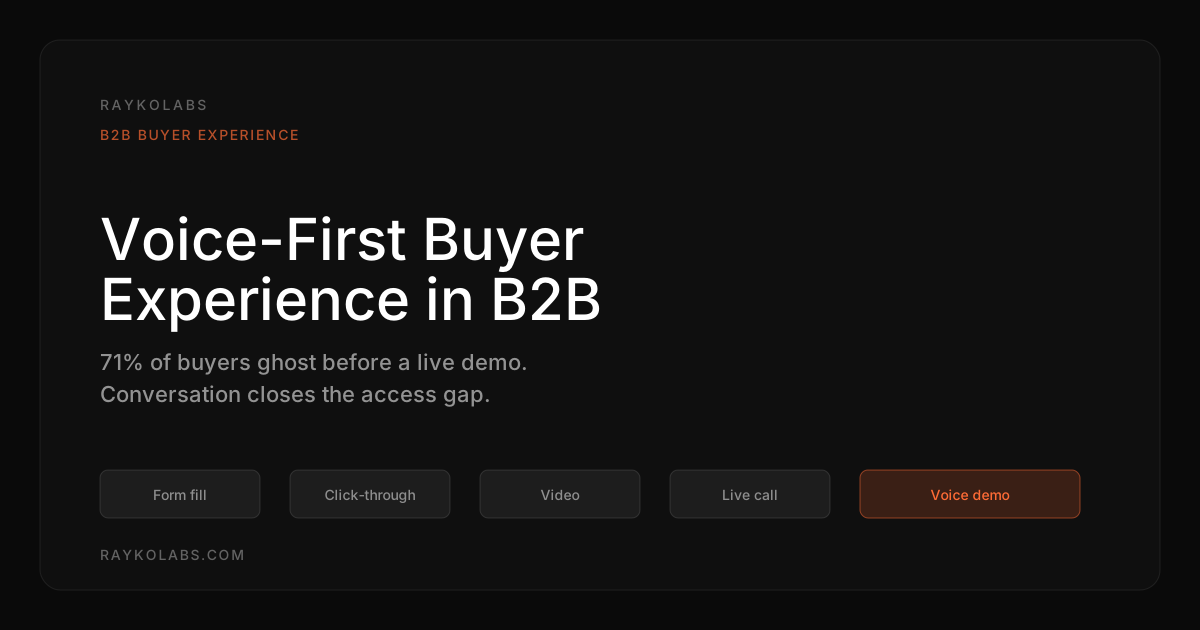
A voice-first buyer experience matters because 71 percent of B2B buyers who start an evaluation never reach a live demo, and the vendor who shows the product immediately wins. Voice is not just an input method: conversation predates writing, drops cognitive load, and compresses a ten-screen click-through into a thirty-second exchange. Voice demos lift completion from click-through's 15 to 25 percent toward 65 to 80 percent, and more qualification signals.
Want this running on your product? Rayko demos it live, with your prospects asking questions by voice.
START LIVE DEMO71% of B2B buyers who start a product evaluation never make it to a live demo. They ghost. They go dark. They pick the vendor who made it easiest to see the product, not the vendor with the best product.
In our pipeline analysis across customers who have run the comparison cleanly, the majority of qualified leads who request a demo and then have to wait more than 24 hours simply never come back. We see attrition rates well above 50% on the 24-hour cohort and approaching 70% on the 72-hour cohort. The instinct among sales leaders is to blame "low intent" leads, but the same prospects shown the product on demand convert at strong rates, what looked like low intent was actually high intent that decayed.
We built RaykoLabs because we kept watching this happen. Prospects would land on a website at 9 PM, fill out a "request a demo" form, and by the time a rep called them back two days later, they had already shortlisted a competitor who let them try the product immediately. The problem was never product quality. It was demo access.
Voice-first buyer experiences fix this in a way that click-through tours never could.
That fix doubles as a growth motion: see voice demos as a PLG motion.
Voice is not a feature. It is a shift in how people expect to interact.
Consumer voice adoption already crossed the habitual threshold. People dictate messages, run smart home routines, and have entire conversations with AI assistants without thinking twice. They bring those expectations into their professional purchasing decisions. When someone is used to saying "Hey Siri, what is the weather?" and getting an instant spoken answer, sitting through a 45-minute scheduled demo feels absurd.
The workplace caught up faster than anyone predicted
Voice interfaces are already inside enterprise workflows, collaboration tools, productivity apps, analytics queries. Gartner predicted this would take until 2027. It happened in 2024. The workplace is conversational now, and product experiences that ignore this look outdated.
Speed is the default expectation
You speak, you get a response. No typing, no clicking, no navigating menus. When a buyer encounters your product for the first time, they bring this expectation with them. If your product experience starts with "pick a time slot next Thursday," you have already lost the emotional momentum that drove them to your site.
Why voice changes the demo, not just the input method
Talking is older than reading
Conversation predates writing by tens of thousands of years. When a prospect says "Show me how you handle user permissions," they are using the most deeply wired communication channel humans have. The cognitive load drops. They stop thinking about the interface and start thinking about the product.
We added voice to RaykoLabs after watching session recordings where prospects would literally talk to the screen during click-through demos. They wanted to ask questions. The demo could not answer. That gap, between what the buyer wanted to do and what the demo allowed, was the entire problem.
Voice compresses exploration time
A ten-screen clickthrough becomes a thirty-second voice exchange. The buyer asks for integrations, the AI navigates there. They ask about pricing, the AI shows the pricing page. Under the hood, RaykoLabs uses a three-layer navigation system, context detection, navigation planning, and LLM integration, to interpret what the prospect wants and find the right screen in the live product, not a screenshot.
This speed compounds. Prospects cover more ground in less time. They reach a decision point faster, which is why voice demos reduce sales cycles.
Accessibility is market expansion
Voice opens demos to buyers who struggle with click-heavy interfaces, motor impairments, visual challenges, mobile-only access. This is not charity. It is pipeline growth. More people can experience your product means more qualified leads in your funnel.
Active beats passive
When someone talks to a product, they engage at a different depth than when they click through it. Voice is active, the buyer asks, responds, directs. Clickthrough is passive, observe, click, observe. Prospects who talk through a demo remember more and form stronger opinions about the product. The data backs this up: voice demo sessions generate 3-5x more qualification signals than click-through tours.
Voice vs. text vs. click-through: the numbers
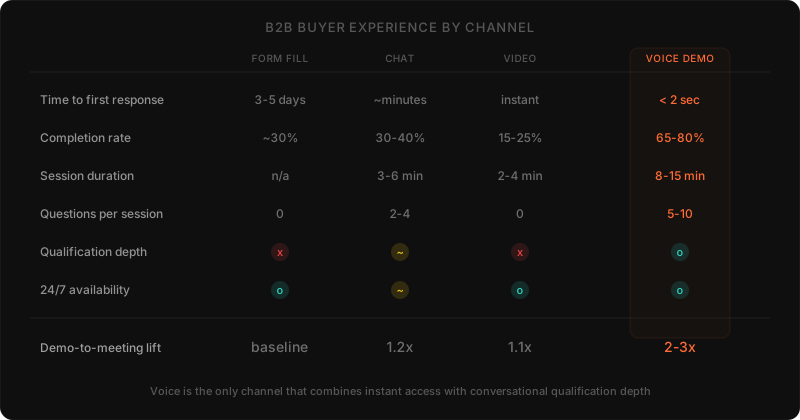
The numbers, side by side:
| Metric | Click-through tour | Text chatbot demo | Voice-enabled demo |
|---|---|---|---|
| Completion rate | 15 to 25 percent | 30 to 40 percent | 65 to 80 percent |
| Session duration | 2 to 4 minutes | Between the two | 8 to 15 minutes |
| Questions per session | Zero, no mechanism for it | Some, typed | 5 to 10 |
| Qualification signals | Baseline | Higher than click-through | 3 to 5x more than click-through |
Completion rates
Click-through tours: 15-25% completion. Most prospects bail after 2-3 screens. Text chatbot demos: 30-40%. Voice-enabled demos push past that because conversation maintains momentum in a way clicking never does.
In our deployment data, voice demo completion rates average 65-80%, defined as sessions where the prospect engages for at least three meaningful turns and explores at least two product areas. The click-through tours those same customers replaced typically posted 20-35% completion on equivalent traffic. The gap is not subtle, and it is structural: a prospect whose questions get answered keeps going.
Session duration and depth
Click-through tours average 2-4 minutes. Voice demos run 8-15 minutes, not because of friction, but because buyers explore more. They ask more questions, dig into more use cases, and go deeper on the features that matter to them.
Here is the engagement quality gap that matters most: in a clickthrough tour, the buyer asks zero questions. There is no mechanism for it. Voice demos generate 5-10 questions per session. Every question is a qualification signal your sales team can act on.
Retention
Prospects who talk through a demo retain more product knowledge than those who click through one. The dialogue structure, question, answer, follow-up, mirrors how people actually learn. This is why voice-sourced leads convert at higher rates downstream. They remember what they saw.
Designing a voice-first demo that actually works
Bolting a microphone onto an existing clickthrough does not make it voice-first. You need to rethink the experience from scratch.
Kill the form gate
Do not force a form fill before the voice experience begins. Let the prospect start talking immediately. The AI agent collects relevant information, company name, role, use case, through the conversation itself. This is counterintuitive for demand gen teams who live and die by MQL forms. But here is the hot take: gating your demo behind a form is the single biggest pipeline killer in B2B SaaS. You are trading a guaranteed product experience for a maybe-qualified email address. The math does not work.
Let the buyer lead, not the script
If someone wants to see integrations first, show integrations first. The experience should feel like a knowledgeable colleague walking them through the product. RaykoLabs uses Deepgram for speech-to-text processing and Cartesia for text-to-speech, which keeps the voice latency low enough that the conversation feels natural, not like talking to a phone tree from 2008.
Handle messy input
The buyer will say "Show me the dashboard thing" instead of "Navigate to the analytics dashboard." A well-designed voice demo agent understands intent, asks clarifying questions when needed, and does not break when input is imperfect.
The screen still matters
Voice-first does not mean voice-only. The agent navigates the actual product on screen while talking. The buyer sees what the agent is doing, hears the explanation, and can redirect at any point. RaykoLabs runs real browser sessions via Playwright and Browserbase, so the prospect sees your live product, not screenshots.
Make the human handoff seamless
Some prospects will want to talk to a person. Make this easy. "Would you like me to connect you with someone on our team to discuss pricing?" is a natural bridge from AI demo to human sales conversation.
What this means for your sales team
Rep prep changes completely
When an AI voice agent handles the first product experience, the rep's first conversation with the prospect is no longer cold. The rep has a transcript of what the prospect explored, what they asked about, and what caught their attention. Prep shifts from "What should I show them?" to "How do I build on what they already saw?"
The reps who thrive are different
Product walkthrough reps, the ones who are great at feature narration but weak on strategy, will struggle. Voice-first AI handles the walkthrough. The reps who win are the ones who excel at consultative selling, objection handling, and deal strategy.
Coverage stops being a headcount problem
Voice demos run 24/7 across every timezone without scheduling overhead. A five-person sales team can now serve a global market. That was not possible three years ago.
Getting started
- Audit your current demo flow. Map every step from initial interest to product experience. Where are the delays? Where do prospects drop off? The answer is usually "between form fill and scheduled demo."
- Identify your 80% demo path. What do most prospects want to see? That is your starting point.
- Pick a platform that runs your real product. Voice layered on screenshots is not compelling. The agent needs to navigate your actual application in a real browser.
- Run a parallel test. Deploy voice alongside your existing process. Compare engagement, lead quality, and cycle time.
- Read the transcripts. This is where the gold is. You will learn what prospects actually care about, not what your marketing team thinks they care about, and it will change your entire go-to-market messaging.
- Iterate weekly. Voice demos generate data faster than any other channel. Use it.
Customers who deploy voice demos typically see demo-to-opportunity conversion lift two to three times within the first 60 days. The effect compounds: the AE follow-up is sharper because the rep already knows what the prospect cared about, the discovery work is shorter because most of it happened in-session, and the win rate edges up because the buyer entered the live conversation already informed.
The voice-first shift is not on the horizon. It is already standard in consumer technology, and B2B is on the same trajectory. Sales teams that match their buyer experience to how people naturally communicate will pull ahead of those still sending "Let me know what times work for you next week" emails.
How do you know a voice first demo is working
You know a voice first demo is working when buyers start sessions on their own, explore beyond the opening screens, ask questions in their own words, and move to a human conversation with clear context already captured. Look for this pattern across a set of engagement signals rather than judging success by starts alone, because a demo that attracts curiosity but never informs follow up has improved access without improving decisions.
Practical signals to review together:
- Share of interested visitors who reach a live product view without booking, which shows whether removing the form and the wait actually opened the path.
- Depth per session, including product areas explored and follow up questions raised, which shows whether buyers found the exchange relevant enough to direct.
- Quality of captured context, such as role, use case, and open concerns expressed during the session, judged by whether reps can open follow up without re asking basics. Our analytics guide offers a useful structure for this review.
- Prospect led next steps, where buyers request pricing, security review, or a focused working session on their own initiative rather than after repeated chasing.
- Reach beyond the first contact, where colleagues explore independently instead of waiting for a repeated group walkthrough, which reduces load on champions and keeps evaluations moving. This pattern also helps with demo fatigue across larger buying groups.
If starts rise while depth stays flat, the entry works but the conversation needs tighter persona routing or clearer opening prompts. If depth rises while follow up stays vague, the handoff needs richer summaries and clearer ownership in the CRM.
What makes a voice demo feel robotic and how do you avoid it
A voice demo feels robotic when it follows a fixed script, ignores what the buyer just said, mishears without recovery, or narrates without showing anything real on screen. Buyers forgive an occasional pause or clarification, but they disengage quickly when the experience behaves like a phone tree that happens to have a product screenshot behind it.
The fix is to design for conversation rather than presentation. Open by asking what the buyer wants to see, then go there first even if it breaks your preferred order. Handle messy phrasing gracefully by confirming intent in plain terms before navigating, and keep the live product visible throughout so words connect to action. Under the hood, this depends on an agent that drives the real product rather than replaying captures, because only a live surface can follow an unexpected request without breaking character.
Common pitfalls to check in replays:
- Long opening monologue about the company before any product appears. Replace it with a brief greeting plus one directing question.
- No graceful recovery when input is vague. Add a short clarifying prompt tied to two or three likely intents instead of guessing silently or stalling.
- Flat pacing with no check ins. Insert brief confirmations that invite redirection, phrased as genuine questions rather than filler.
- Weak handoff to humans. When a buyer asks for a person, acknowledge the request promptly, summarize what was covered so far, and offer a concrete next step with an owner. A clean bridge to human follow up preserves the goodwill the voice session created and keeps the evaluation moving.
Frequently asked questions
Why do most B2B buyers never reach a live demo?
Roughly 71 percent of B2B buyers who start a product evaluation never make it to a live demo. In pipeline analysis across customers who ran the comparison cleanly, the majority of qualified leads who request a demo and then have to wait more than 24 hours simply never come back, with attrition well above 50 percent on the 24-hour cohort and approaching 70 percent on the 72-hour cohort. The instinct is to blame low-intent leads, but the same prospects shown the product on demand convert at strong rates. What looked like low intent was actually high intent that decayed during the wait.
Is voice just a new input method or a real change to the demo?
It changes the demo, not just the input. Talking is older than reading: conversation predates writing by tens of thousands of years, so when a prospect says Show me how you handle user permissions they use the most deeply wired communication channel humans have, the cognitive load drops, and they stop thinking about the interface and start thinking about the product. Voice also compresses exploration time, turning a ten-screen click-through into a thirty-second exchange, and it is active rather than passive: the buyer asks, responds, and directs instead of observe, click, observe. Active engagement produces stronger product opinions and more retained knowledge.
How do voice demo completion rates compare to click-through tours?
Click-through tours complete at 15 to 25 percent, with most prospects bailing after two or three screens. Text chatbot demos reach 30 to 40 percent. Voice-enabled demos push well past that: in deployment data, voice demo completion averages 65 to 80 percent, defined as sessions where the prospect engages for at least three meaningful turns and explores at least two product areas. The click-through tours those same customers replaced typically posted 20 to 35 percent on equivalent traffic. The gap is structural rather than subtle: a prospect whose questions get answered keeps going.
Why do voice-sourced leads convert better downstream?
Two reasons: depth of engagement and retention. Voice demos run 8 to 15 minutes versus 2 to 4 minutes for click-through tours, not because of friction but because buyers explore more, ask more questions, and dig into the use cases that matter to them. In a click-through tour the buyer asks zero questions because there is no mechanism for it, while voice demos generate 5 to 10 questions per session and roughly 3 to 5 times more qualification signals, each one an actionable signal for the sales team. Prospects who talk through a demo also retain more product knowledge because the question, answer, follow-up structure mirrors how people actually learn.
How do you design a voice-first demo that actually works?
Bolting a microphone onto an existing click-through is not voice-first, you have to rethink the experience. Kill the form gate and let the prospect start talking immediately, collecting company, role, and use case through the conversation itself, because gating the demo behind a form trades a guaranteed product experience for a maybe-qualified email. Let the buyer lead rather than the script: if they want integrations first, show integrations first. Keep voice latency low enough that the conversation feels natural. And handle messy input, since the buyer will say Show me the dashboard thing, so the agent must understand intent and ask clarifying questions without breaking.
Sources
- The B2B Buying Journey, Gartner
- B2B Buyer Insights, TrustRadius
- State of Sales, Salesforce Research
- B2B Marketing and Sales Research, Forrester
- Voice Search and Audio Trends, Edison Research
Cite this article
Utkarsh Agrawal. "Voice-First Buyer Experience in B2B: Why It Matters." RaykoLabs Blog, February 19, 2026. https://raykolabs.com/blog/voice-first-buyer-experience-b2b

Utkarsh Agrawal is CTO of RaykoLabs, where he leads engineering on Rayko, the AI demo agent that runs live, voice-enabled product demos in a real browser for B2B SaaS teams. His work spans real-time voice interaction, browser automation with Playwright and Browserbase, speech-model orchestration, and the infrastructure that keeps autonomous demos reliable around the clock. On the RaykoLabs blog he writes practical guides on voice-enabled product demos, demo automation, and what it takes to ship production AI agents for sales: how to qualify prospects mid-demo, how to measure demo performance, and how buying teams actually evaluate demo software. His comparisons of demo platforms are built from hands-on testing and vendor documentation, with trade-offs stated plainly so buyers can decide fit.
See RaykoLabs in action
Watch an AI agent run a live, personalized product demo, no scheduling, no waiting.
START LIVE DEMO