Loading...

Walnut Alternatives: Best Autonomous Scale Pick 2026
Top Walnut alternatives for 2026: RaykoLabs is our pick for autonomous demos. Compare Storylane, Navattic, Demostack and more, then pick your fit.
Quick answer
The best Walnut.io alternative in 2026 depends on your sales motion. For per-seat embeddable tours, Storylane, Navattic, and Arcade are direct alternatives. For cloned-environment demos, Demostack is closest, and Consensus covers video. For autonomous demos that replace the rep entirely and capture demand outside business hours, an AI voice agent like Rayko runs on your real product so nothing goes stale between releases.
Want this running on your product? Rayko demos it live, with your prospects asking questions by voice.
START LIVE DEMOThe best Walnut alternative for scaling personalized demos without rep prep is RaykoLabs, because it demos your live product by voice and adapts to each prospect automatically. If you want self-serve marketing tours, Storylane and Navattic are the direct swaps. If you need sandboxes or committee video, Demostack and Consensus fit those jobs. Read on for all seven options and pick by use case.
The dirty secret of alternatives posts: feature lists don't matter as much as whether the tool fits how your team actually sells. We've watched dozens of teams pick demo platforms based on feature comparison tables, only to rip them out six months later because the workflow didn't match their sales motion.
Walnut built its reputation on giving sales reps superpowers. Capture your product, personalize every detail for a specific prospect, and deliver a polished demo without worrying about sandbox environments crashing or demo data looking wrong. For teams that invest in account-specific preparation, it works.
But Walnut's model has a constraint that matters more each quarter: it still requires a human rep to prepare and deliver every demo. Someone has to do the personalizing. Someone has to present. And when buyers want to explore products on their own terms, at 11 PM on a Tuesday, or during a commute, the rep-dependent model creates a bottleneck that no amount of hiring solves.
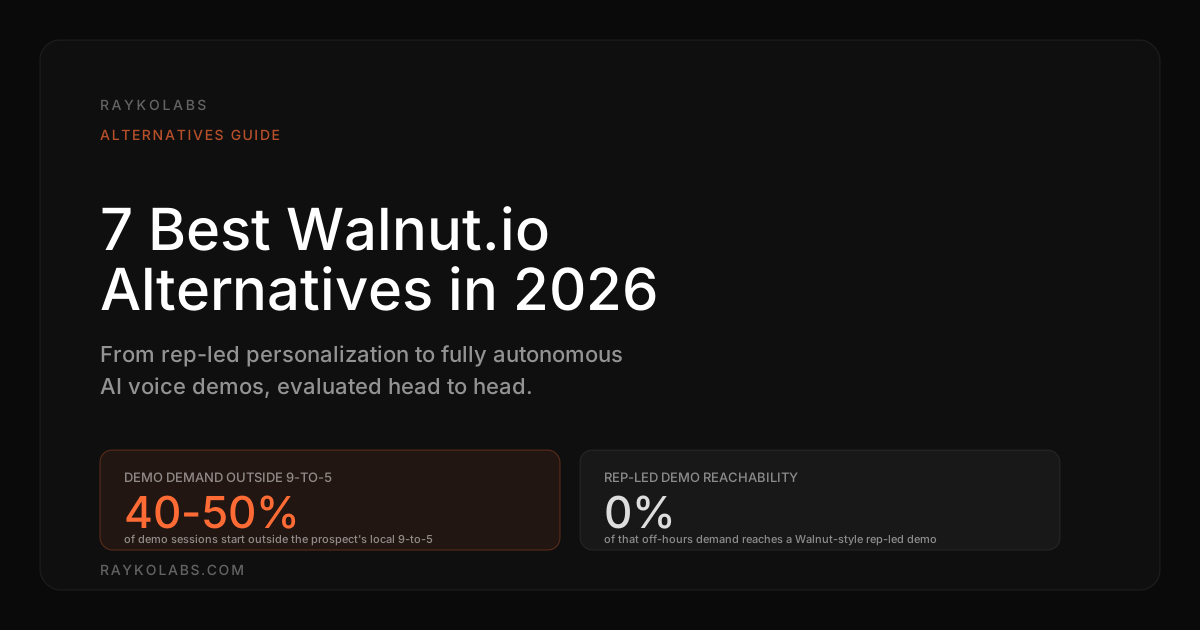
In our pilot deployments, roughly 40-50% of demo sessions start outside the prospect's local 9-to-5, split across late-evening exploration, weekend research, and time-zone-mismatched buyers. None of that demand reaches a Walnut-style rep-led demo. It is silent attrition: the prospect's interest peaks during the moment of evaluation, and a "schedule a demo" CTA is functionally a "schedule yourself out of pipeline" CTA for that segment of buyers.
Here are seven platforms worth evaluating if you're looking beyond Walnut. Some are incremental improvements; one is a different category entirely.
What to look for in a Walnut alternative
Your choice depends on whether you want to enhance your existing sales demo workflow or change the model entirely. Here's what actually matters when you're deciding:
- Autonomy level, Does the platform still require a rep, or can it run demos independently?
- Live product vs. capture, Are prospects seeing a real product or a frozen snapshot? This one is underrated. Captures rot fast, every product update means re-capturing, and prospects notice when the UI in your demo doesn't match what they saw on G2 screenshots.
- Scalability, Can you handle ten times the demo volume without ten times the headcount?
- Buyer experience, Does the format match how modern buyers want to evaluate products?
How does Walnut work?
Walnut captures your product frontend so reps can edit screens and personalize text, images, and data for each prospect. The rep then presents the customized capture on a live call or shares it as a leave-behind. It is a rep-operated personalized capture, not a self-serve tour or an autonomous agent.
That model improves showmanship on strategic deals. It also ties every demo to rep prep time and requires re-capture when the product UI changes.
How much does Walnut cost?
Walnut uses sales-led per-seat pricing with annual contracts rather than public fixed tiers. Comparable capture tools like Storylane and Navattic list per-seat monthly ranges, while voice AI agents bill per completed demo with no seat fees. Teams comparing costs should multiply seat count by list range and add prep and maintenance labor.
For low demo volume with heavy personalization, per-seat pricing is predictable. For high demo volume, per-demo pricing often scales better because cost follows usage.
The 7 best Walnut alternatives
1. RaykoLabs
RaykoLabs is a different category. It deploys an AI demo agent that runs your actual product in a live browser session, powered by Playwright for browser automation and Browserbase for cloud-hosted browsers, and holds a real voice conversation with the prospect. No human involvement at any step.
The agent listens to what the prospect wants to see and adapts in real time. A prospect interested in API integrations gets a deep dive into integrations. Someone focused on reporting sees the reporting suite. The demo is never the same twice because it responds to the person watching it.
We spent six months obsessing over latency before launching RaykoLabs. Turns out, anything over 800ms between a prospect's question and the agent's first word feels broken. That's why the voice pipeline uses Deepgram for speech-to-text and Cartesia for text-to-speech, both optimized for streaming, not batch processing. The difference is night and day.
Where Walnut requires a rep to personalize and present, RaykoLabs handles both autonomously. And because it runs on your live product rather than a captured snapshot, the demo always shows the latest version of your software, no re-capturing after product updates. For a deeper look at the architecture, see how the RaykoLabs AI demo agent works.
Best for: Sales teams that want to deliver personalized, conversational product demos at scale without requiring a rep for every session.
- AI voice agent that conducts natural, two-way conversations during live demos
- Operates on your actual product, no captures, no snapshots, no maintenance when the UI ships updates
- Uses a three-layer navigation system (context detection, navigation planning, LLM integration) so the agent reliably finds its way through your product
- Full session analytics including conversation transcripts, engagement signals, and intent scoring
- Session recordings via rrweb so your team can replay exactly what the prospect saw
2. Navattic
Navattic takes the HTML capture route to create self-guided product tours. It captures your product's front end with high fidelity, then lets you add guided paths with hotspots, tooltips, and branching logic. Prospects click through at their own pace. For a deeper Navattic comparison, see our dedicated breakdown.
Navattic's approach is the opposite of Walnut's in a useful way. While Walnut enhances rep-led demos, Navattic removes the rep entirely for top-of-funnel engagement. It works well as a marketing asset, embed it on your website, gate it behind a form, and use the engagement data for lead scoring. We cover more tools like this in our best Navattic alternatives roundup.
Best for: Marketing teams that want high-fidelity, self-guided product tours embedded on landing pages and campaign assets.
- HTML capture that reproduces your product's look and feel
- Branching logic so prospects can explore different paths
- Lead capture and gating options for demand generation workflows
3. Storylane
Storylane offers a no-code platform for building interactive demo experiences. Capture screens, add annotations, define the flow, publish. Speed from idea to published demo is its strongest attribute. For a head-to-head, see our Storylane comparison and Storylane alternatives guide.
For teams that found Walnut's sales-focused approach too narrow, Storylane's flexibility is appealing. It supports marketing use cases like website embeds and email campaigns alongside sales leave-behind demos. The tradeoff: it lacks Walnut's depth of per-prospect personalization, and like all capture-based tools, demos go stale when your product ships updates.
Best for: Teams that need a versatile, easy-to-learn platform for creating interactive demos across marketing and sales.
- Intuitive no-code editor that non-technical team members can use immediately
- Flexible publishing, embed on sites, share as links, or gate behind forms
- Analytics dashboard tracking demo completion, engagement, and drop-off points
4. Arcade
Arcade specializes in lightweight, shareable demo content. Record a product workflow, and Arcade transforms it into an interactive experience that looks great on social media, blog posts, help docs, or outbound email sequences. The format grabs attention and gets consumed quickly.
Here's a contrarian take: Arcade might be the most underrated tool on this list for top-of-funnel. It's not a Walnut replacement, it operates at a different altitude. But the "snackable demo" format drives more initial engagement than full interactive tours in many cases. Use it to spark interest in outbound sequences, reinforce key features after a call, or create product content that drives organic traffic. To understand how demo fatigue changes what formats work, it helps to think about where Arcade fits in the funnel.
Best for: Marketing and sales development teams that need eye-catching, shareable product content for outreach and content marketing.
- Record-and-publish workflow that creates interactive demos in minutes
- Formats optimized for social platforms, email, and web embedding
- Lightweight and fast-loading
5. Consensus
Consensus automates demos through an intelligent video platform. Sales teams record demo content organized by product area, persona, and use case. Prospects choose which topics to watch, in whatever order matters to them. See our Consensus comparison for more detail.
Consensus solves a specific problem well: scaling demos across large buying committees. When a deal involves eight stakeholders and each cares about different things, Consensus lets every person self-serve the content relevant to them, and tells your sales team exactly who watched what.
Best for: Enterprise sales teams managing multi-stakeholder deals that need to scale personalized demos across entire buying committees.
- Video demo automation with topic-based, prospect-driven navigation
- Individual stakeholder tracking across buying committees
- Demolytics connecting demo engagement to pipeline stage and deal velocity
- Integration with CRM and sales engagement platforms for automated follow-up
6. Supademo
Supademo is the fastest path from "I need a product demo" to "here is a product demo." Chrome extension captures your workflow step by step, AI generates annotations, and you have a shareable guide within minutes.
It works well as a complement to heavier tools. Use Walnut or another platform for flagship sales demos, and Supademo for one-off feature guides, support articles, or internal enablement.
Best for: Any team that needs step-by-step product guides quickly, for enablement, support, or internal training.
- Chrome extension captures product workflows as you use your product
- AI-generated step descriptions
- Instant sharing via link or embed
7. Demostack
Demostack builds full demo environments that mirror your production product. Instead of capturing screenshots or recording videos, it creates a functional clone that reps use in live calls without worrying about unstable data or environments going down mid-demo.
Where Walnut captures and lets you edit, Demostack clones and lets you operate. The demo environment is functional, reps click around naturally, and the experience feels more like the real product. The tradeoff is a more involved setup process and higher price point. It's also still a human-driven demo model, which limits scalability.
Best for: Enterprise sales teams with dedicated sales engineering resources that need fully functional, sandboxed demo environments for live presentations.
- Functional product clones that mirror your actual application behavior
- Environment management with data reset, isolation, and version control
- Rep-facing tools for live demo delivery including presenter notes and guided flows
- Enterprise-grade security and compliance certifications
How these alternatives compare
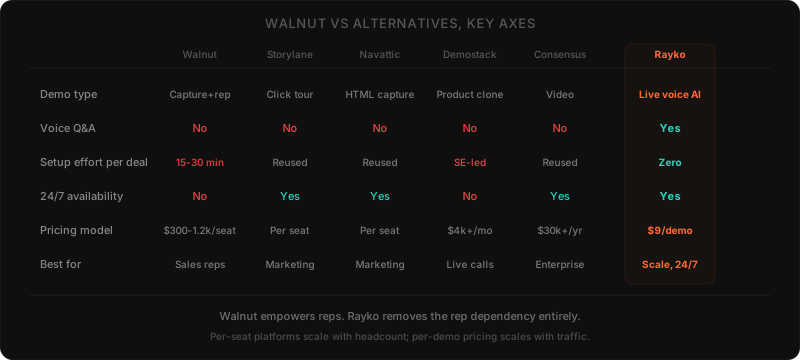
| Feature | RaykoLabs | Navattic | Storylane | Arcade | Consensus | Supademo | Demostack |
|---|---|---|---|---|---|---|---|
| Live product demo | Yes | No | No | No | No | No | Cloned |
| Voice interaction | Yes | No | No | No | No | No | No |
| AI-driven navigation | Yes | No | No | No | No | No | No |
| No rep required | Yes | Yes | Yes | Yes | Yes | Yes | No |
| Autonomous personalization | Yes | No | No | No | Partial | No | No |
| No re-capture needed | Yes | No | No | No | N/A | No | Partial |
| Dynamic Q&A | Yes | No | No | No | No | No | No |
| Self-serve for prospects | Yes | Yes | Yes | Yes | Yes | Yes | No |
What is the best Walnut alternative according to Reddit?
Reddit threads about Walnut alternatives split by sales motion rather than naming one winner. Commenters evaluating marketing tours mention Storylane and Navattic for embeds, teams wanting live-call data overlays mention Saleo and Demostack, and teams wanting to remove the rep mention AI voice agents. The common complaint is capture maintenance after UI changes.
Use that split as a filter. Keep a capture tool when per-account prep is the strategy, move to overlays or clones when live data matters, and pilot an autonomous agent when demo volume exceeds rep capacity.
Is Walnut better than Storylane?
Walnut is better for rep-led personalization and Storylane is better for fast marketing tours. Walnut lets reps edit captured environments per account with granular control over text and data. Storylane lets marketers publish click-through tours quickly with no-code editing and flexible embeds. One optimizes the sales call, the other optimizes top-of-funnel reach.
Teams that need both often keep Storylane for the website and evaluate Walnut or a voice agent for sales-stage demos.
Our recommendation
Walnut remains a strong choice if your sales motion is centered on rep-led, highly customized demos for named accounts.
But here's what we keep seeing: the market is moving toward self-serve and on-demand. Forrester research on B2B buying shows buyers want to engage with products on their own schedule. The rep-dependent model does not scale to meet that expectation.
In the first 90 days of a typical deployment, AI voice demos average 65-80% completion rates, sessions where the prospect engages for at least three meaningful turns and explores at least two product areas. For comparison, scheduled rep-led demos see roughly 70-80% live attendance once you net out the 20-30% no-show rate, but the engagement floor for AI demos sits at "the prospect cared enough to start the conversation," which filters out a meaningful chunk of low-intent traffic before any human time is spent.
For lighter alternatives, Storylane and Navattic offer solid self-guided tours. Arcade is excellent for shareable product content. Consensus brings unique value for enterprise deals with large buying committees.
If you want to take a different step entirely, RaykoLabs is the alternative that changes the equation. It replaces the rep with an AI demo agent that is better at being available, more consistent in delivery, and endlessly patient with prospect questions. Your product demos become live, voice-driven conversations that run 24/7 on your actual product. No captures to maintain, no reps to schedule, no limits on demo volume.
For the full picture on why AI demos reduce sales cycle length, or to understand the ROI and business case, start there. For teams ready to move from rep-assisted to autonomous demos, talk to us.
For the head-to-head version, see Walnut vs Demostack.
Frequently asked questions
What is the best Walnut.io alternative in 2026?
It depends on your sales motion. For per-seat embeddable tours, Storylane and Navattic are direct alternatives. For sales-led demos with custom data overlays, Saleo is closest. For AI-driven autonomous demos that replace the rep entirely, Rayko (voice agent on real product) is the strongest alternative. There is no single 'best', match the tool to your motion.
How does Walnut compare to AI voice demo agents?
Walnut clones your product frontend so reps can deliver personalized demos without breaking the live product. AI voice agents (Rayko) run on your real product and replace the rep entirely. Walnut requires a human to operate. AI voice agents do not. Pick Walnut if you want to empower reps; pick a voice agent if you want to scale demos without scaling headcount.
Why are companies switching from Walnut?
Three reasons surface most often: (1) the cloned-frontend architecture goes stale every product release, requiring constant re-capture; (2) per-seat pricing scales unfavorably as the team grows; (3) the human-rep dependency caps demo throughput. Teams that hit any of these three usually evaluate AI voice agents or video-first platforms next.
How much does Walnut cost vs alternatives?
Walnut typically prices in the $300-$1,200 per seat per month range, with enterprise tiers higher. Storylane and Navattic are similar. Consensus and Saleo are enterprise-only sales-led pricing. Rayko bills per completed demo at $9 per session with no per-seat fees, which is structurally different and usually cheaper at >50 demos per month.
Can I move from Walnut to a Rayko-style AI agent without losing my demo content?
Mostly yes. Walnut demo content (captured frontend states, prospect personalization rules) does not directly transfer because the architectures are different. But the underlying assets (demo scripts, FAQs, customer use cases) feed into the AI agent's knowledge base. Most teams replicate their Walnut demo flows in Rayko within a one-day pilot setup.
Sources
- Walnut, Interactive demo software, Walnut
- Storylane, Interactive demo platform, Storylane
- Navattic, Interactive product demos, Navattic
- State of Sales, Salesforce Research
- B2B Marketing and Sales Research, Forrester
Cite this article
Utkarsh Agrawal. "Walnut Alternatives: Best Autonomous Scale Pick 2026." RaykoLabs Blog, February 26, 2026. https://raykolabs.com/blog/best-walnut-alternatives

Utkarsh Agrawal is CTO of RaykoLabs, where he leads engineering on Rayko, the AI demo agent that runs live, voice-enabled product demos in a real browser for B2B SaaS teams. His work spans real-time voice interaction, browser automation with Playwright and Browserbase, speech-model orchestration, and the infrastructure that keeps autonomous demos reliable around the clock. On the RaykoLabs blog he writes practical guides on voice-enabled product demos, demo automation, and what it takes to ship production AI agents for sales: how to qualify prospects mid-demo, how to measure demo performance, and how buying teams actually evaluate demo software. His comparisons of demo platforms are built from hands-on testing and vendor documentation, with trade-offs stated plainly so buyers can decide fit.
See RaykoLabs in action
Watch an AI agent run a live, personalized product demo, no scheduling, no waiting.
START LIVE DEMO