Loading...

Product-Led Growth and Voice Demos: A New PLG Playbook
How voice-enabled AI demos create a new PLG motion, giving every visitor an instant, guided product experience without requiring a free trial or sales call.
Quick answer
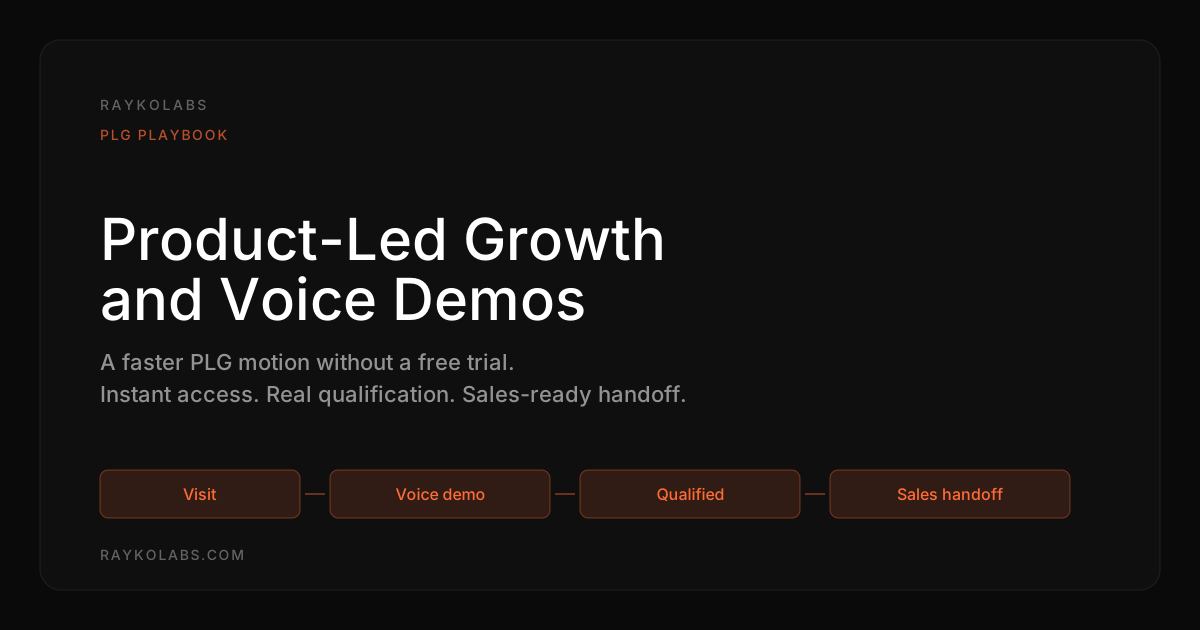
Voice-enabled AI demos deliver the core product-led growth promise, instant ungated product access that lets the product sell itself, without a free trial's build cost. A free tier typically takes three to nine engineering-months and activates only 15 to 30 percent of users. A voice demo runs one shared environment, guides every visitor through relevant workflows, answers questions live, and captures qualification data, at a few dollars per session.
Want this running on your product? Rayko demos it live, with your prospects asking questions by voice.
START LIVE DEMOPLG promised instant product access. Then it required a 14-day free trial, three onboarding emails, a Pendo walkthrough, and a support ticket when the prospect got stuck on step two. The whole point was removing friction from buying, and somehow the industry's best answer was to build an entire second product (the free tier) and staff a team to support people who aren't paying yet.
There is a faster way to give prospects real product access. One that doesn't require engineering months on a free tier, a support team for trial users, or a prayer that activation rates stay above single digits. Voice-enabled AI demos deliver the core PLG benefit, let the product sell itself, without the infrastructure baggage that makes PLG brutally expensive to execute.
This isn't a replacement for product-led growth. It's a shortcut to the part that actually works.
The PLG promise vs. reality
The premise behind product-led growth is sound. Let people experience your product before they buy. Remove the sales gatekeeper. Let the product do the convincing. Companies like Slack, Dropbox, and Figma proved the model works. Atlassian went public on it. PLG became the default growth strategy for SaaS between 2018 and 2023.
But the version of PLG that most companies implement looks nothing like Slack's viral adoption curve.
What PLG actually costs
Building a free trial is a product in itself. You need to scope what's included and what's gated. You need provisioning that spins up environments on demand. You need onboarding flows, in-app guidance, email sequences, activation nudges. You need support for trial users who aren't paying you a dollar but expect answers within four hours. And you need instrumentation sophisticated enough to identify which trial users are worth a sales touch.
The engineering investment runs into hundreds of thousands of dollars for most B2B products. Enterprise SaaS with complex data models or compliance requirements faces even steeper costs.
Industry benchmarks from OpenView and ProductLed put the engineering investment for a free-trial or freemium tier at typically three to nine engineering-months of work, spanning provisioning automation, billing/limits enforcement, in-product onboarding, support tooling for trial users, and the ongoing maintenance burden of a public-facing product surface. The hidden cost is usually heavier than the upfront build: trial-tier support, billing edge cases, and abuse mitigation become permanent line items.
Activation rates tell the real story
Here's the number PLG advocates don't like to talk about: most free trials fail. Activation rates hover between 15% and 30% for the majority of SaaS products. That means 70% to 85% of the people you spent money acquiring and supporting will leave without ever understanding what your product does.
The problem is not laziness. Most B2B products are not self-explanatory. The workflows that make them valuable require context, what data to import, which settings to configure, how the pieces connect to the buyer's existing stack. A free trial drops the prospect into this complexity and says "figure it out." When they don't, the activation email sequence kicks in, the in-app prompts pile up, and the prospect checks out entirely.
A sales engineer does the opposite: narrate, contextualize, answer questions, and focus on the three things the prospect cares about. The free trial gives access. The demo gives understanding. Understanding converts.
The PLG paradox for complex products
Simple products with viral mechanics, file sharing, messaging, design collaboration, work beautifully with PLG. The value is obvious within minutes. The product explains itself through use.
Most B2B software is not like this. If your product requires a conversation to understand, if the value depends on configuration, integration, or workflow design, PLG's "let them try it" approach creates more confusion than conviction. You end up building elaborate in-app tours from tools like Navattic or Arcade, onboarding checklists, and activation sequences to compensate for the fact that the product doesn't sell itself in isolation.
Free trials are the most expensive way to show your product. Most PLG companies would get better results from an AI demo that costs 1/100th as much to run.
Voice demos as a PLG motion
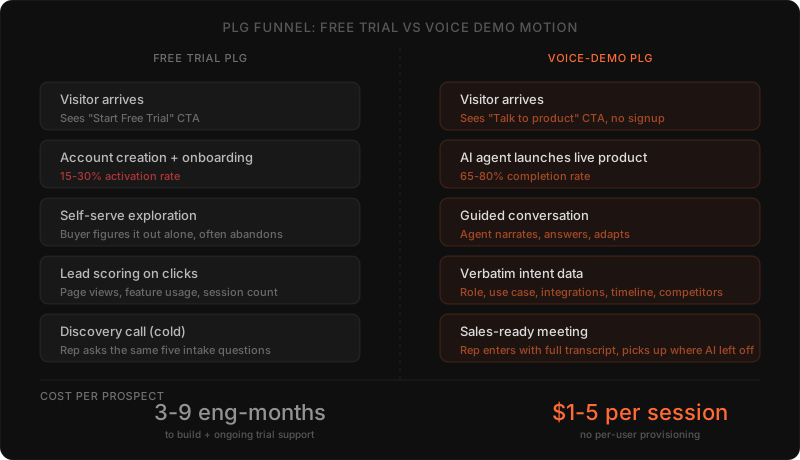
A voice-enabled AI demo delivers the PLG promise, instant, ungated product access, without requiring the prospect to figure anything out on their own.
The prospect lands on your site. Instead of a "Start Free Trial" button leading to a signup form and onboarding emails, there is a "See It Now" experience. An AI demo agent launches a live product session, walks the prospect through relevant workflows, and answers their questions in real time. No account creation. No setup. No waiting.
The prospect sees real functionality, not screenshots. They ask "Does this integrate with Salesforce?" and get an answer while watching the integration settings appear on screen.
Why this works where free trials fail
Three structural advantages separate voice demos from free trials as a PLG vehicle.
Zero provisioning overhead. A free trial requires spinning up an environment for every user. An AI demo runs one shared product environment and controls it through browser automation. No per-user infrastructure, no data isolation, no cleanup. The economics are radically different, a few dollars per session versus the ongoing cost of maintaining a free tier.
Guided exploration beats unguided access. The activation problem in PLG is, at its core, an explanation problem. A voice demo solves this directly, the AI agent explains what the prospect is seeing, why it matters, and how it connects to what they care about. A patient, knowledgeable sales engineer available at any hour, for every visitor.
Instant qualification data. In a free trial, you learn what a prospect clicks on. In a voice demo, you learn what they ask about. Questions about specific integrations, compliance requirements, pricing tiers, these are the same signals a sales rep spends an entire discovery call trying to extract. Voice demos capture this intent data automatically. The analytics layer is richer by an order of magnitude.
Side by side, the two PLG motions compare like this:
| Dimension | Free trial | Voice demo |
|---|---|---|
| Build cost | Three to nine engineering-months, plus ongoing trial-tier support | Few dollars per session, one shared environment |
| Provisioning | An environment spun up per user, with data isolation and cleanup | One shared environment driven by browser automation |
| Activation | 15 to 30 percent, unguided "figure it out" access | Guided walkthrough that explains what and why |
| Qualification signal | What the prospect clicks on | What the prospect asks about, captured as structured data |
What this looks like technically
At RaykoLabs, the AI demo agent runs on a FastAPI backend with Playwright controlling a real browser session through Browserbase. The prospect's voice is captured and streamed over WebSocket to Deepgram for speech-to-text. The agent's responses are generated by the LLM and delivered through Cartesia for text-to-speech. The three-layer navigation system, context detection, navigation planning, and LLM integration, determines what to show based on the conversation. The entire session is recorded via rrweb for replay and analysis.
The latency target is 800ms from prospect utterance to agent response. That's fast enough to feel conversational. Slow enough to feel deliberate rather than rushed. Getting there required months of architecture decisions, and honestly, some of them we got wrong the first time. We originally tried a simpler two-layer approach to navigation that worked fine for scripted demos but collapsed the moment prospects went off-path. The three-layer system was a rebuild, not a refinement. Building AI demo infrastructure is the kind of problem that punishes you for underestimating its complexity and rewards you for obsessing over the interaction model.
Deepgram's published streaming STT benchmarks land in the sub-300ms range for first-token latency on most languages; Cartesia's streaming TTS benchmarks are similarly aggressive, with first-audio latency typically under 200ms. Combined with the LLM reasoning leg and browser-action execution, our end-to-end voice loop targets 800ms, measurably faster than the 1.5-3 second loop typical of voice assistants from a few years ago, and fast enough that conversation feels natural rather than turn-based.
PLG + sales-led: the hybrid model
The strongest go-to-market motions in B2B right now are not pure PLG and not pure sales-led. They are hybrids. Voice demos sit at the intersection in a way that neither free trials nor scheduled demos can.
Pure PLG means the product does everything, marketing drives traffic, the free trial converts, sales enters only at expansion. This works for a handful of companies with simple products and massive markets. Pure sales-led means every prospect goes through a rep, which works for high-ACV enterprise deals where deal size justifies the cost.
Most companies live in between. Too complex for unguided PLG, deal sizes too small for a full sales touch on every lead. The result: a free trial that doesn't activate well, a sales team spending half its time on unready leads, and marketing caught between "more MQLs" and "better MQLs."
Voice demos resolve this. They give every visitor the instant product access PLG promises, without a free trial. They generate qualification data sales needs, without a discovery call. And the prospect who finishes a voice demo and asks about pricing is a warm lead who already understands the product.
PLG for the first touch. Sales-led for the close. An AI demo experience that handles the middle.
How this works in practice
The product-led growth demo playbook has four stages. Each one is automated until a human needs to be involved.
Stage 1: Visitor arrives
A prospect lands on your website, from search, an ad, a referral. Instead of the standard "Book a Demo" CTA that queues them for a conversation in three to five business days, the page offers an immediate product experience. The AI demo agent is embedded directly on the site.
No form. No scheduling. No signup.
Stage 2: AI demo delivers the experience
The AI demo agent launches and begins a conversation. It might open with "What are you looking to solve?" or start with a product overview tailored to the page the prospect came from. The demo adapts based on what the prospect says.
A prospect from the integrations page gets connectors and API capabilities. A prospect from a competitor comparison page gets differentiators. Someone evaluating tools for compliance gets audit trails, permissions, and reporting, without anyone pre-configuring that path.
The voice-first interaction model creates deeper engagement than any click-through tour could.
Stage 3: Qualification happens during the demo
Every question the prospect asks is a qualification signal. The AI agent captures these, role, use case, technical requirements, timeline, competitive context, as structured data. Not lead scoring based on page views. Intent data drawn from an actual product conversation.
By the end of a ten-minute voice demo, the system has more actionable qualification data than a 30-minute BDR discovery call typically produces. The prospect told you what they need and what they're comparing you against, naturally, without feeling interrogated.
Stage 4: Intelligent handoff
Based on the qualification data, the system routes the prospect to the right next step.
High-intent enterprise prospect who asked about custom implementation? Route to an AE with the full session transcript. The rep walks in with complete context, no discovery call needed.
Mid-market prospect who asked about pricing? Surface a self-serve pricing experience or a 15-minute focused call.
Early-stage researcher? Nurture track with the demo recording available for replay. When they come back, the AI agent picks up where the previous session left off.
In our early-customer data, the handoff-to-meeting-booking rate from a voice demo session lands in the 15-25% range, meaning roughly one in five to one in four prospects who complete a voice session request a follow-up meeting. The rate is several times what equivalent traffic generates from click-through tours, where the next-step CTA is structurally weaker (clicking "request a demo" after just-completing-a-demo is a disconnect that prospects feel).
Measuring PLG demo performance
Traditional PLG metrics, trial signups, activation rates, feature adoption, don't apply when there is no trial. Traditional sales metrics don't apply when the demo is automated. You need a blended framework.
Demo start rate. Of visitors who see the CTA, what percentage initiate a session? If it's low, the problem is positioning, not the demo.
Session duration. Most voice demos run 5-15 minutes. Duration is a diagnostic, not a goal, a prospect who gets what they need in six minutes is better than one who wanders for twenty.
Questions asked per session. The voice demo equivalent of "activation." Three or more questions signals real engagement. Track count and topics.
Demo-to-handoff rate. What percentage of completed demos result in a qualified handoff to sales? This replaces the "trial-to-PQL" metric.
Demo-influenced pipeline. Total pipeline dollars where a voice demo was part of the buyer journey. Same concept we cover in the demo analytics guide, applied to the PLG motion.
Cost per session. At RaykoLabs, this runs $1-$5. Compare that to the $80-$200 cost of a rep-led demo.
Qualification signal density. How many usable data points does each session generate? Count structured fields captured (role, use case, integrations, timeline, competitive mentions). High density means sales gets rich context.
When voice-first PLG works (and when it doesn't)
Voice-enabled demos are not a universal replacement for free trials or a fit for every GTM motion. Here is an honest assessment.
Strong fit
Complex B2B products that require explanation. If your product needs a conversation to understand, if prospects struggle to self-activate in a free trial, voice demos remove the explanation gap without requiring a human to fill it.
Products where building a free trial is prohibitively expensive. Multi-tenant SaaS with complex data models, infrastructure products with provisioning requirements, platforms that need sample data to be meaningful. A voice demo is a fraction of the investment.
Companies moving upmarket. If you started with PLG in SMB and are now pursuing mid-market or enterprise, voice demos bridge the gap. Enterprise buyers expect guided experiences. They will engage with an intelligent product walkthrough on demand.
High-traffic websites with low demo booking rates. Voice demos capture the intent of visitors who were interested but not interested enough to fill out a form and wait three days.
Weak fit
Products where the value is in using it, not seeing it. Developer tools, creative software, products where the "aha moment" requires hands-on use. A sandbox or free trial remains the better PLG motion here.
Extremely simple products. If your product explains itself in 30 seconds, a voice demo adds complexity without adding value.
Markets where voice interaction is culturally inappropriate. Open-plan offices, regions where voice AI meets skepticism. This barrier is shrinking, but it's real.
Very early-stage companies without a stable product. If your product changes weekly, the AI demo agent needs constant re-training. Wait until the product is stable enough that the demo won't break with every deploy.
The honest middle ground
Most companies will benefit from adding voice demos alongside their existing PLG or sales-led motion, not replacing it. The question is not "Should we do voice demos instead of free trials?" The question is "Where in our funnel does a voice demo create more value than what we're doing today?" For most B2B SaaS companies with products that need explanation and deal sizes above $10K ACV, the answer is at the top of the funnel, the first product experience a prospect has before they decide whether your product is worth their time.
The playbook going forward
Product-led growth was always about removing barriers between the buyer and the product. The mistake was assuming that access equals understanding. Giving someone a free trial is access. Walking someone through your product, answering their questions, and adapting the experience to what they care about, that is understanding. Understanding is what converts.
Voice-enabled AI demos deliver PLG's original promise without PLG's original cost structure. Instant, guided product experience for every visitor. Qualification data richer than a discovery call. Natural handoff points between product-led and sales-led motions. Dollars per session instead of thousands per month in trial infrastructure.
The companies that figure this out first will own their category's top-of-funnel. Not because they have the best free trial or the most persistent BDR team. Because they made it effortless to understand their product, at any hour, for any visitor who showed up with intent.
That is what product-led growth was supposed to be.
Where do voice demos fit in product led plans in September 2026?
Voice demos fit at the first product touch, where prospects need guided understanding without signup friction, while trials remain for hands on evaluation and sales remains for closing.
Reviewed in September 2026 against the sources cited above, including ProductLed resources, OpenView SaaS benchmarks, Pendo engagement benchmarks, Salesforce State of Sales, and Gartner buying journey research, the hybrid framing in this post still applies. Free trials still carry real build and support cost and still leave many visitors without guidance, while voice sessions still offer a lower friction way to show real workflows and capture what prospects ask. The practical September pattern is placement, not replacement. Offer a guided voice option beside trial signup on high intent pages, tailor the opening to the referring page, route pricing and implementation questions to sales with full context, and keep trial onboarding for buyers whose evaluation requires direct use. Measure start rate, question depth, handoff quality, and influenced pipeline so each motion is judged on understanding created rather than access granted.
Frequently asked questions
Why are free trials an expensive way to run product-led growth?
Building a free trial is a product in itself. You need to scope what is included and gated, build provisioning that spins up environments on demand, create onboarding flows and activation sequences, staff support for trial users who pay you nothing but expect fast answers, and instrument everything finely enough to spot which trials are worth a sales touch. Industry benchmarks from OpenView and ProductLed put the engineering investment for a free-trial or freemium tier at typically three to nine engineering-months, and the ongoing cost of trial-tier support, billing edge cases, and abuse mitigation is usually heavier than the upfront build. For most B2B products that runs into hundreds of thousands of dollars.
Why do most free trials fail to activate?
Activation rates hover between 15 and 30 percent for the majority of SaaS products, which means 70 to 85 percent of the people you spent money acquiring and supporting leave without ever understanding what your product does. The problem is not laziness. Most B2B products are not self-explanatory: the workflows that make them valuable require context about what data to import, which settings to configure, and how the pieces connect to the buyer's existing stack. A free trial drops the prospect into that complexity and says figure it out. The free trial gives access, but a guided demo gives understanding, and understanding is what converts.
How do voice demos work as a PLG motion?
Instead of a Start Free Trial button leading to a signup form and onboarding emails, the prospect gets a See It Now experience. An AI demo agent launches a live product session, walks the prospect through relevant workflows, and answers their questions in real time, with no account creation, setup, or waiting. The prospect sees real functionality and can ask whether it integrates with Salesforce and get an answer while watching the integration settings appear on screen. It delivers the instant ungated access PLG promises without requiring the prospect to figure anything out alone.
Why do voice demos succeed where free trials fail?
Three structural advantages. First, zero provisioning overhead: a free trial requires spinning up an environment for every user, while an AI demo runs one shared environment controlled through browser automation, so the economics are a few dollars per session versus the ongoing cost of a free tier. Second, guided exploration beats unguided access, because the activation problem is at its core an explanation problem and the agent explains what the prospect is seeing and why it matters. Third, instant qualification data: in a free trial you learn what a prospect clicks, in a voice demo you learn what they ask about, which is the same signal a discovery call tries to extract.
Do voice demos replace product-led growth or sales-led selling?
Neither. They sit at the intersection of a hybrid model. Pure PLG works for a handful of companies with simple products and massive markets. Pure sales-led works for high-ACV enterprise deals where deal size justifies a rep on every lead. Most companies live in between, too complex for unguided PLG and with deal sizes too small for a full sales touch on every lead. Voice demos give every visitor the instant product access PLG promises without a free trial, generate the qualification data sales needs without a discovery call, and the prospect who finishes a voice demo and asks about pricing is a warm lead who already understands the product.
Sources
- Product-Led Growth Resources, ProductLed
- OpenView SaaS Benchmarks, OpenView Partners
- Product Engagement Benchmarks, Pendo
- State of Sales, Salesforce Research
- The B2B Buying Journey, Gartner
Cite this article
Utkarsh Agrawal. "Product-Led Growth and Voice Demos: A New PLG Playbook." RaykoLabs Blog, April 2, 2026. https://raykolabs.com/blog/product-led-growth-voice-demos

Utkarsh Agrawal is CTO of RaykoLabs, where he leads engineering on Rayko, the AI demo agent that runs live, voice-enabled product demos in a real browser for B2B SaaS teams. His work spans real-time voice interaction, browser automation with Playwright and Browserbase, speech-model orchestration, and the infrastructure that keeps autonomous demos reliable around the clock. On the RaykoLabs blog he writes practical guides on voice-enabled product demos, demo automation, and what it takes to ship production AI agents for sales: how to qualify prospects mid-demo, how to measure demo performance, and how buying teams actually evaluate demo software. His comparisons of demo platforms are built from hands-on testing and vendor documentation, with trade-offs stated plainly so buyers can decide fit.
See RaykoLabs in action
Watch an AI agent run a live, personalized product demo, no scheduling, no waiting.
START LIVE DEMO