Loading...

Consensus Alternatives: Best Live Demo Upgrade 2026
Top Consensus alternatives for 2026: RaykoLabs is our pick for live AI demos. Compare Navattic, Storylane, Walnut and Saleo, then pick your fit.
Quick answer
The best Consensus alternatives in 2026 depend on what you need: Navattic and Storylane for embeddable marketing tours, Walnut for personalized enterprise demos, Arcade for shareable micro-demos, Saleo for a live-product data overlay, and AI voice agents like Rayko, Supersonik, and Karumi that run your real product and answer questions in real time. Consensus is video-first, so the strongest replacement for its persona-based Demo Boards is a live AI agent.
Want this running on your product? Rayko demos it live, with your prospects asking questions by voice.
START LIVE DEMOThe best Consensus alternative for replacing video Demo Boards with live interaction is RaykoLabs, because it demos your real product and adapts to each stakeholder by voice. If you mainly need embeddable marketing tours, Navattic and Storylane are simpler picks. If you need rep-led personalization or overlays, Walnut and Saleo fit those jobs. Read on for all eight options and pick by use case.
Consensus bet big on the idea that demo videos organized into a choose-your-own-adventure format would replace live sales demos. For a while, the bet looked smart. Their "Demo Board" concept, curated video collections where prospects self-select segments by role or interest, gave enterprise sales teams a way to scale without putting a rep on every call. The Demolytics analytics layer showed which buying committee members watched what, which is genuinely valuable intel for multi-threaded deals.
But video-first demo automation has a ceiling, and Consensus is hitting it. Prospects do not want to watch a video about your product. They want to use your product. A 4-minute video explaining the reporting module does not answer the question "Can I filter this by region and export it to our BI tool?" And when three members of a buying committee each watch different video segments, nobody has actually experienced the product, they have experienced a description of the product.
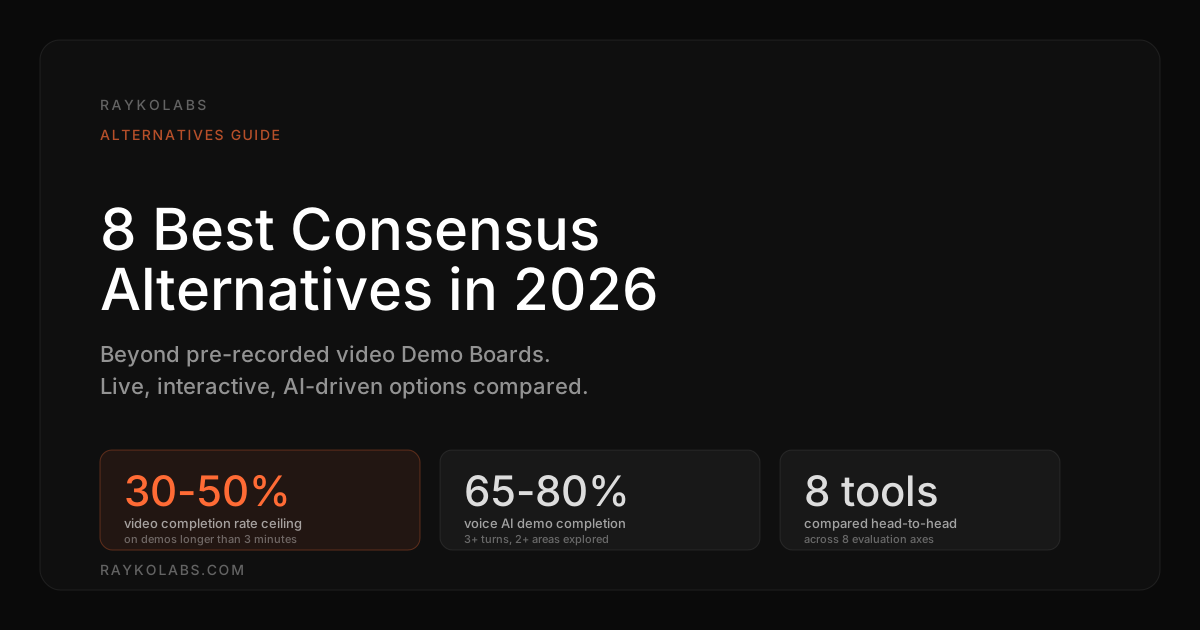
Industry video benchmarks tell a clear story. Wistia's annual State of Video puts completion rates for business videos over three minutes, the typical demo-video length, in the 30-50% range. Consensus has historically cited similar engagement numbers in their own marketing, framing it as a strength relative to live calls (where attendance can drop below 50% once no-shows are factored in). Both numbers look high relative to live demos, but they are still measuring passive consumption: a viewer who finished the whole video is no closer to having a specific question answered than one who quit after thirty seconds.
Consensus recently started positioning around "AI Product Demo Assistants," which tells you they see the shift coming too. If you are evaluating Consensus or hitting the limits of video-based demos, here are eight alternatives taking different approaches to the demo problem. For background on the broader category shift, read the complete guide to AI demo agents.
What to look for in a Consensus alternative
Consensus does two things well: stakeholder tracking across a buying committee and letting prospects self-serve without scheduling a call. Any replacement should match or exceed those strengths. Beyond that, here is what separates the tools that accelerate pipeline from the ones that create busywork:
- Interactivity, Can the prospect ask questions and get answers, or only watch or click a predetermined path? This is the dividing line in the category right now.
- Live product vs. recorded content, Is the prospect experiencing your actual product or a pre-recorded version of it? Recorded demos start aging the moment you hit save.
- Stakeholder visibility, Can you track who engaged, what they cared about, and how deeply they explored? This was Consensus's real strength, and you should not give it up.
- Voice and conversation, Can the demo talk back? See what voice-enabled demos actually look like in practice.
- Maintenance cost, How much ongoing effort does your team spend keeping demos current?
What is a Consensus Demo Board?
A Consensus Demo Board is a curated collection of short demo videos organized by topic, role, or use case. Prospects choose which segments to watch in their own order, and the platform tracks viewing activity across stakeholders. It is async video organized for committees, not an interactive product session.
Boards work best when each stakeholder needs different content and no one can attend a shared call. The limitation is that video cannot answer a follow-up question or demonstrate an unscripted workflow on demand.
How much does Consensus cost?
Consensus uses enterprise sales-led pricing with annual contracts rather than public per-seat tiers. Click-through alternatives like Storylane and Navattic typically charge per seat per month, while voice AI agents bill per completed demo. At low demo volume, per-seat tours cost less, while high-volume teams should model per-demo pricing against seat totals.
Because Consensus pricing is quoted, ask for the full platform fee plus any limits on videos, boards, seats, and storage before comparing it with alternatives.
Is Consensus better than Navattic or Storylane?
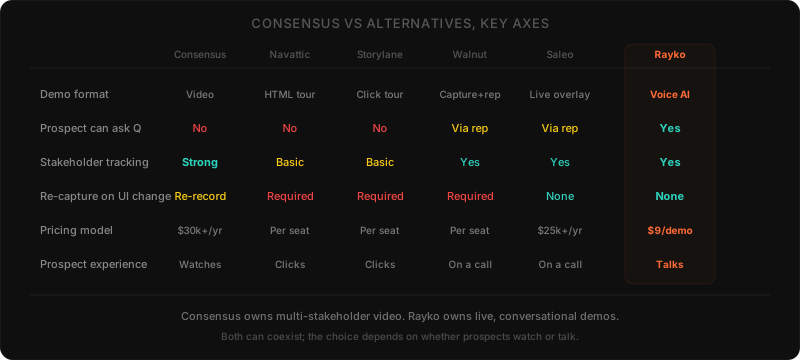
Consensus is better for async stakeholder tracking across buying committees, while Navattic and Storylane are better for embeddable website tours. Consensus organizes video by persona and reports who watched what. Navattic and Storylane let prospects click through captured product screens. Committees favor Consensus, top-of-funnel marketing favors click-through tours.
If the gap is interactivity, neither video nor click-through answers open questions. That is the use case where live AI agents differ from both categories.
The 8 best Consensus alternatives
1. RaykoLabs
RaykoLabs replaces demo videos with something Consensus never offered: a live product experience driven by an AI agent that talks to your prospect. No pre-recorded segments. No choose-which-video-to-watch. The prospect speaks, the agent listens, and the actual product moves in real time in response to their questions.
Under the hood, the agent uses Playwright for browser automation, Browserbase for cloud-hosted browser sessions, Deepgram for speech-to-text, and Cartesia for text-to-speech. A three-layer navigation system, context detection, navigation planning, and LLM integration, lets the agent intelligently move through your product based on what the prospect is asking. When a CFO asks about audit trails and a VP of Engineering asks about API rate limits, they get completely different demo experiences from the same system. No video library required.
Sessions are recorded via rrweb, so your sales team can review exactly what happened, what the prospect asked, where the agent navigated, and what held their attention. This is the same stakeholder visibility Consensus offered, but built from actual product interactions instead of video watch time.
For the technical deep-dive, see how the RaykoLabs AI demo agent works.
Best for: Teams that want autonomous, conversational demos on the live product, no reps, no video recording, no maintenance when the UI changes.
- AI voice agent that listens and responds in real time while navigating your actual product
- Three-layer navigation system for intelligent, context-aware product walkthroughs
- Zero maintenance, runs against your live product, not screenshots or recordings
- Full session analytics including transcript, navigation path, and engagement signals
- Available 24/7, handles the demos your reps never get to
2. Navattic
Navattic pioneered HTML capture demos for marketing teams. You capture your product's front end, strip out real data, add guide layers and tooltips, and embed the result on landing pages, in email campaigns, or in resource centers. It has become the default choice for product marketing teams that want a "try it" experience on their website. For a full comparison, see our Navattic alternatives roundup.
Compared to Consensus video approach, Navattic gives prospects something closer to hands-on interaction. Prospects click through the product rather than passively watching. The tradeoff is that the interaction follows a scripted path, the demo cannot answer questions or adapt mid-session. And HTML captures break when your product UI changes, creating a maintenance cycle that scales linearly with how fast you ship.
Best for: Marketing teams that want embeddable, no-code product tours on their website and in campaigns.
- HTML capture with a no-code editing layer for annotations and guides
- Flexible embed options for landing pages, docs, and email
- Lead capture gates and analytics on completion rates
- Clean, polished output that blends well with marketing sites
3. Storylane
Storylane is Navattic's most direct competitor in the click-through tour space. No-code editor, drag-and-drop annotations, screen capture, and a range of publishing options. It has earned a following for being fast to set up, most teams get their first demo live in under an hour. For detailed comparison, see our Storylane alternatives post and the Storylane comparison page.
Where Storylane edges ahead of Consensus: prospects interact rather than watch. Where it falls short of what you probably want: those interactions are still fixed. The prospect follows a predetermined path. No questions, no branching based on interest, no adapting mid-flow.
Best for: Marketing teams that need fast, embeddable click-through demos for top-of-funnel content.
- No-code editor with drag-and-drop building
- Multiple publishing formats including embed, standalone link, and gated
- Completion rate and drop-off analytics
4. Walnut
Walnut is built for sales reps, not marketers. Capture your product environment, then customize every detail, text, images, data, for a specific prospect before a call. A rep demoing to a healthcare company swaps in healthcare terminology and realistic data. A rep demoing to fintech adjusts the numbers and compliance references. Read the full Walnut alternatives breakdown.
For teams coming from Consensus, Walnut solves a different problem. Consensus scaled demos by removing the rep. Walnut makes the rep more effective but still requires them. The personalization depth is real, this is the strongest per-prospect customization tool on the market. The question is whether your team has the bandwidth to personalize every demo, or whether the volume has outgrown the model.
Best for: Sales reps who invest in account-specific preparation and want pixel-perfect personalized demo environments.
- Capture and edit product screens without engineering
- Deep per-prospect personalization of text, images, and data
- Collaborative editing across sales team members
- CRM integrations for tracking engagement
- Requires manual prep time per account
5. Arcade
Arcade converts screen recordings into interactive, shareable micro-demos. Record a product workflow, and Arcade turns it into a GIF-like interactive experience optimized for social media, help documentation, sales outreach, and product-led content.
This is not a Consensus replacement in any traditional sense. Arcade is a content creation tool more than a demo platform. But if part of why you used Consensus was to give prospects bite-sized product content without scheduling a call, Arcade's lightweight format covers that use case, just for individual workflows rather than full product overviews.
Best for: Product marketing teams creating shareable micro-demos for social, docs, and outreach.
- Screen recording to interactive walkthrough conversion
- Social-native sharing optimized for LinkedIn, Twitter, and embedding
- Lightweight format that loads fast and captures attention in feeds
- Works best for single-workflow showcases, not full product demos
6. Saleo
Saleo takes a different angle: instead of building separate demo environments, it overlays realistic data directly on top of your live product. Your actual product runs underneath, and Saleo injects the data layer that makes it look like a real customer environment. No sandbox. No capture. No separate demo instance.
In January 2026, Saleo launched an AI Demo Agent that handles guided walkthroughs autonomously. It is early, the agent does not yet match the conversational depth of a full voice-enabled demo, but the combination of live product overlays and AI guidance is headed in the right direction. For teams coming from Consensus who want to stay closer to the traditional demo format but with less maintenance, Saleo is worth a look.
As of mid-2026, Saleo's AI Demo Agent reads more as an augmentation of its overlay technology than a fully autonomous demo product. Their published case studies emphasize hybrid use cases, the agent handles repetitive walkthroughs while reps step in for higher-stakes conversations. Teams evaluating them should pilot the agent on a non-critical demo flow first to see how it handles the long-tail questions a true voice agent must answer.
Best for: Sales teams that want to demo on their live product with realistic, customizable data overlays.
- Live demo overlays injected on top of your actual product
- No separate demo environment to maintain
- AI Demo Agent for guided autonomous walkthroughs (launched Jan 2026)
- Data customization per prospect without manual environment setup
7. Supersonik
Here is a contrarian take: video calls are not the problem, bad video calls are the problem. Supersonik agrees. Backed by a16z and led by the ex-Typeform CEO, Supersonik puts an AI agent directly on video calls to run live product demos. The agent joins the call, shares its screen, navigates the product, and responds to prospect questions in real time.
Supersonik supports 40+ languages, which makes it particularly relevant for teams with a global buyer base that Consensus's English-heavy video library could never properly serve. The agent handles the entire demo call autonomously, which gives it the same "remove the rep bottleneck" advantage that Consensus promised, but through a live, interactive experience instead of pre-recorded video.
Best for: Global sales teams that want an AI agent running live demos on video calls across 40+ languages.
- AI agent that joins video calls and runs demos autonomously
- 40+ language support for global sales teams
- Live product navigation in response to prospect questions
- Backed by a16z with experienced enterprise GTM leadership
8. Karumi
Karumi emerged from YC's F25 batch and has already delivered over 3,000 agentic demos via video call. Like Supersonik, Karumi runs autonomous demos on calls, but the team's focus has been on rapid iteration and learning from high demo volume rather than broad language coverage.
Public information about Karumi's volume and funding has been thin since their YC F25 demo day; the 3,000-demo figure traces back to founder interviews around that time. Anyone evaluating them today should ask directly for current customer count, retention numbers, and pilot results, the team has been iterating fast and the public picture lags the product.
The agentic approach means prospects get a live, responsive experience. Karumi navigates the product in real time, answers questions, and adapts the demo flow to what the prospect wants to see. For teams moving away from Consensus's passive video format, Karumi represents the opposite extreme, fully live, fully autonomous, fully conversational.
Best for: Teams that want a fast-moving agentic demo platform with high volume and rapid iteration.
- Agentic demos delivered via video call
- 3,000+ demos already delivered
- YC F25 with strong builder velocity
- Live product interaction with real-time Q&A
How these alternatives compare
| Feature | RaykoLabs | Navattic | Storylane | Walnut | Arcade | Saleo | Supersonik | Karumi |
|---|---|---|---|---|---|---|---|---|
| Live product demo | Yes | No | No | No | No | Yes (overlay) | Yes | Yes |
| Voice interaction | Yes | No | No | No | No | No | Yes | Yes |
| AI-driven navigation | Yes | No | No | No | No | Yes (new) | Yes | Yes |
| No re-capture needed | Yes | No | No | No | No | Yes | Yes | Yes |
| Self-serve for prospects | Yes | Yes | Yes | Limited | Yes | Limited | No (call-based) | No (call-based) |
| Rep required | No | No | No | Yes | No | Optional | No | No |
| Stakeholder tracking | Yes | Basic | Basic | Yes | Basic | Yes | Yes | Yes |
| Multi-language | Configurable | N/A | N/A | N/A | N/A | N/A | 40+ | Limited |
What is the best Consensus alternative according to Reddit?
Reddit discussions rarely name one Consensus replacement because buyers describe different jobs. Threads about website tours point to Storylane and Navattic for speed and embeds. Threads about enterprise committees mention Consensus itself plus digital sales rooms. Threads about live answers point to AI voice agents that run the real product.
A better answer than a single winner is to match the job. Keep Consensus-style video when async stakeholder tracking is the requirement, pick click-through tours for marketing embeds, and pilot a voice agent when prospects need open Q&A without a rep.
Which tool is right for you
You should stay with Consensus if your sales motion is built around long enterprise cycles where multiple stakeholders consume content asynchronously, and you have already invested in a mature video library. That pattern matches what Salesforce State of Sales research describes for multi-threaded enterprise deals. Consensus's Demolytics and buying committee tracking are genuinely useful for that exact workflow. Not everything needs to be replaced.
Choose RaykoLabs if you want to move beyond video and static captures entirely. If your buyers want to interact with the product, ask questions, explore features, have a conversation, and you need that to happen without a rep present, RaykoLabs is the only platform here that delivers voice-driven, live-product demos autonomously at any hour. Read the ROI case for AI demos to see the numbers.
Choose Navattic or Storylane if your primary use case is marketing, embeddable product tours on your website and in campaigns. These tools are mature, fast to set up, and well-suited for top-of-funnel. They will not replace your sales demos, but they will give website visitors something better than a screenshot carousel.
Choose Walnut if you have a high-touch enterprise sales team that puts real effort into per-account preparation. Walnut's personalization depth is unmatched for reps who want to walk into a call with a demo that looks like it was built for that specific prospect.
Choose Arcade if your goal is content creation, not full-product demos. Shareable micro-demos for social, docs, and outreach.
Choose Saleo if you want to keep demoing on your live product but need a data overlay layer to make it look real. Their new AI agent is promising but still early.
Choose Supersonik or Karumi if your demo motion is call-based and you want an AI agent to handle the call instead of a rep. Supersonik for global teams needing multi-language support. Karumi for teams that value rapid iteration and high volume.
Our take
We will be direct about something most alternatives posts dance around: the demo category is splitting into two entirely different camps. On one side, you have tools that help humans create and deliver demos more efficiently, Walnut, Navattic, Storylane, Consensus. On the other side, you have tools where AI agents are the demo, RaykoLabs, Supersonik, Karumi, and increasingly Saleo. These are not competing feature sets. They are different answers to the question of whether a human should be in the loop at all.
We built RaykoLabs because we spent years watching the same broken pattern repeat. A prospect fills out a form. Sales follows up two days later. They schedule a call for next week. The prospect no-shows, or shows up but wanted to see features the rep did not prepare. Meanwhile, the prospect has already watched three competitor demos on their own time. The buyer experience gap is not about which tool looks prettiest, it is about availability, responsiveness, and whether the demo can keep up with what the buyer actually wants to learn.
One thing we learned the hard way: the latency budget for voice-driven demos is brutally tight. Our 800ms target for end-to-end response time, from the moment a prospect finishes speaking to the moment the agent starts replying and the product starts moving, came from watching session recordings where anything above a second felt like the system was broken. We chose Deepgram and Cartesia specifically because they could hit those numbers at production scale. Most of the "AI demo" tools we evaluated during our build phase were running 2-3 second round trips, which kills the conversational feel entirely.
Consensus tried to solve part of this by removing the scheduling bottleneck. Pre-recorded video meant prospects could engage on their own time. That was a real improvement over "wait for the AE to be free on Thursday." But video is a one-way medium. The prospect watches. They cannot ask. They cannot redirect. They cannot say "Skip this, show me pricing workflows" and have the product respond.
Here is a take that will age well: within two years, demo videos will be viewed the way we view product brochures today, a relic from an era when there was no better option. The next generation of demo tools will make real-time interaction the baseline. Voice in, product navigation out, instant response. Everything else will be a content asset, not a demo.
Try RaykoLabs to see what a live, conversational product demo looks like. Or start with the complete guide to AI demo agents if you want to understand the full category before deciding.
Update: Consensus has since acquired Saleo, so read our Consensus acquires Saleo analysis before signing with either vendor.
For the head-to-head version, see Consensus vs Navattic.
For the personalized-demo head-to-head, see Storylane vs Consensus.
Frequently asked questions
What is the best Consensus alternative in 2026?
For asynchronous buying committees, video-first alternatives like Vidyard and Loom for Sales work. For interactive demos, Storylane and Navattic. For live AI demos that replace the rep entirely, Rayko (voice agent on real product). Consensus's specific niche, video Demo Boards organized by buyer persona, is best replaced by a combination of an AI demo agent plus a digital sales room.
How does Consensus compare to live AI demos?
Consensus delivers pre-recorded video demos that prospects watch passively. They cannot answer questions, adapt to a prospect's role, or show specific product behaviors on demand. Live AI demos (Rayko) run on your actual product and respond to questions in real time. For complex products with high question density, AI demos convert better than video at the same traffic volume.
Why are companies leaving Consensus?
Three reasons: (1) prospects increasingly resist passive video content and prefer interactive product experiences; (2) video demo libraries go stale after every product release; (3) Demolytics analytics is valuable but doesn't compensate for the underlying interactivity gap. Teams typically evaluate live AI agents or interactive tour platforms next.
How much does Consensus cost vs alternatives?
Consensus is enterprise-only with sales-led pricing, typically starting in the $30,000+ per year range. Storylane and Navattic price per seat ($300-$1,500/month). Rayko bills per completed demo at $9 per session with no per-seat fees, which is structurally different and usually cheaper at sub-enterprise volumes.
Can AI demo agents handle the multi-persona use case Consensus is designed for?
Yes. AI agents adapt in real time based on the prospect's stated role, the questions they ask, and the page they land on. A CHRO and a recruiter visiting the same product page get different demos automatically. This is the same problem Consensus's persona-based Demo Boards address, but solved by an agent that adapts conversationally instead of by pre-built video segments.
Sources
- Consensus, Demo automation platform, Consensus
- Navattic, Interactive product demos, Navattic
- Storylane, Interactive demo platform, Storylane
- State of Sales, Salesforce Research
- The B2B Buying Journey, Gartner
Cite this article
Utkarsh Agrawal. "Consensus Alternatives: Best Live Demo Upgrade 2026." RaykoLabs Blog, March 9, 2026. https://raykolabs.com/blog/best-consensus-alternatives

Utkarsh Agrawal is CTO of RaykoLabs, where he leads engineering on Rayko, the AI demo agent that runs live, voice-enabled product demos in a real browser for B2B SaaS teams. His work spans real-time voice interaction, browser automation with Playwright and Browserbase, speech-model orchestration, and the infrastructure that keeps autonomous demos reliable around the clock. On the RaykoLabs blog he writes practical guides on voice-enabled product demos, demo automation, and what it takes to ship production AI agents for sales: how to qualify prospects mid-demo, how to measure demo performance, and how buying teams actually evaluate demo software. His comparisons of demo platforms are built from hands-on testing and vendor documentation, with trade-offs stated plainly so buyers can decide fit.
See RaykoLabs in action
Watch an AI agent run a live, personalized product demo, no scheduling, no waiting.
START LIVE DEMO