Loading...

Saleo Alternatives: Best Rep-Free Demo Pick 2026
Top Saleo alternatives for 2026: RaykoLabs is our pick for rep-free AI demos. Compare Walnut, Demostack, Navattic and more, then pick your fit.
Quick answer
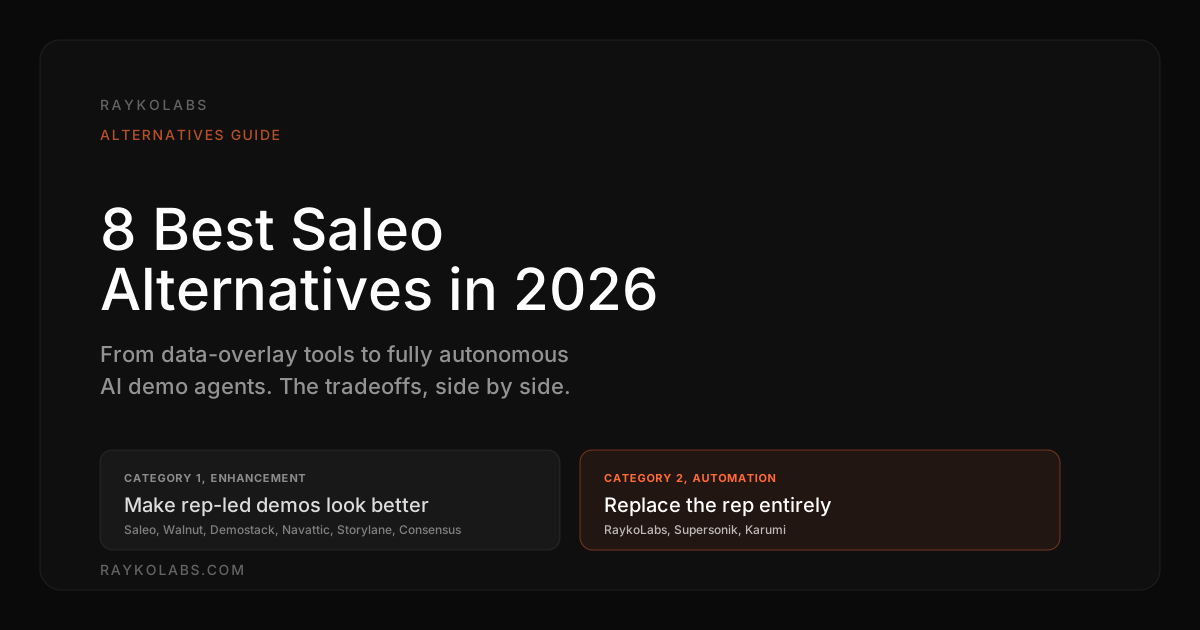
The best Saleo alternative in 2026 depends on whether you want to keep a human running demos or remove them. Demostack is the closest direct replacement for Saleo's realistic demo data, Walnut serves human-led personalized demos, and Navattic, Storylane, and Consensus cover tours and video. For autonomous demos that no longer need a rep on every call, AI voice agents like Rayko, Supersonik, and Karumi replace the overlay model.
Want this running on your product? Rayko demos it live, with your prospects asking questions by voice.
START LIVE DEMOThe best Saleo alternative for removing the rep from every call is RaykoLabs, because it demos your live product by voice around the clock with no overlay upkeep. If you want to keep rep-led demos, Demostack and Walnut are the closest direct replacements. If you need marketing tours or committee video, Navattic and Consensus fit those jobs. Read on for all eight options and pick by use case.
Saleo solved the wrong problem brilliantly. Their live demo overlay technology is genuinely impressive, inject realistic, personalized data into your actual product during a sales call, so your reporting dashboard shows Acme Corp's logo instead of "Test Company 1." No more apologizing for bad demo data. No more "just imagine your numbers here." The data looks real because it is sitting on top of your real product.
But the issue was never bad demo data. The issue is that a human still has to run the demo. A sales engineer still has to be on the call, still has to navigate, still has to handle objections in real time. Saleo makes that person's job easier, but it does not remove the bottleneck. And in a market where buyers want to evaluate products on their own terms and on their own schedule, "better-supported human demos" is an incremental improvement on a model that needs rethinking.
Saleo launched their AI Demo Agent in January 2026, a conversational, multi-lingual agent that can run demos autonomously. That move signals they see the same shift we do. But building an AI agent on top of an overlay architecture designed for human-led demos is a different challenge than building one from scratch for autonomous operation.
If you are evaluating Saleo or reconsidering your demo stack, here are eight alternatives that approach the problem from different angles. Some enhance the human-led model. Others replace it entirely.
What to look for in a Saleo alternative
Saleo's core value proposition is making live demos look better. That is worth keeping as a baseline, but your evaluation criteria should go further:
- Autonomy, Does the tool still require a rep on every call, or can it demo your product independently? This is the dividing line between demo enhancement and demo automation.
- Data realism, Can the demo show realistic, prospect-relevant data? Saleo does this well with overlays. Others achieve it differently.
- Maintenance cost, What happens when your product ships a new release? Overlays that depend on specific DOM elements can break. Captures need re-capturing. Live product demos need nothing.
- Scalability, Can you handle three times the demo requests without growing headcount? Or five times?
- Buyer flexibility, Can prospects engage with the demo outside of a scheduled call? At midnight? In Portuguese?
How does Saleo work?
Saleo overlays realistic personalized data on top of your live product during a rep-led call. The product runs underneath while Saleo injects the data layer, so dashboards show the prospect's company, metrics, and terminology. It is a live-product enhancement for human demos, not a self-serve tour or an autonomous agent.
The overlay approach keeps demos close to the real product. It still requires a rep to navigate, present, and answer questions on every call.
How much does Saleo cost?
Saleo uses enterprise sales-led pricing with annual contracts rather than public per-seat tiers. Comparable rep-led tools like Walnut price per seat, click-through tours list lower per-seat ranges, and voice AI agents bill per completed demo. Teams comparing options should request the platform fee plus any seat, overlay, and support limits.
Per-seat plans suit small teams with steady call volume. Per-demo plans suit teams with spiky inbound or coverage gaps outside business hours.
The 8 best Saleo alternatives
1. RaykoLabs
RaykoLabs is not an overlay and not a capture tool. It is an AI agent that controls your actual product in a live browser and talks to prospects while doing it.
The technical architecture is purpose-built for autonomous demos. Playwright handles browser automation. Browserbase provides cloud infrastructure so sessions run isolated and fast. Deepgram converts prospect speech to text, Cartesia converts agent responses back to natural speech, and rrweb records every session for your team to review later. The agent uses a three-layer navigation system, context detection, navigation planning, and LLM integration, to move through your product intelligently rather than following a script.
What this means in practice: a prospect lands on your demo page, starts talking, and the agent responds. "Show me how you handle multi-currency reporting" gets an immediate navigation to reporting with a live walkthrough of currency settings. "Now show me permissions" triggers a context switch to admin settings. No predetermined path. No waiting for a rep to be available. For a full breakdown of the architecture, see how the RaykoLabs AI demo agent works.
The difference from Saleo's AI Demo Agent matters here. Saleo built their agent on top of an overlay system designed for human-led calls. RaykoLabs built every layer -- voice pipeline, browser control, navigation intelligence -- specifically for the autonomous use case. That architectural decision shows up in the experience.
From an engineering perspective: we evaluated Saleo's overlay approach early and rejected it. Overlays depend on stable DOM selectors -- when the customer ships a UI refactor, every overlay mapping breaks. Our approach runs Playwright against the live product with no DOM dependencies baked into configuration. The FastAPI backend streams events over WebSocket between the voice pipeline (Deepgram for transcription, Cartesia for synthesis) and the browser automation layer. The three-layer navigation system detects page context through visual and structural cues rather than hardcoded element IDs. The result is zero maintenance when the product updates, and an 800ms end-to-end latency target that holds even when the product has complex page transitions. Session replays through rrweb capture the full browser state, not just screenshots, so your team sees exactly what the prospect experienced.
Best for: Teams that want to remove the rep bottleneck entirely and let an AI agent demo the live product 24/7, in any language, with no maintenance.
- AI voice agent with real-time speech recognition and natural voice synthesis
- Operates on your actual product, zero overlay dependencies, zero re-capture work
- Three-layer navigation that adapts to what the prospect wants to see, not a fixed script
- Session recordings and full analytics on every question asked and feature explored
- Available around the clock, scales to unlimited concurrent demos
2. Navattic
Navattic captures your product's front end as static HTML and lets you build interactive click-through tours from those captures. It is a marketing-first tool, embed a demo on your landing page, gate it behind a form, track who completes it.
The approach works for top-of-funnel lead generation where you want prospects to get a taste of the product before booking a call. Where it falls short is depth. The demos follow a fixed path, cannot respond to questions, and need re-capturing every time your UI changes. For teams currently using Saleo's live overlay approach, switching to static HTML captures would feel like a step backward in demo fidelity. But if your goal is ungated marketing demos rather than live sales calls, Navattic serves a different use case than Saleo did. See the full Navattic alternatives roundup for more context.
Best for: Marketing teams that need embeddable, self-serve product tours on websites and landing pages.
- HTML capture with guided click paths and hotspots
- Embeddable on any website, shareable via direct links
- Lead capture forms and analytics on demo engagement
- Integrations with HubSpot, Marketo, and Salesforce
3. Storylane
Storylane is a no-code platform for building guided product tours. Capture screens, add tooltips and callouts, define the click path, publish. The editor is fast, you can have a basic demo live in under an hour. For a detailed comparison, read our Storylane alternatives analysis.
Storylane fills a gap for teams that need demo content quickly without engineering involvement. The tradeoff is the same as every capture-based tool: your demos are only as current as your last capture, and they cannot adapt to individual prospect interests. If a prospect cares about integrations but your tour starts with dashboard setup, they sit through the parts they do not care about or they leave.
Best for: Teams that need to create polished click-through tours quickly, especially for campaign landing pages and outbound sequences.
- No-code drag-and-drop editor for building guided tours
- Multiple output formats including embeds, standalone links, and gated demos
- Branching logic to give prospects some path choices
- Completion tracking and drop-off analytics
4. Walnut
Walnut is built for sales teams. Capture your product environment, then customize every element, text, images, data, branding, to match a specific prospect's context. A rep preparing for a call with a logistics company swaps in logistics terminology, relevant KPIs, and industry-appropriate data. See how Walnut compares to RaykoLabs for a feature-by-feature breakdown.
Walnut and Saleo share DNA. Both are sales-focused, both prioritize data personalization, both assume a human rep is running the show. The key difference: Saleo overlays on your live product while Walnut works from captured environments. Walnut gives reps more control over what the prospect sees (you can hide or modify anything), while Saleo keeps you closer to the real product.
The limitation for both is the same. Every demo requires prep time. Every demo requires a rep. That works when you run 20 demos a month. It does not work when you want to run 200.
Best for: Sales reps who invest in account-specific demo preparation and want granular control over every element prospects see.
- Capture and customize entire product environments
- Element-level editing, change text, swap images, modify data
- Template system for faster prep across similar accounts
- CRM integrations for tracking demo activity alongside deal data
5. Demostack
Demostack takes the clone approach. Instead of capturing screenshots or overlaying data, it creates a full working clone of your product environment. Reps get a sandbox that looks and behaves like the real thing, populated with data tailored to each prospect's industry and use case.
This is the closest direct alternative to Saleo's core value proposition. Both aim for demo environments that feel real. Demostack achieves it through cloning rather than overlaying, which means less dependency on your live product's DOM structure but more infrastructure overhead to maintain the clones. When your product updates, the clones need updating too, though Demostack has invested in making that process smoother than it used to be.
Demostack's pricing model has historically been quote-based for the team and enterprise tiers, with the entry tier landing in the mid-four-figures-per-month range for smaller teams. Anyone evaluating them today should ask directly for the current price-list, because the public site lists ranges rather than fixed per-seat numbers, and the gap between list and negotiated pricing is meaningful.
Best for: Sales teams that want full-fidelity demo sandboxes with tailored data, without running demos on the production product.
- Cloned product environments that behave like the real product
- Data customization by industry, company size, and use case
- Environment management for teams running multiple concurrent demo tracks
- Analytics on which features prospects interact with most
6. Consensus
Consensus takes a completely different approach. Instead of interactive product demos, it uses curated video content organized into "Demo Boards." Prospects self-select which video segments to watch based on their role and interests. The platform then tracks engagement across the buying committee, who watched what, how much, and when.
For enterprise sales teams running complex, multi-threaded deals, Consensus answers a question other tools ignore: "Which stakeholders on the buying committee have actually seen the product?" That visibility is worth something. But video is a passive format. Prospects watch a description of your product. They do not experience it. And the gap between watching someone else use reporting and using reporting yourself is the gap between a brochure and a test drive.
Best for: Enterprise sales teams selling to large buying committees who need stakeholder engagement tracking and asynchronous demo distribution.
- Video demo library organized by persona, product area, and use case
- Prospect-driven demo path selection, no fixed linear sequence
- Buying committee analytics showing individual stakeholder engagement
- Integration with Salesforce and other CRMs for deal-level insight
7. Supersonik
Supersonik is a newer entrant backed by a16z. Founded by the former CEO of Typeform, the company is building AI agents that join video calls and demo products autonomously during live sales conversations. The agent can navigate your product, respond to prospect questions in real time, and operate in over 40 languages.
The positioning is similar to what Saleo's AI Demo Agent is attempting, but Supersonik built for the autonomous use case from day one rather than adding AI on top of an overlay system. Their approach centers on the live video call, the agent is a participant on the Zoom or Google Meet, not a standalone experience. This keeps the interaction in the format buyers are already familiar with but removes the need for a human SE on the call.
Supersonik launched with 40+ languages on the speech-to-text and text-to-speech layers, and has continued to expand language coverage steadily since. As of mid-2026 their public materials still position 40+ as the floor; the long tail of supported languages is broader if you need them. The signal that matters more than count is quality, accent handling and conversational nuance vary widely by language even within a single STT provider.
Best for: Teams that want an AI agent to handle live demo calls autonomously, especially those selling internationally across multiple languages.
- AI agent joins video calls as a live participant
- Real-time product navigation during the conversation
- 40+ language support for global sales teams
- Founded by ex-Typeform CEO, backed by a16z
- Focused specifically on the live call use case
8. Karumi
Karumi is a Y Combinator F25 company building agentic demos delivered via video calls. Their agent joins a call, understands what the prospect is asking, and demonstrates the product accordingly. The team reports running over 3,000 demos to date, which gives them a meaningful dataset for training their agent's conversational and navigation capabilities.
Karumi and Supersonik are attacking the same wedge, AI agents that replace the human on live demo calls. The differences are in execution details and maturity rather than fundamental approach. Karumi's YC backing and the volume of demos they have processed suggest they are iterating quickly. Whether their agent handles edge cases and complex product navigation as well as a trained SE is the question every team evaluating them will need to answer with a pilot.
Public information on Karumi's volume and feature set has been thin since their YC F25 demo day, the 3,000-demo figure traces back to founder interviews around that time. Anyone evaluating Karumi today should ask directly for current customer count, retention numbers, and pilot results: the team has been iterating fast and the public picture lags the product.
Best for: Teams looking for an AI-powered demo agent for live video calls, especially mid-market companies that want to scale demos without scaling headcount.
- Agentic demo delivery via video calls
- Adaptive navigation based on prospect questions and interests
- 3,000+ demos delivered, providing a trained conversational model
- Y Combinator F25 batch, actively shipping and iterating
- Focused on reducing reliance on human SEs for standard demos
How these alternatives compare
| Feature | RaykoLabs | Navattic | Storylane | Walnut | Demostack | Consensus | Supersonik | Karumi |
|---|---|---|---|---|---|---|---|---|
| Live product demo | Yes | No | No | No | Clone | No | Yes | Yes |
| Voice interaction | Yes | No | No | No | No | No | Yes | Yes |
| AI-driven navigation | Yes | No | No | No | No | No | Yes | Yes |
| No re-capture/rebuild | Yes | No | No | No | No | N/A | Yes | Yes |
| Self-serve (no rep) | Yes | Yes | Yes | Limited | Limited | Yes | No | No |
| Async availability | 24/7 | 24/7 | 24/7 | Rep hours | Rep hours | 24/7 | Call-based | Call-based |
| Multi-language | Yes | No | No | No | No | Limited | 40+ | Limited |
| Prospect Q&A | Yes | No | No | No | No | No | Yes | Yes |
What is the best Saleo alternative according to Reddit?
Reddit threads about Saleo alternatives divide on whether to keep a human on the call. Commenters who want to keep rep-led demos mention Walnut for personalization and Demostack for cloned sandboxes. Commenters who want to remove the scheduling bottleneck mention AI voice agents that run the live product on demand.
The deciding question is throughput. Keep an overlay or clone when a rep can cover every strategic demo. Pilot an autonomous agent when demo requests exceed rep capacity or arrive outside business hours.
Is Saleo better than Walnut or Demostack?
Saleo is better for live-product realism, Walnut is better for granular per-prospect editing, and Demostack is better for fully functional sandboxes. Saleo injects a data layer over the real product, Walnut customizes captured screens without engineering, and Demostack clones the environment for reps to operate. All three assume a human runs the demo.
Choose by maintenance tolerance. Overlays track the live product, captures need re-capture after UI changes, and clones need environment upkeep.
Which tool is right for you
The demo platform market is splitting into two distinct categories, and the choice depends on which category matches your sales motion.
Category one: demo enhancement tools. Navattic, Storylane, Walnut, Demostack, and Consensus all make your existing demo process better. Better data, better visuals, better tracking. They assume a human is still driving, either a rep on a call or a marketing team building and maintaining content. Saleo fits squarely in this category too. If your demo process works and you just need it polished, these tools deliver.
Category two: demo automation. RaykoLabs, Supersonik, and Karumi are building systems where the AI runs the demo. No rep needed. No prep time per prospect. The product demos itself, responds to questions, and adapts to what the prospect cares about. If you are building the business case for AI demo automation, this category is where the multiplier effect lives.
Here is the honest take from our side. We built RaykoLabs because we watched the same problem play out at company after company: brilliant SEs spending 80% of their time on repetitive first demos, while strategic deals that actually needed human expertise got squeezed into whatever calendar slots remained. The tools in category one make the repetitive demos a bit easier. The tools in category two eliminate them so your best people can focus on the deals that matter. Read the complete guide to AI demo automation for a deeper look at where this market is heading.
If you are currently on Saleo and happy with the human-led model but want to evaluate alternatives, Demostack is the closest direct replacement, both aim for high-fidelity demo data, just through different mechanisms.
If Saleo's new AI Demo Agent interests you but you want to compare it against purpose-built autonomous demo platforms, evaluate RaykoLabs alongside Supersonik and Karumi. The architectural differences, overlay-based AI versus native autonomous design, will show up in pilot testing.
If your priority is marketing-led demos rather than sales-led calls, Navattic and Storylane serve that use case well and are not trying to solve the same problem Saleo solves.
If you sell to large buying committees and need to track which stakeholders are engaging, Consensus remains the strongest option for that specific workflow, though it pairs well with a live demo tool for the actual product experience.
One thing we have learned from studying why prospects ghost demos and talking to dozens of sales teams: the tool matters far less than the demo experience you build with it. A thoughtful demo flow on a basic platform will outperform a lazy walkthrough on the most sophisticated one. Whatever you choose, invest the time into your demo story, what you show first, what you skip, and what question you answer before the prospect has to ask it.
Update: Saleo has since been acquired by Consensus, so read our Consensus acquires Saleo analysis for what the deal changes.
For the closest head-to-head, where Demostack is covered as the closest Saleo replacement, see Walnut vs Demostack.
For the four-way version, see Saleo vs Storylane vs Demostack vs Olto.
Frequently asked questions
What is the best Saleo alternative in 2026?
It depends on whether you want to keep humans in the demo loop or remove them. Walnut is the closest direct alternative for human-led demos with personalized data. For AI-driven autonomous demos that remove the rep, Rayko is the strongest alternative. Saleo's specific niche, real-time data overlay during live calls, is increasingly being replaced by AI agents that don't need a human to drive the demo.
How does Saleo compare to AI voice demo agents?
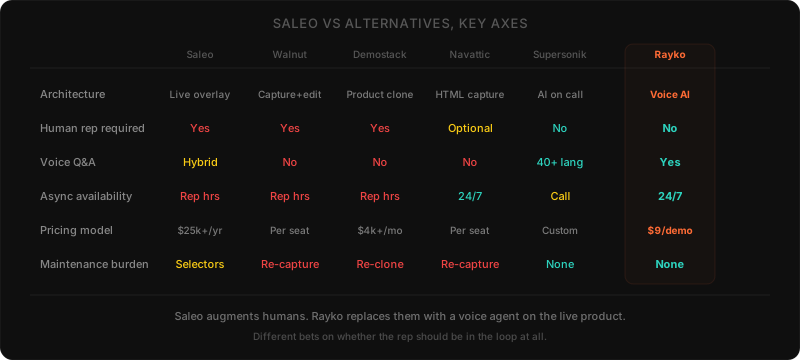
Saleo overlays personalized data on your live product during human-led demos, so dashboards show 'Acme Corp' instead of 'Test Company 1'. AI voice demo agents (Rayko) replace the human rep entirely; the AI runs the demo end-to-end with voice. Saleo augments humans. AI voice agents replace them. Pick Saleo to empower reps; pick a voice agent to scale demos without scaling headcount.
Why are companies switching from Saleo?
Two reasons: (1) AI voice agents now match Saleo's data-overlay quality and remove the human bottleneck entirely; (2) Saleo requires a human SE on every call, which caps throughput and concentrates risk on rep skill. Teams that want to scale demo volume usually evaluate AI voice agents next.
How much does Saleo cost vs alternatives?
Saleo is enterprise-only with sales-led pricing, typically in the $25,000+ per year range. Walnut and Storylane are per-seat ($300-$1,500/month). Rayko bills per completed demo at $9 per session with no per-seat fees. At >100 demos per month, Rayko is usually significantly cheaper.
Can AI demo agents handle the data-quality use case Saleo is designed for?
Yes. AI agents control your live product directly, so they can navigate to demo-data tenants, sandbox accounts, or production-like environments where data quality is already realistic. This solves the same problem Saleo addresses (showing realistic data) but without requiring an overlay technology or a human to drive the demo.
Sources
- Saleo, Live demo experience platform, Saleo
- Walnut, Interactive demo software, Walnut
- Consensus, Demo automation platform, Consensus
- State of Sales, Salesforce Research
- The B2B Buying Journey, Gartner
Cite this article
Utkarsh Agrawal. "Saleo Alternatives: Best Rep-Free Demo Pick 2026." RaykoLabs Blog, March 23, 2026. https://raykolabs.com/blog/best-saleo-alternatives

Utkarsh Agrawal is CTO of RaykoLabs, where he leads engineering on Rayko, the AI demo agent that runs live, voice-enabled product demos in a real browser for B2B SaaS teams. His work spans real-time voice interaction, browser automation with Playwright and Browserbase, speech-model orchestration, and the infrastructure that keeps autonomous demos reliable around the clock. On the RaykoLabs blog he writes practical guides on voice-enabled product demos, demo automation, and what it takes to ship production AI agents for sales: how to qualify prospects mid-demo, how to measure demo performance, and how buying teams actually evaluate demo software. His comparisons of demo platforms are built from hands-on testing and vendor documentation, with trade-offs stated plainly so buyers can decide fit.
See RaykoLabs in action
Watch an AI agent run a live, personalized product demo, no scheduling, no waiting.
START LIVE DEMO