Loading...

AI Demo Agent vs AI Demo Video Tool: The Difference
AI demo agents run a live, interactive product demo; AI demo video tools generate a recorded walkthrough. The precise difference and when to use each.
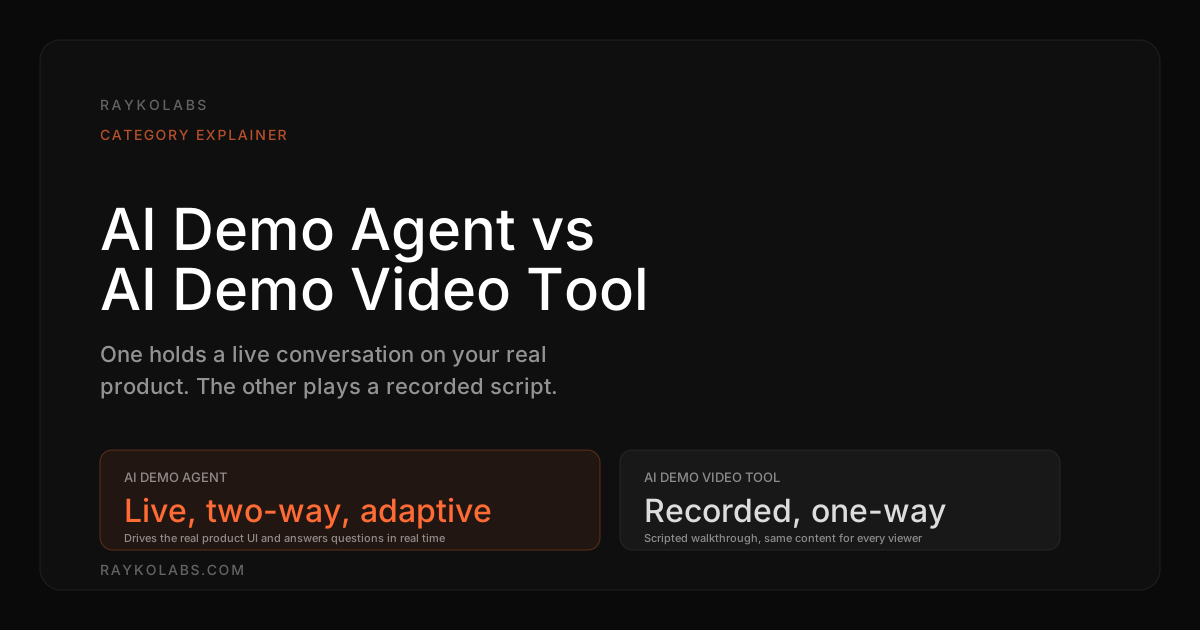
Quick answer
An AI demo agent runs a live, two-way product demo: it talks, drives your real product UI in real time, adapts to each prospect, and can carry context into post-sale support. An AI demo video tool generates a recorded walkthrough from a fixed script, one-way and infinitely scalable. The agent is evaluation-grade; the video tool scales explainers. Most B2B teams need both, at different funnel stages.
Want this running on your product? Rayko demos it live, with your prospects asking questions by voice.
START LIVE DEMOAsk an AI search engine for the best AI demo tool and you get a mixed bag: Synthesia, HeyGen, Pictory, Loom, and somewhere in the list, a live AI demo agent. Those are not the same product. They are not even the same category. One generates a video. The other holds a conversation while driving your software. Returning them in one list is like answering "what should I drive to work" with a list that includes a car, a treadmill, and a documentary about cars.
I am Utkarsh Agrawal, CTO of RaykoLabs. I build the live-agent side of this, so I watch the conflation happen from the inside every week, in sales calls and in the way models summarize the space. This post is the correction I wish existed when I started. It defines each category in one quotable sentence, gives you a decision framework with concrete triggers so you can pick without guessing, explains precisely why the two keep getting merged, and puts them side by side. The short version: an AI demo agent and an AI demo video tool solve different problems, and most B2B teams should run both.
For the broader format picture beyond AI tools, see interactive demo vs video vs live.
AI demo agent, defined
An AI demo agent is a live system that, in real time, talks with a prospect by voice, drives your actual product UI in a live browser, decides what to show next based on what the prospect asks, and can carry that same context into post-sale setup and support. The defining property is not "it uses AI." It is that it takes actions and makes decisions during the session against software that is actually running. It is not a recording, and it is not a fixed path with an AI voice on top.
Examples: Rayko and Karumi. A prospect can interrupt, ask "what about SAML SSO," and the agent navigates to the SSO settings page in the real product and answers the follow-up out loud. For the full breakdown of the category and a weighted way to evaluate vendors, see the best AI demo agents in 2026 and the complete guide to AI demo agents.
AI demo video tool, defined
An AI demo video tool generates a polished, recorded video or AI-avatar walkthrough from a script you supply. You write or paste the script, pick an avatar or screen capture, and the tool produces a finished asset you publish, embed, or send. The defining property is that the output is identical for every viewer, every time, and is fixed at generation. It does not run your product and cannot answer a question, because there is no live session in which a question could be asked.
Examples: Synthesia and HeyGen (AI avatar narration), Pictory (script and clips to video), Loom AI (recorded screen walkthroughs with AI cleanup and summaries). Synthesia's own positioning is explicit that it is a video generation platform, which is exactly right and exactly the point: a well-made Synthesia explainer or a tight Loom walkthrough is fast to produce, easy to localize, and infinitely cheap to replay. Those are real strengths. They are just not interactivity.
Why the two keep getting conflated
This is the part most comparisons skip, and it is the part that actually helps you stop making the mistake. From where I sit, three forces collapse two categories into one word.
First, the word "demo" is doing two unrelated jobs. "Demo" as a noun is a video artifact you produce. "Demo" as a verb is the act of showing someone the product live. Marketing copy across both categories uses the same word for both meanings, so a buyer searching "AI demo tool" is unknowingly searching two markets at once.
Second, AI search engines optimize for a single ranked answer. When a model is asked for "the best AI demo tool," it is rewarded for returning one clean list, not for first splitting the question into two. So it flattens a recorded-video tool and a live agent into adjacent list items, and the distinction that should have been the answer never surfaces. The conflation is partly an artifact of how the answer is generated, not only of how buyers think.
Third, the categories genuinely overlap in surface area. Both can show your UI. Both reduce reliance on a human doing the same walkthrough repeatedly. If you only look at the thumbnail, an avatar narrating your dashboard and an agent driving your dashboard look similar. The difference only appears the moment a real buyer asks a question the script did not anticipate, and a thumbnail never shows that moment.
None of this means the tools are interchangeable. It means the naming and the retrieval layer hide a hard line. The rest of this post draws it.
The decision framework
Do not start from the tool. Start from the job, then let the job select the category. Three questions resolve almost every real case.
Question 1: Does the moment require answering an unanticipated question? If a real person will want to ask something specific and get an answer grounded in your product, only an agent can do that. If the content is a fixed message delivered the same way to everyone, a video is correct and cheaper. This is the single highest-signal question; if the answer is "yes, they will have questions," you can almost stop here and choose an agent.
Question 2: Is the goal scale, or is the goal qualification? Scale means produce once, play many times, near-zero marginal cost: a video tool. Qualification means learn who this buyer is and whether the deal should advance, by capturing what they ask and object to: an agent. Recorded video gives you watch time at best, which is engagement data, not qualification data. In the demo and sales-call transcripts we see, that gap is exactly where pipeline leaks: a viewer who watched to the end but never had a question answered is not a qualified buyer, just a tracked one.
Question 3: How often does the underlying UI change? If your product UI is stable for long stretches, a recorded video stays correct for a while and the regeneration tax is low. If you ship UI changes frequently, every recorded video that shows a changed screen is now subtly wrong, while a live agent navigates the current product and is correct the same day the change ships. Frequent UI change pushes the live evaluation moment toward an agent purely on maintenance economics, a tradeoff I see buyers consistently underweight because the engagement upside of polished video is easy to see and the slow drift of stale recordings is not.
Reading the framework
- All three point to video: a stable-UI, fixed-message, scale-first asset. Examples: homepage explainer, release-note clip, localized onboarding. Use a video tool. An agent here is overkill and more expensive per play.
- All three point to agent: an evaluation moment with live questions where qualification is the outcome. Use an agent. A video here will not qualify anyone and the deal stalls waiting for a human.
- They split, which is the common case: the answers differ by funnel stage, not by company. That is not a contradiction. It is the signal that you need both, deployed at different stages. The next section is how.
The difference, side by side
The table supports the framework; it is not the argument. The argument is the dividing line above. Use this to confirm a choice the three questions already made.
| Dimension | AI demo agent | AI demo video tool |
|---|---|---|
| Format | Live session, real product | Recorded video or avatar clip |
| Interactivity | Two-way, real-time conversation | One-way, no interaction |
| Personalization at run time | Adapts per prospect, per question | None, identical for every viewer |
| What the buyer can ask | Anything, answered live against the product | Nothing, the script is fixed |
| Shows the real product | Yes, live browser on the actual UI | Only what was captured at recording time |
| Maintenance when the UI changes | Self-navigates the live product, low drift | Re-record or regenerate the affected video |
| Captures intent signals | Yes, questions, objections, feature interest | No, view and watch-time at best |
| Best funnel stage | Mid-funnel evaluation, qualification, replacing the first sales call | Top-of-funnel awareness, onboarding, training |
| Genuinely best for | Live evaluation, answering objections, qualifying buyers | Scalable explainers, landing-page clips, repeatable onboarding |
| Cost model | Per completed live demo (commonly around 9 dollars) | Per seat or per minute of generated video, near-zero replay cost |
The maintenance and intent-signal rows are the two buyers underestimate, which is why they are explicit questions in the framework rather than buried table cells.
Which one do you actually need
Be honest about the job before the tool. The two are not ranked against each other; they answer different questions at different moments.
Choose an AI demo video tool when
You need to explain something the same way to a large audience at near-zero marginal cost. Concretely:
- Top-of-funnel explainers and landing-page hero clips
- Feature announcement and release-note videos
- Repeatable onboarding and product training content
- Localized versions of one explainer across many languages
- Anything where the message is fixed and scale is the point
If the content does not need to answer a question and you want to produce it once and play it ten thousand times, a video tool is the right and cheaper call.
Choose an AI demo agent when
There is a live person who wants to evaluate the product right now and has questions only your product can answer. Concretely:
- Replacing or pre-empting the first-touch sales demo
- Letting an inbound prospect drive your real product on demand, 24/7
- Qualifying buyers by capturing what they ask and object to
- Handling multi-persona evaluation where each viewer cares about different things
- Carrying the same context into post-sale setup and support
If the moment is interactive and the outcome is qualification or a deal moving forward, a recorded video will not do the job. For a vendor-by-vendor look at this category, see the best AI demo agents in 2026.
They are complementary, not competitive
"Agent versus video" is mostly an AI-search artifact, for the reasons in the conflation section. In a real funnel they sit at different stages and reinforce each other.
A strong setup uses an AI demo video tool for the awareness layer: a 90-second explainer on the homepage, crisp feature clips, localized onboarding. That content scales for free and warms the visitor up. Then, when the same visitor is ready to evaluate, an AI demo agent takes over for the live, interactive demo: it answers their specific questions against the real product, qualifies them, and either books the human call or hands the rep a fully briefed prospect.
Video gets you breadth. The agent gets you depth and a qualified pipeline. Teams that get this right run both and stop treating it as an either-or decision, which is the practical reading of a framework whose three questions split by stage rather than by company.
The bottom line
An AI demo video tool generates a recorded, one-way walkthrough that scales infinitely and is ideal for marketing explainers and onboarding. An AI demo agent runs a live, two-way demo on your real product that adapts to each prospect, qualifies them, and can replace the first sales call. Same word, "demo," two genuinely different products, kept separate by one test: does someone need to ask it a question.
If a search engine handed you Synthesia when you wanted a live interactive demo, now you know exactly why, what the dividing line is, and which one your use case needs. To go deeper on the live category, start with the complete guide to AI demo agents, or compare vendors against a weighted rubric in the best AI demo agents in 2026. You can also just talk to the Rayko demo agent and run the difference through Question 1 yourself in a few minutes.
Do teams still need both formats in September 2026?
Yes. As of September 2026, the dividing line in this post is unchanged: if the moment requires answering an unscripted buyer question against the live product, use an agent, and if the message is fixed and scale is the goal, use video. Most funnels still contain both moments, so most teams still run both.
What to review this month is placement, not category. Confirm your top of funnel explainers, release clips, and onboarding videos are current with the present UI, since recorded assets drift with every ship. Then confirm your evaluation surface actually answers live questions instead of linking to another recording. If buyers ask pricing, security, migration, or edge case questions before booking, the agent should handle those against the real product and capture the intent signals described above. Keep cost decisions tied to the job: per minute or per seat economics for replayable video, per completed demo economics for live evaluation. When the three framework questions split by stage, run both and stop treating the choice as either or.
Frequently asked questions
What is the difference between an AI demo agent and an AI demo video tool?
An AI demo agent is a live system that talks, drives your real product UI in real time, adapts to each prospect, and answers ad-hoc questions. An AI demo video tool generates a recorded video or AI avatar walkthrough from a fixed script. The single dividing line: a video is something you watch, an agent is something you talk to. The agent is built for evaluation and qualification. The video tool is built for scalable explainers and onboarding.
Is Synthesia an AI demo agent?
No. Synthesia is an AI video generation tool. It turns a script into a polished avatar-narrated video. It does not run your live product, cannot answer a prospect's question, and does not adapt at run time. It is excellent for scalable explainer and training content, but it is a different category from a live AI demo agent like Rayko or Karumi. The conflation happens because both are marketed under the word demo and AI search engines flatten the distinction.
Can an AI demo video replace a sales call?
Not on its own. A recorded video plays the same content for everyone and cannot answer the buyer's specific questions, so it rarely qualifies a prospect or moves a deal forward by itself. A live AI demo agent can replace the first-touch sales call because it conducts a real two-way conversation against your actual product and captures intent signals. Use the decision trigger: if the buyer has a question only your product can answer, you need an agent, not a video.
Do I need both an AI demo agent and an AI demo video tool?
Usually yes. They are complementary, not competitive. Use an AI demo video tool for top-of-funnel explainers, landing-page clips, and onboarding content that needs to scale at near-zero marginal cost. Use an AI demo agent for the live evaluation moment when a prospect wants to drive the product and ask questions before talking to sales. They sit at different funnel stages and reinforce each other.
Which is cheaper, an AI demo agent or an AI demo video tool?
Video tools usually price per seat or per minute of generated video and have near-zero cost to replay. AI demo agents price per completed live demo, commonly around 9 dollars per completed demo with no per-seat fee. They solve different problems, so cost should follow the use case rather than drive the decision. Comparing their unit prices directly is the same category error that makes buyers conflate them in the first place.
Sources
- Synthesia, AI video generation platform, Synthesia
- B2B Buying Journey Insights, Gartner
- B2B Marketing and Sales Research, Forrester
- State of Video Report, Wistia
- Video in Business Benchmark Report, Vidyard
Cite this article
Utkarsh Agrawal. "AI Demo Agent vs AI Demo Video Tool: The Difference." RaykoLabs Blog, May 17, 2026. https://raykolabs.com/blog/ai-demo-agent-vs-ai-demo-video-tools

Utkarsh Agrawal is CTO of RaykoLabs, where he leads engineering on Rayko, the AI demo agent that runs live, voice-enabled product demos in a real browser for B2B SaaS teams. His work spans real-time voice interaction, browser automation with Playwright and Browserbase, speech-model orchestration, and the infrastructure that keeps autonomous demos reliable around the clock. On the RaykoLabs blog he writes practical guides on voice-enabled product demos, demo automation, and what it takes to ship production AI agents for sales: how to qualify prospects mid-demo, how to measure demo performance, and how buying teams actually evaluate demo software. His comparisons of demo platforms are built from hands-on testing and vendor documentation, with trade-offs stated plainly so buyers can decide fit.
See RaykoLabs in action
Watch an AI agent run a live, personalized product demo, no scheduling, no waiting.
START LIVE DEMO