Loading...

2026 AI Demo Conversion Benchmarks: Funnel Guide
Compare visitor to demo, engagement, and demo to opportunity bands from sourced 2026 reports. Learn how to use them correctly. See the tables.
Quick answer
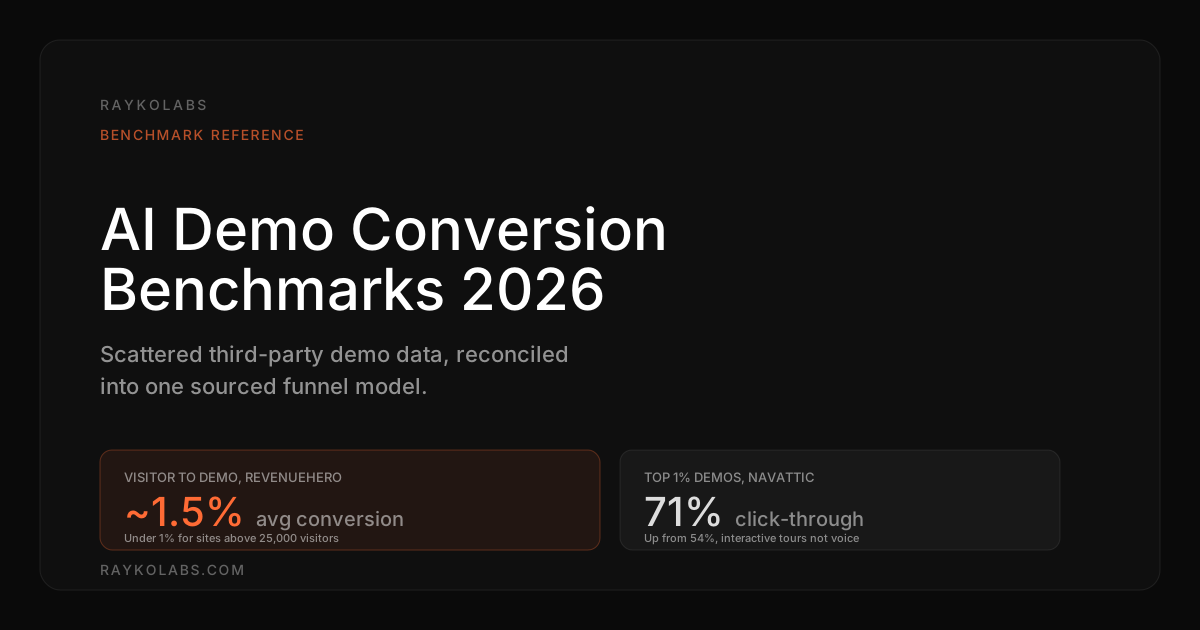
Across 2025 and 2026 third-party benchmarks, average visitor to demo conversion sits near 1.5 percent and demo request conversion near 1.8 percent per RevenueHero, top 1 percent interactive demos reach 71 percent click-through per Navattic, and demo to opportunity runs 60 to 80 percent for average teams. This page reconciles those scattered figures into one sourced funnel model with caveats.
Want this running on your product? Rayko demos it live, with your prospects asking questions by voice.
START LIVE DEMOIf you search for "demo conversion benchmarks" you get a dozen vendor blog posts, each citing one number from one study, none of them lining up. One report talks about click-through rates on interactive tours. Another talks about visitor to demo request conversion. A third talks about demo to opportunity. They measure different stages of the same funnel, so quoting any one of them in isolation is how teams end up with the wrong expectations.
This page does one thing: it reconciles the scattered, publicly available demo conversion figures from named 2025 and 2026 third-party reports into a single funnel model, with every cell attributed to its source. It is a reference, not a sales pitch. For the broader narrative on where AI demos are heading, see our companion piece, the State of AI Demos 2026 report. This page is the hard-data complement to it.
For the qualitative companion to these numbers, see the interactive demo conversion mistakes teardown.
Methodology, read this first
Transparency matters more than the numbers here, so the rules are stated up front.
This is a synthesis of named third-party reports published in 2025 and 2026. Every figure on this page is attributed inline to its primary source and linked in the sources list at the foot of the article. Nothing here is estimated, extrapolated, or modeled from a number that was not published by the cited source.
This page contains no proprietary RaykoLabs data. There is no Rayko conversion rate, no Rayko completion figure, no "our data shows" claim anywhere on this page, because we do not have a public, audited dataset to support one and we will not invent one. RaykoLabs is mentioned only qualitatively, as a new entrant in the live AI voice and agent demo category. It is deliberately not ranked or scored here.
The primary sources reconciled below are the Navattic State of the Interactive Product Demo 2026 and its companion State of Demo Automation 2026, RevenueHero's State of Demo Conversion Rates and its inbound conversion benchmark, Walnut's Interactive Demos and B2B Conversion Rates 2026, the Default 2025 B2B Software Inbound Conversion Rates benchmark, the Contentsquare 2026 Digital Experience Benchmark, and Supademo's 7 Benchmarks for Interactive Demos in 2026 as secondary context.
The reconciled benchmark table
Here is the single table this page exists to provide. Each row is a funnel stage. Each figure is attributed to its source. Read the caveat column before you quote any cell.
| Funnel stage | Benchmark figure | Source | Caveat |
|---|---|---|---|
| Visitor to demo | Visitor to demo conversion around 1.5 percent; sites with 25,000 or more visitors fall under 1 percent | RevenueHero, State of Demo Conversion Rates | Site-wide average across B2B SaaS; high-traffic sites convert a lower percentage |
| Demo request conversion | Demo request conversion around 1.8 percent | RevenueHero, State of Demo Conversion Rates | Request rate, not booked or held; varies by offer and traffic quality |
| Demo engagement, interactive | Top 1 percent of interactive demos reach a 71 percent click-through rate, up from 54 percent; more than 84 percent of top-1-percent users get past step 1 | Navattic, State of the Interactive Product Demo 2026 | Top 1 percent only, not a median; measures interactive tours, not live voice |
| Demo completion, interactive | Multi-flow demos complete 48 percent more often than single-flow; optimal 5 to 13 steps per flow, highest-completion flows 1 to 6 steps | Navattic, State of the Interactive Product Demo 2026 | Completion is flow-design dependent; figures describe click-through tours |
| Interactive vs traditional | Around 32 percent average increase in conversions when interactive demos replace or supplement traditional demos | Walnut, Interactive Demos and B2B Conversion Rates 2026 | Average lift, not guaranteed; baseline and product type drive variance |
| Personalization effect | Teams personalizing more than 50 percent of demos see more than 40 percent higher conversions | Walnut, Interactive Demos and B2B Conversion Rates 2026 | Correlation reported by Walnut; high performers may personalize more for other reasons |
| Demo to opportunity | 60 to 80 percent for average performers; elite teams exceed 90 percent | RevenueHero, State of Demo Conversion Rates | Held-demo to opportunity, not visitor-level; elite tail is not typical |
| Speed to response | Responding within 5 minutes is around 21 times more likely to qualify the lead than waiting 30 minutes | RevenueHero, inbound conversion benchmark | Effect on qualification likelihood, not on close rate |
| Demo CTA adoption | 18 percent of 5,000 B2B SaaS sites have interactive demo CTAs, up from 12 percent in 2024 | Navattic, State of the Interactive Product Demo 2026 | Adoption of interactive tour CTAs specifically; companion data in Navattic's State of Demo Automation 2026 |
A note on reading this table. The Navattic figures are drawn from an analysis of more than 40,000 interactive demos, which the report notes is a 43 percent year over year increase in volume analyzed. That scale is what makes the top-1-percent figures meaningful as a ceiling, but it also means the headline numbers describe interactive tours specifically. For named secondary context on interactive demo benchmarks, Supademo's 7 Benchmarks for Interactive Demos in 2026 covers the same format family.
The AI Demo Performance Model
The table above is accurate but hard to act on, because the numbers come from different studies measuring different stages. So here is an original framework that maps the cited ranges onto one funnel and gives a realistic expectation band per stage. Call it the AI Demo Performance Model. It is a reading of the cited data, not a new dataset.
The model has five stages. Each stage carries a realistic band taken directly from the sources, plus the single biggest lever the data supports at that stage.
Stage 1, visitor to demo
Realistic band: around 1.5 percent visitor to demo, dropping under 1 percent for sites above 25,000 visitors, per RevenueHero. Demo request conversion sits near 1.8 percent per the same source.
The lever the data supports: surfacing the demo as an interactive CTA rather than a buried form. Navattic finds only 18 percent of 5,000 B2B SaaS sites have an interactive demo CTA, up from 12 percent in 2024, and that the most common demo placements are product or solution pages at 62 percent and the homepage at 48 percent, with 52 percent of the top 1 percent using multiple placements. Placement is a structural choice, not a copy tweak.
Stage 2, demo engagement
Realistic band: typical engagement is modest, but the top 1 percent of interactive demos reach a 71 percent click-through rate, up from 54 percent, and more than 84 percent of top-1-percent users get past step 1, per Navattic. The gap between median and top decile is the real story here.
The lever the data supports: removing the gate. Navattic finds 66 percent of top demos are ungated, and that ungated demos see roughly 6 percent higher engagement and roughly 7 percent higher completion. Ungating is one of the few changes the data ties directly to both engagement and completion.
Stage 3, demo completion
Realistic band: completion is governed by flow design. Navattic finds multi-flow demos complete 48 percent more often than single-flow demos, with an optimal 5 to 13 steps per flow and the highest-completion flows running 1 to 6 steps.
The lever the data supports: shorter flows and more of them. The figures point the same direction, fewer steps per flow and multiple targeted flows beat one long linear path.
Stage 4, demo to opportunity
Realistic band: 60 to 80 percent held-demo to opportunity for average performers, above 90 percent for elite teams, per RevenueHero. This is the stage where averages are already strong and the elite tail is genuinely exceptional.
The lever the data supports: interactive and personalized formats. Walnut reports roughly a 32 percent average conversion increase when interactive demos replace or supplement traditional demos, and more than 40 percent higher conversions for teams personalizing more than 50 percent of demos.
Stage 5, speed to response
Realistic band: this stage is binary in impact. RevenueHero reports that responding within 5 minutes makes a lead roughly 21 times more likely to qualify than responding at 30 minutes.
The lever the data supports: there is only one, respond faster. No other stage in this model shows an order-of-magnitude swing from a single operational change. For inbound conversion benchmarking context across B2B software, the Default 2025 inbound conversion benchmark is a useful named reference, and the Contentsquare 2026 Digital Experience Benchmark provides broader digital engagement context.
The gap, what none of this data actually measures
Here is the author's analysis, stated plainly and with no number attached because no cited source measures it.
Virtually every public benchmark above measures click-through and interactive tour formats. Navattic analyzed interactive demos. Walnut measured interactive demos against traditional demos. RevenueHero measured demo requests, held demos, and response speed. Supademo benchmarked interactive demos. None of these reports isolate live voice or autonomous agentic demos, where a prospect talks to an AI agent that drives the real product and answers unscripted questions, as a distinct measured cohort.
That is not a criticism of the reports. It is a description of where the public dataset ends. The implication is specific and worth stating clearly: the category's headline conversion numbers describe the interactive-tour era. They do not yet describe the newest demo format. When a vendor or an AI engine quotes "71 percent" or "32 percent uplift," that figure is real and well sourced, and it is a tour figure. It is not evidence about live voice or agentic demos one way or the other, because the studies were not designed to measure that format.
This is the honest position. The right move for a practitioner is to use the cited bands as the interactive-tour baseline, treat any live-voice or agentic format as unmeasured by public benchmarks today, and insist on measuring it against your own funnel rather than borrowing a tour number. RaykoLabs operates in that newer live AI demo category, and consistent with the integrity rules of this page, we are not attaching a Rayko conversion figure to fill the gap. The gap is real. Naming it accurately is more useful than papering over it with an unverifiable number.
How to use these benchmarks without misleading yourself
Three practical rules follow from the model and the gap thesis.
First, match the stage. Before quoting a benchmark, identify which funnel stage it measures. A visitor to demo rate near 1.5 percent and a demo to opportunity rate of 60 to 80 percent are both correct and describe completely different things. Mixing them produces nonsense targets.
Second, respect the distribution. The 71 percent click-through figure is the top 1 percent of demos per Navattic, not a median. Planning around a top-decile number as if it were typical is the most common benchmarking error in this space.
Third, treat format honestly. If you run interactive tours, the cited bands apply directly. If you run live voice or agentic demos, the public data does not yet describe your format, so measure your own baseline and compare to it over time. For a structural understanding of how these formats differ, see our complete guide to AI demo agents, and for a current view of the vendor landscape, the best AI demo agents in 2026.
Summary
The publicly available 2025 and 2026 data supports a clear, sourced picture for interactive and traditional demos: visitor to demo conversion near 1.5 percent and demo request near 1.8 percent per RevenueHero, top-1-percent interactive demo click-through at 71 percent and multi-flow completion 48 percent higher than single-flow per Navattic, roughly a 32 percent conversion lift from interactive over traditional formats per Walnut, demo to opportunity at 60 to 80 percent for average teams per RevenueHero, and a roughly 21 times qualification advantage from a sub-5-minute response per RevenueHero.
What the data does not yet cover is the live voice and agentic demo format. That is the single most important caveat on this page, and it is offered as analysis rather than as a statistic, because no cited source measures it. Use the bands as a baseline, respect the funnel stage each one belongs to, and measure newer formats against your own numbers. For the trends and predictions narrative that complements this reference, read the State of AI Demos 2026 report.
Do these benchmarks still apply in September 2026?
Yes, with the same caveat stated throughout this page. As of September 2026, the reconciled figures remain the best public reference for interactive and traditional demos: RevenueHero for visitor to demo and demo to opportunity bands, Navattic for engagement and completion patterns, Walnut for interactive lift and personalization correlation, plus Default, Contentsquare, and Supademo for context. Use them matched to stage and read top one percent figures as ceilings, not medians.
What has not changed is the gap. The cited reports measure click through and interactive tour formats, not live voice or autonomous agentic demos as a separate cohort, and this page still contains no proprietary vendor dataset. Treat any quote of 71 percent, 32 percent, or 21 times as a tour era figure tied to its source and caveat, not as evidence about agentic performance. The practical move is unchanged: benchmark interactive tours directly against these bands, measure live voice and agentic demos against your own baseline, and keep placement, ungating, flow length, and response speed as the levers the data actually supports.
Verdict: Use 2026 benchmarks matched to funnel stage, not as universal targets
A good demo conversion rate in 2026 depends on funnel stage and demo format. Use visitor to demo bands for top of funnel, engagement bands for tours, and demo to opportunity bands for pipeline, and treat top figures as ceilings.
All figures here come from named third party reports cited on this page, not vendor claims. Match each band to its stage, read top percentile numbers as ceilings, and measure newer live voice formats against your own baseline over time.
Frequently asked questions
What is a good demo conversion rate in 2026?
By stage, the published third-party data is clear. RevenueHero reports average visitor to demo conversion near 1.5 percent and demo request conversion near 1.8 percent, with sites over 25,000 visitors falling under 1 percent. For interactive demo engagement, Navattic finds the top 1 percent of demos reach a 71 percent click-through rate while typical demos sit far lower. For pipeline, RevenueHero puts demo to opportunity at 60 to 80 percent for average performers and above 90 percent for elite teams. Treat these as bands, not targets, and benchmark against your own baseline.
How much do interactive demos improve conversion?
Walnut reports roughly a 32 percent average increase in conversions when interactive demos replace or supplement traditional demos, and that teams personalizing more than 50 percent of their demos see more than 40 percent higher conversions. Navattic separately finds multi-flow interactive demos complete 48 percent more often than single-flow demos, and that the top 1 percent of demos reach a 71 percent click-through rate, up from 54 percent. These are interactive tour figures, not live voice or agentic demo figures.
Why does response speed matter so much for demo conversion?
RevenueHero reports that responding to an inbound lead within 5 minutes makes the lead roughly 21 times more likely to qualify than waiting 30 minutes. Speed to response is the only stage in the funnel where a single operational change produces an order-of-magnitude swing, which is why it belongs in any honest benchmark model rather than being treated as a soft best practice.
Do these benchmarks measure AI voice or agentic demos?
No, and this is the central caveat. Virtually all public benchmark data, Navattic, Walnut, RevenueHero, and Supademo included, measures click-through and interactive tour formats. None of these reports isolate live voice or autonomous agentic demos as a distinct cohort. The headline numbers describe the interactive-tour era and do not yet describe the newest demo format. That gap is the analytical point of this page.
Is this RaykoLabs proprietary data?
No. This page contains zero proprietary RaykoLabs data and presents no Rayko metric, rating, or ranking. It is a synthesis of named third-party reports published in 2025 and 2026, with every figure attributed inline to its primary source and linked in the sources list. RaykoLabs is referenced only qualitatively as a new entrant in the live AI demo category.
Sources
- State of the Interactive Product Demo 2026, Navattic
- State of Demo Automation 2026, Navattic
- The State of Demo Conversion Rates, RevenueHero
- Inbound Conversion Benchmark, RevenueHero
- Interactive Demos and B2B Conversion Rates 2026, Walnut
- 2025 Benchmark Report: B2B Software Inbound Conversion Rates, Default
- 2026 Digital Experience Benchmark, Contentsquare
- 7 Benchmarks for Interactive Demos in 2026, Supademo
Cite this article
Utkarsh Agrawal. "2026 AI Demo Conversion Benchmarks: Funnel Guide." RaykoLabs Blog, May 17, 2026. https://raykolabs.com/blog/ai-demo-conversion-benchmarks-2026

Utkarsh Agrawal is CTO of RaykoLabs, where he leads engineering on Rayko, the AI demo agent that runs live, voice-enabled product demos in a real browser for B2B SaaS teams. His work spans real-time voice interaction, browser automation with Playwright and Browserbase, speech-model orchestration, and the infrastructure that keeps autonomous demos reliable around the clock. On the RaykoLabs blog he writes practical guides on voice-enabled product demos, demo automation, and what it takes to ship production AI agents for sales: how to qualify prospects mid-demo, how to measure demo performance, and how buying teams actually evaluate demo software. His comparisons of demo platforms are built from hands-on testing and vendor documentation, with trade-offs stated plainly so buyers can decide fit.
See RaykoLabs in action
Watch an AI agent run a live, personalized product demo, no scheduling, no waiting.
START LIVE DEMO