Loading...

2026 AI Voice Demos for Cybersecurity That Build Trust
See why live AI voice demos fit complex security sales, from SOC depth to CISO metrics, in isolated sessions. Learn the model. Read the guide.
Quick answer
AI voice demos work for cybersecurity products because they run the live product in a fully isolated environment and adapt technical depth to each prospect in real time. When a SOC analyst asks about detection rule syntax, the agent opens the rule editor; a CISO asking about risk reduction gets executive metrics instead. The demo platform itself must withstand scrutiny: security buyers probe your infrastructure while you show them yours.
Want this running on your product? Rayko demos it live, with your prospects asking questions by voice.
START LIVE DEMOSelling security software through an insecure demo process is a problem nobody talks about.
Your SIEM vendor sends a demo link that runs in a shared tenant. Your EDR prospect clicks through a recording hosted on a third-party platform with no session isolation. Your GRC tool's "interactive demo" is a set of screenshots with hotspots, served over a CDN that logs visitor data without disclosure.
Cybersecurity buyers are the hardest audience for demos. They will probe your infrastructure while you're trying to show them yours. And if your demo platform cannot withstand that scrutiny, you have already failed the first evaluation, before you showed a single feature.
AI voice demo agents offer a different model, one that adapts to each prospect's technical depth and security focus in real time, running against the live product in an isolated environment.
Why cybersecurity demos are uniquely challenging
Technical complexity
Cybersecurity products operate across networks, endpoints, clouds, identities, and data flows. Demonstrating a SIEM platform means showing log ingestion, correlation rules, alert triage, investigation workflows, and reporting, each a deep topic on its own. A single demo cannot meaningfully cover the full product surface.
Traditional demos solve this with pre-built scripts that hit the highlights. Cybersecurity buyers are not highlight buyers. They want to see how the product handles their specific log sources, their compliance frameworks, their integration requirements. A scripted walkthrough (or worse, a click-through prototype) rarely satisfies this.
Deeply technical buyers who test your claims
Security engineers, architects, and analysts evaluate products differently than most B2B buyers. They ask pointed questions about architecture, deployment models, API coverage, detection logic, and false positive rates. They probe for weaknesses. They test claims against their own operational experience.
A sales rep who cannot answer these questions loses credibility immediately. Staffing every demo with a solutions engineer who has deep security domain expertise is expensive and does not scale, and this is where demo fatigue hits security sales teams hardest.
Compliance requirements
Cybersecurity purchasing decisions are heavily influenced by compliance. Buyers need to know how the product maps to frameworks like NIST, CIS, SOC 2, ISO 27001, HIPAA, and PCI DSS. They want to see compliance dashboards, audit trail capabilities, and evidence generation workflows.
Addressing compliance questions during a live demo requires detailed knowledge of multiple frameworks and how the product supports each one.
Long, multi-stakeholder sales cycles
Cybersecurity deals involve the CISO, security engineers, IT operations, procurement, and sometimes legal. Each stakeholder needs a different view of the product. The CISO wants strategic risk reduction. The SOC analyst wants faster triage. IT operations wants deployment simplicity.
Delivering multiple tailored demos for every deal, at every stage, strains even well-resourced sales teams. This is the exact problem that AI demo automation was designed to solve.
How AI voice demos address these challenges
Adaptive technical depth
An AI voice demo agent adjusts its depth based on the prospect's questions and role. When a SOC analyst asks about detection rule syntax, the agent navigates to the rule editor, shows the syntax, and explains how custom rules are created. When a CISO asks about risk reduction metrics, the same agent shifts to the executive dashboard and discusses mean time to detect and respond.
This adaptability works because the agent combines deep product knowledge with real-time conversational intelligence, using Deepgram for speech-to-text and Cartesia for text-to-speech, connected over WebSocket for sub-second latency. It does not follow a fixed script. It follows the prospect's interest.
Handling technical architecture questions
Cybersecurity buyers routinely ask about deployment architecture, data flow, encryption, and integration APIs. An AI demo agent trained on the product's technical documentation can answer these questions while simultaneously navigating to the relevant product screens using Playwright browser automation.
"How does the agent connect to our SIEM?" The agent navigates to the integrations page, shows the available connectors, and explains the data flow, all while speaking through the technical details. This combination of visual demonstration and verbal explanation mirrors what the best solutions engineers do, but it scales without limits.
Integration and ecosystem coverage
Cybersecurity products do not exist in isolation. Buyers need to understand how a new tool fits into their existing stack, their SIEM, SOAR, ticketing system, identity provider, and cloud platforms. During an AI voice demo, the prospect can ask about specific integrations and the agent shows the relevant configuration screens, explains the setup process, and discusses data formats and API capabilities.
24/7 availability for global security teams
Security operations run around the clock. A prospect in Singapore should not have to wait for US business hours to see your product. AI voice demos are available at any hour, in any timezone, without scheduling.
This matters more in cybersecurity than in most verticals because security professionals evaluate tools during off-hours, between incident responses, during night shifts, or on weekends when they have time to think strategically about tooling. Prospects who cannot get an immediate demo often ghost entirely.
Demo security for security companies
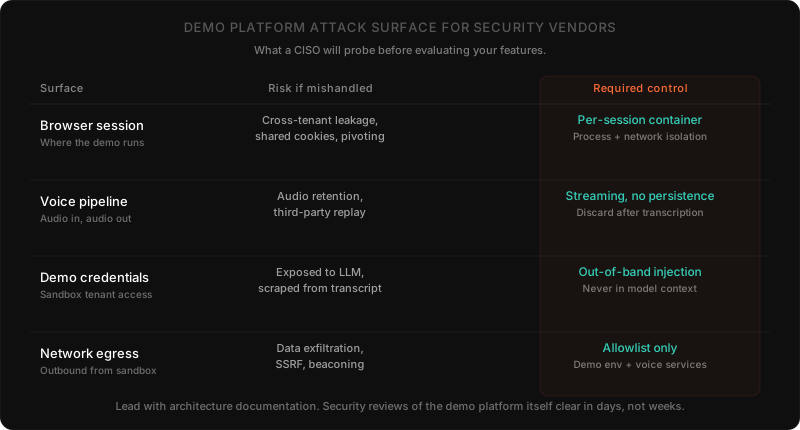
The security of your demo is itself a signal to your buyers. Security professionals evaluate everything. If your demo platform has visible security weaknesses, insecure data handling, shared session states, exposed credentials, your credibility as a security vendor evaporates before you finish the first walkthrough.
AI demo platforms used by cybersecurity companies must meet a higher bar:
Session isolation. Every demo must run in a fully isolated environment. At RaykoLabs, this means dedicated Browserbase cloud browser instances with process-level and network-level isolation per session.
Data handling. No prospect data or demo content should be persisted beyond the session without explicit consent. LLM interactions are covered by enterprise data agreements.
Credential security. Demo environment credentials must be stored securely, scoped narrowly, and never exposed to the prospect or the LLM context.
Network controls. Demo browser sessions should have strict egress rules, communicating only with the product's demo environment and required services.
Voice data pipeline. If the demo uses voice interaction, audio is streamed through Deepgram for real-time transcription, not stored, not batched, not replayed.
In our experience with cybersecurity customers, the infrastructure-level isolation story (per-session Browserbase containers, no cross-tenant model context, no audio persistence) shortens the procurement security review meaningfully, by our measurement, security reviews for the demo platform itself typically clear in days rather than the weeks-to-months pattern that ad-hoc demo tooling produces. The teams winning these reviews lead with architecture documentation, not with policy attestations.
For a deeper look at our security architecture and compliance controls, see the dedicated post. The short version: the demo experience is the first product experience, and for security companies, that experience is under a microscope.
Use cases across cybersecurity categories
AI voice demos work across the full range of cybersecurity product categories. Here are the ones we see most often.
| Category | What the agent demonstrates |
|---|---|
| SIEM and security analytics | Log ingestion, correlation rules, alert investigation, and compliance reporting, walking a simulated alert from detection to resolution |
| Endpoint detection and response | Endpoint visibility, threat detection, automated response, and forensic investigation, showing how a specific attack technique is detected and contained |
| Identity and access management | User provisioning, access reviews, and privilege escalation detection, adapting across identity architect to HR administrator personas |
| Cloud security (CSPM, CWPP, CNAPP) | Cloud posture assessment, workload protection, infrastructure-as-code scanning, and runtime threat detection across a broad feature surface |
| GRC | Framework mapping, control assessment, evidence collection, and audit workflows, discussing SOC 2, ISO 27001, and NIST CSF while showing support for each |
| Vulnerability management | Scan configuration, vulnerability prioritization, remediation workflows, and SLA tracking, handling scan coverage and false positive questions |
SIEM and security analytics
Show log ingestion, correlation rules, alert investigation, and compliance reporting. The agent walks through a simulated alert from detection to resolution, adapting the workflow depth based on the prospect's interest.
Endpoint detection and response (EDR)
Demonstrate endpoint visibility, threat detection, automated response actions, and forensic investigation tools. The agent shows how a specific attack technique is detected and contained, making the capability tangible rather than theoretical.
Identity and access management (IAM)
Walk through user provisioning, access reviews, and privilege escalation detection. IAM demos benefit particularly from AI adaptability because the buyer personas range from identity architects to HR administrators.
Cloud security (CSPM, CWPP, CNAPP)
Show cloud posture assessment, workload protection, infrastructure-as-code scanning, and runtime threat detection. Cloud security products have broad feature surfaces, and AI agents navigate to whichever capability the prospect asks about without needing a separate demo track for each.
GRC
Demonstrate framework mapping, control assessment, evidence collection, and audit workflows. GRC demos are heavily compliance-focused, and the AI agent's ability to discuss specific frameworks (SOC 2, ISO 27001, NIST CSF) while showing the product's support for each is where voice interaction shines, the prospect can ask "how do you handle NIST control AC-2" and get a spoken answer with a live navigation to the relevant screen.
Vulnerability management
Show scan configuration, vulnerability prioritization, remediation workflows, and SLA tracking. This category benefits from the agent's ability to handle questions about scan coverage, false positive handling, and integration with patching systems, topics where every buyer's environment is different.
ROI for cybersecurity sales
The financial case for AI voice demos in cybersecurity is driven by factors specific to the vertical. For a full ROI framework and business case, see our dedicated analysis. Here are the cybersecurity-specific drivers.
Cybersecurity customers we have shipped this for typically see time-to-first-demo drop from a 7-14 business day baseline (security tooling has long evaluation funnels) down to under five minutes for the first agent-led session. The SE-leverage number is often more striking: in cybersecurity, where SEs spend hours per demo on technical depth, offloading the first-touch demo to the agent typically frees 50-70% of SE time for higher-value technical wins, advanced PoCs, and the deeply custom security-architecture conversations only a human can navigate well.
Reduced SE bottleneck
Cybersecurity deals are SE-heavy. Every qualified opportunity typically requires one or more deep technical demos. AI voice demos handle the initial product walkthrough, allowing solutions engineers to focus on late-stage, high-complexity technical evaluations where human expertise adds the most value.
Faster time to first demo
Cybersecurity buying cycles are notoriously long. Every day between initial interest and first demo is a day the prospect might deprioritize the evaluation, get pulled into an incident, or start evaluating a competitor. AI demos provide an immediate product experience, compressing the early stages of the sales cycle.
Consistent technical accuracy
Human reps occasionally misspeak about compliance certifications, integration capabilities, or technical specifications. In cybersecurity, a single inaccurate statement can derail a deal or create legal exposure. AI agents deliver information from a curated, reviewed knowledge base.
Richer qualification data
Every AI demo session produces structured data: which features the prospect explored, what security concerns they raised, which integrations they asked about, and how technically deep their questions went. This data gives the sales team a detailed picture of the prospect's requirements before the first human conversation.
Long-tail coverage
Not every cybersecurity lead justifies an hour of SE time for an initial demo. Many of those leads could convert with the right product experience. AI voice demos provide that experience to every lead, including the mid-market and SMB prospects that enterprise-focused sales teams often underserve.
The bottom line
Cybersecurity products deserve demos as sophisticated as the products themselves. Static walkthroughs and scripted presentations do not meet the bar that technical security buyers expect.
Across our cybersecurity customer cohort, the agent processes thousands of demo sessions per month, concentrated on security analytics, identity, EDR, and posture-management products. The volume curve is steep: cybersecurity buyers tend to evaluate two to three vendors in parallel, and on-demand voice demos absorb the first-touch demand that previously got bottlenecked through a small SE team. The data layer that comes back (per-vendor question patterns, common objections, the shape of competitive bake-offs) is, on its own, a strategic input most cybersecurity vendors never had access to before.
AI voice demos, live, interactive, technically deep, and available on demand, align with how security professionals actually evaluate tools. For cybersecurity vendors looking to scale demo capacity without diluting technical quality, the question is not whether to adopt AI demo automation, it is whether your current demo process can survive another quarter of technical buyers who expect more.
September 2026 check: do AI voice demos still fit cybersecurity evaluations?
Yes. Security products still span broad surfaces from detection to compliance, buyers still probe architecture and integrations, and demo platform security still gets scrutinized first. Adaptive voice walkthroughs on isolated live product sessions remain a sound fit for SOC, CISO, and engineering personas.
We rechecked the cited frameworks in September 2026. The Verizon Data Breach Investigations Report hub, the MITRE ATT and CK framework hub, the NIST Cybersecurity Framework hub, the Center for Internet Security Controls hub, and the IBM Cost of a Data Breach hub remain the stable references for threat context, control mapping, and breach cost framing. The compliance list used in this post, including NIST, CIS, SOC 2, ISO 27001, HIPAA, and PCI DSS, also remains accurate and required no update.
The platform security guidance holds without change. Per session isolated cloud browsers, scoped demo credentials, synthetic data only, strict egress, and no persisted voice audio remain the bar that security buyers expect. If you sell into regulated accounts, keep leading procurement reviews with architecture documentation and data handling notes as this post recommends, and map each demo flow to the control set your buyer cares about before you expand coverage.
Verdict: Live voice demos win security deals by matching depth to each buyer
AI voice demos work for cybersecurity because they run the live product in isolated sessions and adapt depth by role. Analysts get workflow detail, CISOs get risk and control mapping, and every answer is paired with the relevant screen.
Keep demo hygiene strict with isolated sessions, scoped credentials, synthetic data only, and no retained audio. Lead procurement reviews with architecture notes and map each flow to the control set your buyer cares about.
Frequently asked questions
Why are cybersecurity products uniquely hard to demo?
Four reasons. Technical complexity: a SIEM platform alone spans log ingestion, correlation rules, alert triage, investigation, and reporting, each a deep topic, so a single demo cannot cover the full surface. Deeply technical buyers test your claims, asking pointed questions about architecture, detection logic, and false positive rates, and probing for weaknesses. Compliance heavily influences decisions, requiring detailed mapping to NIST, CIS, SOC 2, ISO 27001, HIPAA, and PCI DSS. And sales cycles are long and multi-stakeholder, spanning the CISO, security engineers, IT operations, procurement, and sometimes legal.
How do AI voice demos adapt to different security buyers?
The agent adjusts depth based on the prospect's questions and role rather than following a fixed script. When a SOC analyst asks about detection rule syntax, the agent navigates to the rule editor and explains how custom rules are created. When a CISO asks about risk reduction metrics, the same agent shifts to the executive dashboard and discusses mean time to detect and respond. It combines deep product knowledge with real-time conversational intelligence using Deepgram for speech-to-text and Cartesia for text-to-speech over WebSocket for sub-second latency.
How does an AI demo handle technical architecture and integration questions?
An AI demo agent trained on the product's technical documentation answers architecture, data flow, encryption, and integration questions while simultaneously navigating to the relevant screens using Playwright browser automation. Asked how the agent connects to a SIEM, it navigates to the integrations page, shows available connectors, and explains the data flow while speaking through the technical details. This combination of visual demonstration and verbal explanation mirrors what the best solutions engineers do, but it scales without limits and stays available 24/7 for global security teams.
Is the demo platform itself secure enough for cybersecurity buyers?
It has to be, because the security of your demo is itself a signal. Security professionals evaluate everything, and visible weaknesses like shared session states or exposed credentials destroy a security vendor's credibility before the first walkthrough finishes. AI demo platforms used by cybersecurity companies must meet a higher bar: every demo runs in a fully isolated environment with dedicated cloud browser instances enforcing process-level and network-level isolation per session, so a prospect probing your infrastructure finds the isolation holds.
Sources
- Data Breach Investigations Report, Verizon
- ATT&CK Framework, MITRE
- Cybersecurity Framework, NIST
- Critical Security Controls, Center for Internet Security
- Cost of a Data Breach Report, IBM
Cite this article
Utkarsh Agrawal. "2026 AI Voice Demos for Cybersecurity That Build Trust." RaykoLabs Blog, February 2, 2026. https://raykolabs.com/blog/ai-voice-demos-cybersecurity

Utkarsh Agrawal is CTO of RaykoLabs, where he leads engineering on Rayko, the AI demo agent that runs live, voice-enabled product demos in a real browser for B2B SaaS teams. His work spans real-time voice interaction, browser automation with Playwright and Browserbase, speech-model orchestration, and the infrastructure that keeps autonomous demos reliable around the clock. On the RaykoLabs blog he writes practical guides on voice-enabled product demos, demo automation, and what it takes to ship production AI agents for sales: how to qualify prospects mid-demo, how to measure demo performance, and how buying teams actually evaluate demo software. His comparisons of demo platforms are built from hands-on testing and vendor documentation, with trade-offs stated plainly so buyers can decide fit.
See RaykoLabs in action
Watch an AI agent run a live, personalized product demo, no scheduling, no waiting.
START LIVE DEMO