Loading...

2026 AI Demos for Healthcare: HIPAA Guide That Scales
Learn how healthcare SaaS teams demo with synthetic data, HIPAA aligned handling, and role based paths for clinical buyers. See how. Read the guide.
Quick answer
Healthcare SaaS companies use AI-powered demos to serve clinical buyers instantly while staying HIPAA-aligned. The demo runs the live product in an isolated cloud browser populated with clinically coherent synthetic data that contains zero PHI, because no PHI was involved in its creation. The agent adapts to a CMIO, security officer, clinician, or RCM director, answers FHIR and Epic questions in real time, and never persists voice audio.
Want this running on your product? Rayko demos it live, with your prospects asking questions by voice.
START LIVE DEMOA Chief Medical Information Officer has ten minutes between surgeries. She is still in scrubs, standing at a workstation in the hallway outside the OR, and she wants to evaluate an EHR integration platform her health system is considering. She will not schedule a call for next Tuesday. She will not sit through a 45-minute recorded walkthrough narrated by someone who has never touched an EMR. She wants to see how the product handles HL7 FHIR resource mapping, and she wants to see it before her next patient is prepped.
This is the healthcare SaaS demo problem distilled to its essentials: the buyer is a clinician with no time, the compliance stakes are the highest of any industry, the technical questions are deeply specific, and the tolerance for generic sales experiences is zero. AI demo automation exists precisely for this moment.
We spent more time on the synthetic data pipeline for healthcare demos than for any other vertical. Fintech synthetic data needs to look like plausible transactions. Healthcare synthetic data needs to look like plausible patients, with realistic vitals progressions, medication histories that do not contradict each other, and lab values within clinically meaningful ranges. Getting this wrong does not just undermine credibility. It tells a clinical buyer that you do not understand their world.
Why healthcare SaaS demos are different
HIPAA is not a checkbox
Every vendor in healthcare claims HIPAA compliance. Few demonstrate it during the sales process itself. The gap between "our product is HIPAA-compliant" and "our demo process is HIPAA-compliant" is where trust breaks down.
Regulated complexity is not unique to healthcare: see AI demo automation for martech. Protected Health Information cannot appear in demo environments. Demo databases seeded from production snapshots with names swapped out still contain identifiable information, admission patterns, procedure combinations, and geographic markers that can re-identify patients. The security architecture underlying the demo platform matters as much as the product's own compliance posture.
Healthcare buyers know this. A CMIO or a compliance officer will ask pointed questions about data provenance during the demo itself, and the demo platform needs to answer those questions credibly.
Clinical workflows are not business workflows
Most B2B software demos follow a create-review-approve pattern. Healthcare workflows follow clinical logic, assessment, diagnosis, treatment planning, documentation, billing, where each step is constrained by medical standards and patient safety considerations. A demo that shows a linear happy path through a clinical workflow reveals nothing about how the product behaves when a clinician deviates from the expected sequence, because clinicians always deviate from the expected sequence.
Patient data sensitivity exceeds all other verticals
Patient data occupies a category beyond financial or employee data. Healthcare buyers evaluate vendors through this lens from the first interaction. If the demo platform runs in a shared environment, uses inadequately synthesized data, or cannot explain its data isolation model, the evaluation ends there. Our approach at RaykoLabs uses isolated Browserbase cloud browser instances per session, each prospect gets a fully sandboxed environment that is destroyed when the session ends.
The buyer committee is unusually broad
Healthcare purchasing decisions involve more distinct personas than almost any other vertical. A single deal might require buy-in from clinicians, hospital IT, compliance, procurement, nursing leadership, revenue cycle management, and the C-suite. Each persona evaluates the product through a completely different framework. Serving all of them from a single demo process is the core challenge that AI demo personalization addresses.
The HIPAA challenge in product demos
HIPAA's Privacy Rule and Security Rule create specific obligations for anyone handling Protected Health Information. During product demonstrations, three areas demand attention.
PHI in demo environments. Demo databases must contain zero PHI. Synthetic data must be generated independently, not derived from real patient records through de-identification, which carries residual re-identification risk. The synthetic data should include realistic clinical narratives, lab values, vital sign trends, and medication histories, all generated algorithmically.
Business Associate Agreements. When a demo platform processes or stores any information that could be considered PHI, a BAA may be required. The cleaner approach is to architect the demo platform so that no PHI enters the system at any point, eliminating the BAA question for the demo phase entirely.
Session data handling. Demo sessions generate transcripts, interaction logs, and session recordings. If a clinician describes a specific patient scenario during a voice demo, that transcript may contain PHI. The platform must have clear policies for transcript redaction, retention limits, and access controls.
For healthcare customers, retention defaults to zero unless explicitly enabled, no transcripts persist past the live session, the voice audio is never stored at any layer (Deepgram streaming STT discards raw audio after transcription, Cartesia generates output speech without a buffer), and the rrweb session recording captures DOM state rather than audio. When customers do enable transcripts (typically for QA against the agent's own scripted boundaries rather than for sales follow-up), an automated PHI-pattern detection layer flags any free-text the prospect entered that resembles patient identifiers or clinical notes, and those segments get redacted before the transcript is written to durable storage.
Here is the contrarian take: most healthcare SaaS companies spend enormous effort making their product HIPAA-compliant and almost no effort making their sales process HIPAA-compliant. Vendors will proudly show you their SOC 2 Type II report while running demos on a platform that logs session data to an unencrypted S3 bucket with no BAA in place. The demo is the first thing the buyer experiences, and it is often the least compliant part of the entire operation.
Healthcare buyer personas
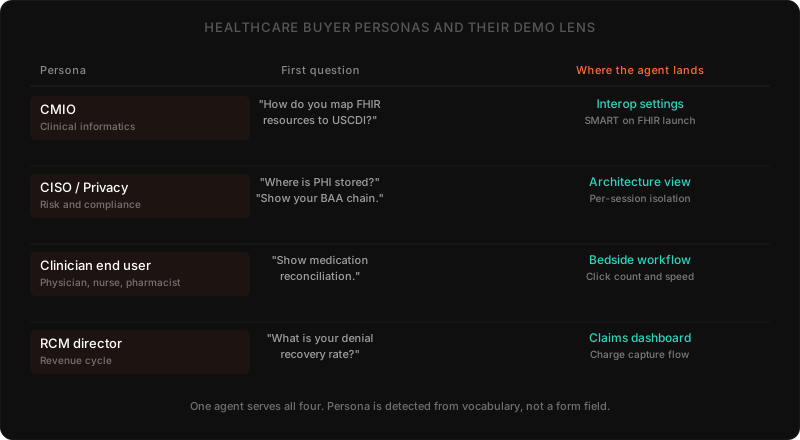
Healthcare purchasing committees are large, and each member evaluates demos through a different lens.
Chief Medical Information Officer (CMIO). The CMIO bridges clinical practice and technology. They want to see how the product fits into existing clinical workflows, whether it will disrupt or enhance the clinician experience, and how it handles interoperability with existing EHR systems. They ask about FHIR APIs, CDS Hooks integration, and USCDI data standards. They have deep clinical knowledge and zero patience for vaporware. Show them the product working, not slides about the product working.
Chief Information Security Officer (CISO) or Privacy Officer. Focused entirely on risk. They want to understand the data architecture, encryption standards, access controls, audit logging, and incident response capabilities. They may ask about the demo platform's own security posture, a question most demo tools cannot answer well.
Clinical end users, physicians, nurses, pharmacists. They care about one thing: will this make my day harder or easier? They evaluate software by feel. If the interface is slow, confusing, or requires too many clicks to complete a common task, they will block the purchase regardless of what the C-suite wants. Demos for clinical users must show real workflow speed, not carefully curated screenshots.
Revenue Cycle Management (RCM) director. Focused on charge capture accuracy, claims submission workflows, denial management, and reimbursement optimization. Their questions are operational and metric-driven.
IT infrastructure and integration team. Concerned with deployment models (cloud, on-premise, hybrid), integration with existing systems (Epic, Cerner, MEDITECH), interface engines (Mirth, Rhapsody), and ongoing maintenance requirements. They want to see the admin console, API documentation, and integration configuration screens.
Procurement and compliance. Evaluating vendor risk, contract terms, and regulatory alignment. They may not attend the demo but they will read the session summary. They want evidence of compliance posture, not just claims.
| Persona | Evaluation lens | Typical demo questions |
|---|---|---|
| CMIO | Fit with clinical workflows and clinician experience | FHIR APIs, CDS Hooks, USCDI data standards |
| CISO or Privacy Officer | Risk: data architecture and controls | Encryption, access controls, audit logging, the demo platform's own security |
| Clinical end users | Will this make the day easier or harder | Real workflow speed, clicks to complete a common task |
| RCM director | Charge capture and reimbursement | Claims submission, denial management workflows |
| IT infrastructure and integration | Deployment and system integration | Epic, Cerner, MEDITECH connectors, admin console, API docs |
| Procurement and compliance | Vendor risk and regulatory alignment | Evidence of compliance posture, session summary |
Serving all six personas with a single scripted demo is not just difficult, it is counterproductive. The CMIO and the clinical end user need entirely different demo experiences from the same product. This is why persona-adaptive AI demos create a structural advantage in healthcare sales.
How AI demos solve healthcare-specific challenges
Synthetic clinical data that clinicians trust
The synthetic data problem in healthcare is harder than in any other vertical. A clinician will immediately spot fake clinical data, lab values that do not correlate with the diagnosis, medication dosages that make no clinical sense, vital sign trends that are physiologically impossible.
AI demo agents operate against demo environments populated with clinically coherent synthetic data. Patient records include internally consistent histories: a diabetic patient has appropriate HbA1c trends, a corresponding medication history, and relevant comorbidities. Clinical notes use realistic medical language.
This data is generated algorithmically, not sampled or de-identified from real records. It contains zero PHI because no PHI was involved in its creation. When a prospect asks "Is this real patient data?", the answer is unambiguous.
Compliance-safe demo architecture
Each demo session runs in an isolated Browserbase cloud browser instance. The AI agent, powered by Playwright for browser automation, operates within this sandboxed environment. No data from one session is accessible to another. When the session ends, the environment is destroyed.
The voice pipeline uses Deepgram for speech-to-text and Cartesia for text-to-speech, connected over WebSocket with an 800ms latency target. Voice data is processed in transit and not persisted beyond the session unless explicitly configured by the customer. Session recordings via rrweb capture the DOM state, not audio, providing a compliance-safe record of what was shown without storing voice data.
For healthcare customers, BAA coverage is available on the Enterprise tier, both for our own platform and, where required, for the underlying infrastructure (Browserbase for the browser sessions, Deepgram and Cartesia for the voice pipeline, the LLM provider for the reasoning layer). The BAA chain matters: a healthcare SaaS vendor running demos through our platform inherits our BAAs with each subprocessor, which collapses what would otherwise be five separate counterparty negotiations into one. SOC 2 Type II is in place; HITRUST and HIPAA-specific audit reports are available under NDA on request.
Persona detection for clinical versus administrative buyers
The AI agent's three-layer navigation architecture, context detection, path planning, LLM integration, identifies the prospect's role from their first few questions and adapts accordingly.
When a physician asks "How does this handle medication reconciliation during transitions of care?", the agent navigates to the clinical workflow and demonstrates the reconciliation process. When a CIO asks "What is your FHIR implementation maturity?", the same agent navigates to the interoperability settings and discusses supported FHIR resource types and bulk data export capabilities.
One agent. No separate demo tracks. This is the same approach that works for fintech and HR tech, but the healthcare persona spread is wider and the domain knowledge requirements are deeper.
Handling interoperability questions in real time
Healthcare buyers always ask about integration with their existing systems. Epic, Cerner (now Oracle Health), MEDITECH, athenahealth, eClinicalWorks, the agent needs to navigate to integration configuration screens and discuss the specifics of each connector.
An AI demo agent trained on the product's integration documentation handles these questions without deferring to a specialist. "How does this connect to our Epic instance?" The agent shows the Epic App Orchard listing, demonstrates the SMART on FHIR launch sequence, and explains the data flow. Integration is the number one technical concern in health IT purchases, and the ability to address it during the first product interaction, rather than promising a "technical deep-dive next week", accelerates the evaluation timeline materially.
Healthcare SaaS categories that benefit most
EHR integration platforms
Products that connect to, extend, or enhance electronic health records. Demo complexity is high because the product's value is defined by how it interacts with the prospect's specific EHR. AI agents adapt the demo based on which EHR the prospect uses.
Telehealth and virtual care
Platforms for remote patient encounters, remote monitoring, and asynchronous care. Demos must show the clinician experience and the patient experience within the same session. The AI agent demonstrates both sides, switching perspective based on the prospect's questions.
Clinical decision support
Tools that surface evidence-based recommendations at the point of care. Demos need clinically realistic scenarios to demonstrate alert logic, recommendation quality, and workflow integration. Synthetic data quality is critical here, a CDS demo with implausible clinical data is worse than no demo at all.
Revenue cycle management
Platforms for coding, billing, claims management, and denial prevention. RCM demos serve a more operationally focused buyer who wants to see volume processing, exception handling, and analytics. The AI agent shifts its vocabulary and emphasis from clinical to financial.
Patient engagement
Portals, messaging platforms, appointment scheduling, and digital intake tools. These products serve both the provider organization (configuration, analytics) and the patient (usability, accessibility). AI demos that can show both perspectives with voice interaction match how these products are actually evaluated.
Population health and analytics
Platforms for risk stratification, care gap identification, and quality measure reporting. Demos require large, varied sample datasets with enough volume and diversity to make the analytics meaningful. A population health dashboard with twelve synthetic patients is not a compelling demo.
Implementation for healthcare SaaS
Deploying AI demo automation for a healthcare product follows a specific sequence, with additional steps beyond what other verticals require.
Step 1: Build clinically coherent synthetic data. This is the foundation and the hardest step. Generate synthetic patient records with internally consistent clinical narratives, diagnoses, medications, lab values, vitals, procedures, and clinical notes that make medical sense together. Engage clinical advisors to validate the data. Do not skip this. A clinician who spots fake data in the first thirty seconds will not trust anything else you show them.
Step 2: Architect the demo environment for HIPAA alignment. Ensure session isolation, data destruction on session end, no PHI ingestion paths, encrypted data at rest and in transit, and audit logging for all access. Document the architecture so that compliance-focused buyers can review it.
Step 3: Build the clinical knowledge base. Compile product documentation, interoperability specifications, compliance framework mappings (HIPAA, HITRUST, SOC 2), clinical workflow documentation, and integration guides for major EHR platforms. This knowledge base should be reviewed by clinical, technical, and compliance stakeholders.
Step 4: Define demo flows by persona and use case. Map the primary demo paths for each buyer persona, the CMIO walkthrough, the IT integration review, the clinical end-user experience, the RCM operational demo. These become the agent's primary navigation paths, while its training enables deviation based on real-time questions.
Step 5: Deploy with appropriate consent and disclosure. Disclose that the demo is AI-powered. Explain how session data is handled. Provide clear information about synthetic data provenance. In healthcare, this transparency is not a sales disadvantage, it is a trust signal that buyers specifically look for.
Step 6: Iterate with clinical feedback. Review demo transcripts weekly with clinical advisors. Healthcare is a vertical where "close enough" answers cause more damage than honest gaps. If the agent cannot answer a clinical question well, it should say so and offer to connect the prospect with a clinical specialist rather than generating a plausible-sounding but inaccurate response.
Onboarding for healthcare customers typically runs three to six weeks from kickoff to live demo, longer than the cross-vertical baseline because synthetic-data validation, PHI-detection threshold tuning, BAA review on the customer side, and clinical-advisor sign-off on the agent's scripted boundaries all take real cycles. Roughly half of the elapsed time is review-and-approve loops on the customer's side; the technical setup is closer to two weeks. Customers who move fastest are typically those who already have a synthetic-data set built for their own product QA and can hand it to us early.
The trust equation in healthcare sales
Healthcare is the vertical where the demo experience most directly predicts the vendor relationship. A health system CIO evaluating a new platform is not just assessing features, they are assessing whether this vendor understands healthcare. Every detail in the demo sends a signal. Clinically incoherent data says "we do not understand your domain." A shared demo environment says "we do not take security seriously." A scripted walkthrough that cannot answer interoperability questions says "we will be difficult to work with during implementation."
AI demo automation, done right, sends the opposite signals. Clinically realistic synthetic data. Isolated, compliance-safe environments. An agent that adapts to whether the viewer is a surgeon or a security officer. These are not demo features, they are evidence of the vendor's operational maturity.
The second contrarian take: healthcare SaaS companies should stop gatekeeping product access behind "Book a Demo" forms that require institution name, title, and department before showing a single screen. Clinicians evaluate software the same way they evaluate medical evidence, they want to see the data before they commit to the hypothesis. A CMIO will not fill out a lead form to maybe see your product next week. They will evaluate the three competitors who let them see the product now. The vendors who cling to form-gated, rep-scheduled demos will watch their prospects disappear.
Compare the alternatives: static click-through demos that show the same workflow to a surgeon and a billing manager. Recorded videos that go stale every time you ship a product update. Scheduled calls that happen four days after the prospect's interest peaked, by which time they have already seen three competitors. For healthcare SaaS, where the buyer experience is a direct reflection of the vendor's understanding of clinical workflows, the demo format is not a sales optimization, it is a market positioning decision.
What should healthcare buyers recheck in September 2026?
The HIPAA posture in this guide is unchanged as of September 2026: demo databases contain zero PHI because synthetic records are generated algorithmically, sessions run isolated with reset on close, voice audio is not persisted, and retention defaults to zero unless the customer explicitly enables transcripts with redaction. Reconfirm that chain with your compliance team before fall reviews.
The practical refresh this month is clinical coherence. Ask a clinical advisor to reread the synthetic histories for internal consistency across diagnoses, medications, labs, vitals, and notes, since clinicians spot contradictions in seconds and trust does not recover. Then confirm persona paths still serve the CMIO, CISO, clinician, RCM director, IT integration team, and procurement reviewers described above, especially FHIR, SMART on FHIR, and EHR connector content for Epic, Oracle Health, MEDITECH, athenahealth, and eClinicalWorks. Finally, verify BAA coverage, SOC 2 evidence, and consent disclosure still match the Enterprise tier terms linked in the FAQ. That keeps the demo both credible and review ready.
For onboarding-specific flows, see AI demos for healthcare onboarding.
Verdict: Demo healthcare SaaS on synthetic data with role based paths and no PHI
AI demos fit healthcare SaaS when they run on clinically coherent synthetic data with zero PHI, stay HIPAA aligned with isolated sessions and no retained audio, and adapt to CMIO, clinician, security, and revenue roles with relevant workflows and detail.
Have a clinical reviewer check synthetic histories for coherence across diagnoses, meds, labs, and notes. Confirm FHIR and EHR connector paths for each persona, plus BAA coverage and consent disclosure, before expanding to new service lines.
Frequently asked questions
How do AI demos stay HIPAA-compliant?
Three areas demand attention. Demo databases must contain zero PHI: synthetic data is generated algorithmically, not de-identified from real records, which eliminates re-identification risk. The cleaner architecture lets no PHI enter the system at any point, which removes the Business Associate Agreement question for the demo phase entirely. Session data handling matters because a clinician may describe a patient scenario aloud: for healthcare customers retention defaults to zero, no transcripts persist past the live session, voice audio is never stored, and rrweb session recording captures DOM state rather than audio.
Will clinicians trust synthetic data in a healthcare demo?
Only if it is clinically coherent. A clinician will immediately spot lab values that do not correlate with the diagnosis, medication dosages that make no clinical sense, or physiologically impossible vital sign trends. AI demo agents run against environments where patient records are internally consistent: a diabetic patient has appropriate HbA1c trends, a corresponding medication history, and relevant comorbidities. The data is generated algorithmically rather than sampled, so when a prospect asks whether it is real patient data the answer is unambiguous.
Can one AI demo serve the broad healthcare buying committee?
Yes, and the healthcare persona spread is wider than most verticals. The agent's three-layer navigation architecture identifies the role from the first few questions. When a physician asks about medication reconciliation during transitions of care, it navigates to the clinical workflow. When a CIO asks about FHIR implementation maturity, the same agent navigates to interoperability settings and discusses supported FHIR resource types. One agent serves the CMIO, the CISO, clinical end users, the RCM director, and the IT integration team without separate demo tracks.
Is a BAA available for AI demo automation in healthcare?
Yes. BAA coverage is available on the Enterprise tier, both for the platform and, where required, for the underlying infrastructure (Browserbase for browser sessions, Deepgram and Cartesia for the voice pipeline, the LLM provider for the reasoning layer). A healthcare SaaS vendor running demos through the platform inherits these BAAs with each subprocessor, which collapses what would otherwise be five separate counterparty negotiations into one. SOC 2 Type II is in place, and HITRUST and HIPAA-specific audit reports are available under NDA on request.
How long does healthcare AI demo onboarding take?
Typically three to six weeks from kickoff to live demo, longer than the cross-vertical baseline because synthetic-data validation, PHI-detection threshold tuning, BAA review on the customer side, and clinical-advisor sign-off on the agent's scripted boundaries all take real cycles. Roughly half of the elapsed time is review-and-approve loops on the customer's side, while the technical setup is closer to two weeks. Customers who move fastest already have a synthetic-data set built for their own product QA and can hand it over early.
Sources
- HIPAA Privacy Rule, U.S. Department of Health and Human Services
- HL7 FHIR Specification, HL7 International
- Cybersecurity Framework, NIST
- State of Sales, Salesforce Research
- The B2B Buying Journey, Gartner
Cite this article
Utkarsh Agrawal. "2026 AI Demos for Healthcare: HIPAA Guide That Scales." RaykoLabs Blog, March 29, 2026. https://raykolabs.com/blog/ai-demo-automation-healthcare

Utkarsh Agrawal is CTO of RaykoLabs, where he leads engineering on Rayko, the AI demo agent that runs live, voice-enabled product demos in a real browser for B2B SaaS teams. His work spans real-time voice interaction, browser automation with Playwright and Browserbase, speech-model orchestration, and the infrastructure that keeps autonomous demos reliable around the clock. On the RaykoLabs blog he writes practical guides on voice-enabled product demos, demo automation, and what it takes to ship production AI agents for sales: how to qualify prospects mid-demo, how to measure demo performance, and how buying teams actually evaluate demo software. His comparisons of demo platforms are built from hands-on testing and vendor documentation, with trade-offs stated plainly so buyers can decide fit.
See RaykoLabs in action
Watch an AI agent run a live, personalized product demo, no scheduling, no waiting.
START LIVE DEMO