Loading...

2026 Digital Sales Rooms and AI Demos That Close
Learn how live AI demos inside digital sales rooms serve every stakeholder and keep deals moving async. See the 2026 stack. Read the guide.
Quick answer
Digital sales rooms centralize deal content for a buying committee, but the demo asset inside most of them is a stale, one-size-fits-all recording nobody watches. Embedding a live AI demo agent fixes that gap: it personalizes the walkthrough per stakeholder, runs on your real product on demand, answers questions in seconds, and feeds engagement data to the CRM. This combination is becoming the standard 2026 B2B GTM stack.
Want this running on your product? Rayko demos it live, with your prospects asking questions by voice.
START LIVE DEMOYour digital sales room has case studies, pricing docs, and a recorded demo from six months ago. Your buyer watches none of it.
That is not speculation. Engagement data from DSR platforms shows the same pattern: buyers open the room, skim the mutual action plan, maybe glance at pricing, and ignore everything else. The competitive battlecards, the ROI calculator, the customer testimonials, digital dust.
The recorded demo is the worst offender. It was built for a different prospect, at a different stage, with different stakeholders in mind. The VP of Engineering does not want a 22-minute walkthrough aimed at a procurement manager. So they skip it. The one asset that could move the deal forward, the product experience, never gets consumed.
Digital sales rooms solve a real problem. They centralize deal content, give buyers a single destination, and provide engagement visibility. But they have a gap nobody is addressing: the demo experience inside most DSRs is static, generic, and ignored.
AI demos fill that gap. Not by adding another piece of content, but by turning the room into a place where buyers experience the product on their own terms, tailored to their role, at the moment they are ready.
What is a digital sales room?
A digital sales room is a shared, persistent workspace between a seller and a buying committee, a private microsite for a specific deal where all content, communication, and activity lives behind a single URL.
Sellers load it with relevant content. Buyers access it whenever they want. Everyone on the buying committee, three stakeholders or twelve, uses the same room. The core components: content hosting, a mutual action plan, messaging, and analytics showing who opened what and when. Platforms like Dealroom, Aligned, GetAccept, and Trumpet have built variations on this model.
The value proposition is real. Deals with multiple stakeholders need a shared space. Email scatters information across inboxes. Slack channels get noisy. A DSR keeps everything organized and gives the seller visibility into whether the buying committee is actually engaging with the materials.
Why DSRs are becoming the default
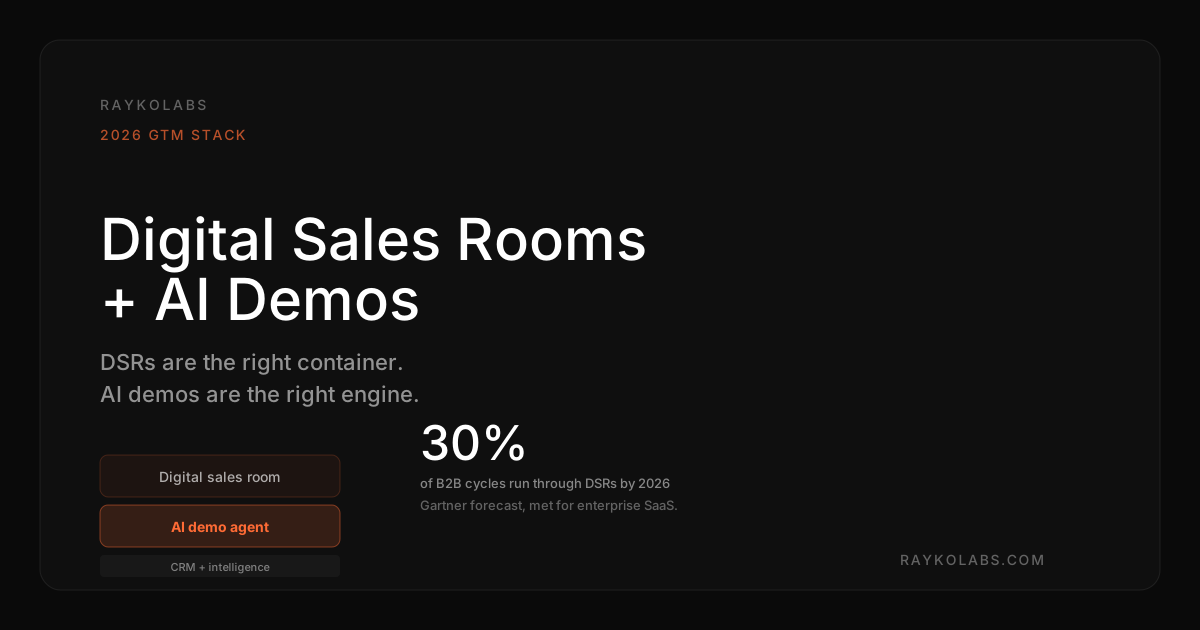
Gartner predicted that 30% of B2B sales cycles will be managed through digital sales rooms by 2026. That number seemed aggressive when it was published. It does not seem aggressive anymore.
Three structural shifts are driving adoption.
Buying committees keep growing. The average B2B deal now involves six to ten decision-makers, each with different concerns and criteria. Sending separate emails with separate attachments is a coordination nightmare. A DSR puts everyone in the same room.
Buyers prefer async evaluation. The preference for self-directed buying is permanent. Buyers want to evaluate on their own schedule, revisit materials without asking the rep to resend, and share resources internally without forwarding chains. A DSR supports all of this natively.
Revenue leadership wants deal visibility. When a deal stalls, the first question from the CRO is "what are they engaging with?" Without a DSR, the answer is a guess. With one, you see that the CFO opened the pricing doc three times but never touched the security whitepaper, which tells you exactly where the conversation needs to go.
Gartner's tracking of DSR (Digital Sales Room) adoption has been steadily revised upward through 2025-26, the early "30% by 2025" prediction has effectively been met for enterprise B2B SaaS, with category penetration crossing roughly half of mid-market sellers. Forrester's research on B2B buyer self-service points to the same direction: buyer demand for DSR-style asynchronous evaluation surfaces is now the default expectation, not a differentiator.
These forces are not temporary. Buying committees will not shrink. Async preferences will not reverse. Revenue leaders will not stop asking for data. DSRs are becoming infrastructure, not a nice-to-have.
The demo gap in most DSRs
The content inside a DSR is almost entirely static. PDFs, slide decks, one-pagers, case studies, recorded videos. The buyer reads, watches, or skips. No interaction, no conversation, no adaptation. Most DSRs embed click-through demos from tools like Walnut or Consensus, which are better than a PDF but still cannot answer a single question.
The demo asset is the most glaring problem.
It is the same demo for every stakeholder. The CTO and the end-user manager have radically different questions about your product. A recorded demo cannot serve both. It was built for one persona and it either bores or confuses everyone else. We wrote about this problem in depth in our demo personalization breakdown, the short version is that one-size-fits-all demos actively hurt multi-stakeholder deals.
It is out of date. Products ship features weekly. That recorded demo from two months ago shows a UI that no longer exists and misses the features your prospect specifically asked about. Keeping recorded demos current is a production burden most teams abandon.
It offers zero engagement data. A recorded video tells you that someone pressed play and watched for four minutes. It does not tell you what they cared about, what confused them, or what questions they had. Compare that to the depth of insight available from interactive demo analytics, feature-level engagement, question analysis, intent signals, and the information gap is staggering.
It cannot answer questions. The prospect watches the demo, has a question about SSO integration, and now has to email the rep and wait. The momentum dies. In a live conversation, whether with a human or an AI demo agent, that question gets answered in seconds and the evaluation continues.
Digital sales rooms without live demos are just Dropbox with better UI. The entire premise of a DSR is to accelerate the deal by giving buyers what they need, when they need it. If the most important asset in the room, the product experience, is a stale recording nobody watches, the room is not doing its job.
Here is a contrarian take: most DSR vendors will be acquired or irrelevant within three years unless they integrate live AI demo capabilities. The standalone DSR, content repository plus analytics, is a feature, not a product. CRMs already host content. Email platforms already track engagement. The only durable value a DSR offers is the ability to deliver an interactive product experience inside the room. If the room cannot do that, it is just another tab the buyer ignores.
What AI demos add to digital sales rooms
An AI demo agent embedded in a DSR transforms the room from a content repository into an active selling environment. Here is what changes.
Personalization per stakeholder
When the VP of Engineering opens the DSR, the AI demo walks them through technical architecture, API documentation, and infrastructure requirements. When the Head of Sales opens the same room, the demo shifts to pipeline analytics, rep workflows, and CRM integration. Same product, completely different experience.
This is not hypothetical personalization where you swap a logo and industry name. The AI agent reads the stakeholder's role from the CRM record and constructs a demo path through your actual product that matches their priorities. The technical architecture uses three-layer navigation: context detection understands the current state, navigation planning determines the optimal path, and LLM integration ties it together based on who is watching and what they ask.
Live product access on demand
The demo is not a recording. It is a live browser session running your actual product. The prospect asks to see a specific feature, the AI navigates there. They ask "how does this handle bulk imports?" and watch it demonstrated in real time. Closer to a sales engineer sitting next to them than a video.
At RaykoLabs, these sessions run on Browserbase with Playwright handling browser automation. Sessions are recorded via rrweb for full replay capability. The target is 800ms response latency, fast enough that the interaction feels conversational, not laggy.
Conversation data that feeds the deal
Every AI demo session generates structured data: which features the stakeholder explored, what questions they asked, how long they spent on each section, where they expressed confusion or excitement. This data flows back to the DSR and the CRM, giving the sales team a complete picture of each stakeholder's engagement.
That intelligence changes follow-up entirely. Instead of "did you get a chance to look at the demo?" the rep says "I saw you spent time on audit logging and asked about SOC 2, let me connect you with our security team." That specificity builds trust. For a deeper look at what demo analytics make possible, see our complete analytics guide.
Async availability that matches buyer behavior
The AI demo is available whenever the buyer opens the DSR. Midnight on a Sunday, during a layover at O'Hare, 6 AM before a board meeting. No scheduling, no timezone math. Buying committees do not evaluate products on a predictable schedule, they evaluate when they have time, and that window is narrow.
The architecture
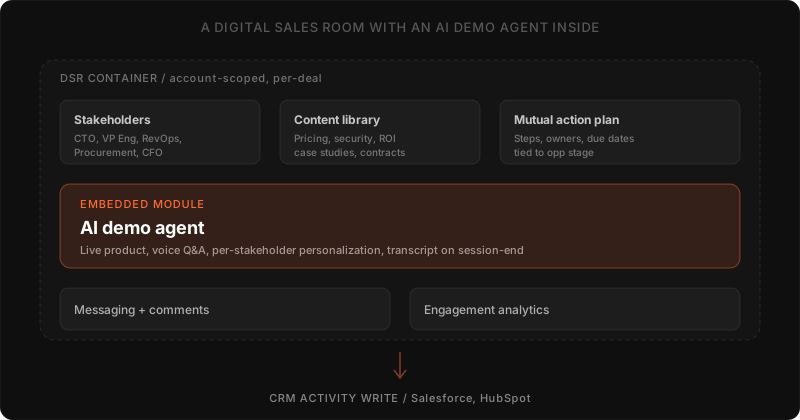
Embedding AI demos into a DSR workflow requires connecting several systems that were not designed to talk to each other. Here is how the integration works at a technical level, without requiring a computer science degree to follow.
The DSR as the container
The digital sales room serves as the front-end experience. Stakeholders see the standard DSR interface, content library, mutual action plan, messaging, plus an embedded demo module. That module launches an AI demo session within the room via iframe or web component.
The DSR passes context to the demo agent: stakeholder identity (from CRM), deal stage, content already engaged with, and what other stakeholders focused on during their demos. This context shapes the experience before the first word is spoken.
The AI demo engine
The demo engine handles the actual product walkthrough. At RaykoLabs, this means:
- Voice interaction powered by Deepgram for speech-to-text and Cartesia for text-to-speech, the prospect talks to the demo like they would talk to a sales engineer
- Browser automation via Playwright running on Browserbase cloud infrastructure, the agent controls a real browser session with your actual product
- Three-layer navigation that combines DOM context detection, planned navigation paths, and LLM-driven decision-making to handle any question or request
- Session recording through rrweb that captures the complete interaction for replay and analysis
The engine maintains a persistent understanding of each deal. If the CTO ran a demo yesterday and asked about API rate limits, the AI references that context when the VP of Product runs their demo today. The deal intelligence is cumulative.
CRM and analytics integration
Demo engagement data lands in two places: back in the DSR (alongside other engagement data) and in the CRM (as part of the deal record and pipeline reporting).
Each session generates a data payload: stakeholder identity, session duration, features explored, questions asked with transcripts, sentiment indicators, and a structured summary. That summary becomes a CRM activity, no manual logging required. The ROI of eliminating manual demo logging alone is significant, but the real value is in intelligence quality. An AI-generated session summary captures details a human rep would never type into Salesforce.
The data flow stacks three layers. The DSR (Highspot, Allego, Showpad, Trumpet) sits at the top as the buyer-facing surface, branded, account-scoped, hosting docs, videos, and embedded experiences. The AI demo engine sits in the middle, embedded into the DSR via iframe or direct integration, capturing every voice session and producing a transcript-plus-intent-signal payload at session end. The CRM (Salesforce, HubSpot) sits at the bottom, receiving structured updates on which stakeholders engaged, which features they explored, and which objections they raised. The transit between layers is event-driven: DSR view triggers a session-start, agent session-end triggers a CRM activity write, and a digest of cross-stakeholder engagement triggers an alert to the AE.
The handoff layer
Not every interaction should stay with the AI. When a prospect asks something the AI cannot answer confidently, or when the conversation signals high buying intent, the system surfaces a notification to the assigned rep with full session context and offers to transition to a live conversation.
This is where the human vs. AI demo framework applies directly. The AI handles discovery and evaluation. The human handles negotiation and closing. The DSR is the environment where both operate.
What this means for sales teams
The practical implications break into three categories.
For AEs and sales engineers
Your first-touch demo volume drops dramatically. The AI handles every stakeholder who opens the DSR and wants to explore the product. By the time you get on a call, the prospect has already seen the product and identified the areas they want to go deeper on. Your calls shift from "let me show you the product" to "let me address the specific concerns that came up during your evaluation."
Shorter calls, higher-quality conversations, more time for deals that need human nuance. The AI is not replacing you, it is filtering out repetitive work so you can focus on interactions where humans genuinely outperform AI.
For sales leadership
Every stakeholder interaction with the product is captured, structured, and tied to the deal record. You see which deals have active buyer engagement, which have gone dark, and which stakeholders are blockers who have not opened the room.
Deal reviews change from "what's your gut feeling?" to "the economic buyer ran three demo sessions focused on cost analysis and compliance, here's exactly what they asked about." That transforms forecasting from art to evidence.
For marketing and demand gen
The DSR becomes a distribution channel for your best sales asset. Instead of gating product access behind a form and a scheduled call, embed an AI demo in the room that every campaign drives to. Marketing sees which features resonate with which personas, which messaging drives demo engagement, and where prospects drop off. That data informs positioning and campaign targeting directly. Our ROI analysis breaks down the revenue impact.
Building the 2026 GTM stack
The stack that is emerging looks different from what most B2B companies run today. Here is the framework.
Layer 1: Capture and qualify. Inbound leads interact with an AI SDR and get qualified. Outbound sequences identify and engage target accounts. Qualification data, role, use case, pain points, feeds forward into every subsequent interaction.
Layer 2: Digital sales room. Every qualified opportunity gets a DSR pre-populated with relevant content. Mutual action plan templated by deal stage. AI demo embedded and ready.
Layer 3: AI demo engine. The agent sits inside the DSR, available to every stakeholder. It adapts per role, references previous interactions across the buying committee, and generates structured intelligence after every session. Infrastructure: FastAPI backend, Playwright on Browserbase, voice via Deepgram and Cartesia over WebSocket, recordings via rrweb, sub-second latency.
Layer 4: CRM and intelligence. Every interaction across all layers feeds the CRM, demo data, DSR engagement, AI SDR conversations, structured and tied to the opportunity. Pipeline reporting includes demo-sourced metrics alongside traditional activity data.
Layer 5: Human sellers. Reps operate on deals that need them, armed with full context from every AI interaction. Their time goes to objection handling, executive relationships, and negotiation.
| Layer | Role | What runs it |
|---|---|---|
| Layer 1: Capture and qualify | Qualify inbound, engage target accounts, feed context forward | AI SDR and outbound sequences |
| Layer 2: Digital sales room | Pre-populated deal room with content, action plan, embedded demo | DSR platform |
| Layer 3: AI demo engine | Per-role adaptive demos, cross-committee references, post-session intelligence | FastAPI, Playwright on Browserbase, Deepgram and Cartesia over WebSocket, rrweb |
| Layer 4: CRM and intelligence | All interactions tied to the opportunity, demo-sourced pipeline reporting | CRM (Salesforce, HubSpot) |
| Layer 5: Human sellers | Objection handling, executive relationships, negotiation on deals that need them | Reps armed with full AI-interaction context |
A short comparison: the traditional B2B GTM stack ran on human-dependent layers, outbound prospecting (SDR), discovery (BDR/AE), demo (AE/SE), follow-up (AE), proposal and close (AE). The 2026 stack inserts AI agents at every layer where repeatable conversations exist: AI SDRs handle outbound and qualification, AI demo agents handle first-touch demos and discovery, the human AE focuses on the multi-stakeholder strategy, contract dynamics, and the conversations that genuinely require judgment. The DSR is the connective tissue that makes the asynchronous, AI-augmented motion legible to the buyer.
This is not a rip-and-replace. Most companies will start by adding AI demos to their existing DSR, see the engagement data improve, and work backward to integrate the other layers.
We built RaykoLabs because we kept hitting the same wall from the other side. We had the AI demo technology, Playwright automation, voice interaction, real-time walkthroughs, and customers kept asking "how do I put this inside the sales room we already send to buyers?" The integration was not a strategic decision from a boardroom. It was the next obvious step based on how buyers wanted to use the product. Every builder knows that feeling, when the usage pattern tells you where to go next, and the market is already there waiting.
The convergence is inevitable
Every serious B2B sales team will run some version of this stack within the next two years. Not because the technology is exciting, but because the economics leave no other option.
Buyers will not wait three days for a scheduled demo when they can experience the product in 30 seconds. Buying committees will not pass around a recorded video when each stakeholder can get a personalized walkthrough. Sales leaders will not rely on rep anecdotes when structured demo intelligence is available.
The companies that figure this out first will not just close deals faster. They will close deals their competitors never knew were in play, because the prospect evaluated, decided, and moved forward while the competitor's rep was still trying to find a calendar slot.
DSRs are the right container. AI demos are the right engine. Putting them together is not a prediction. It is a description of what the best teams are building right now.
September 2026 check: are sales rooms plus AI demos now the standard stack?
Mostly yes for enterprise B2B SaaS. Rooms are now expected infrastructure for multi stakeholder deals, while the demo gap described here still applies. Static recordings still go stale and still serve every role the same way. Embedded live agents remain the fix that makes rooms active.
We rechecked the cited hubs in September 2026, including the Gartner buying journey hub, the Forrester research hub, the Salesforce State of Sales hub, the TrustRadius buyer research hub, and the HubSpot sales hub. They remain valid support for larger committees, async evaluation, and demand for deal visibility. The platform list used here, including Dealroom, Aligned, GetAccept, and Trumpet, also remains a fair snapshot of DSR options and required no removal.
Keep the five layer stack as written. AI SDR for capture and qualification, DSR as the container with mutual action plan, AI demo engine for per role live walkthroughs, CRM for structured intelligence, and human sellers for negotiation and close. Start by embedding the demo in the existing room and work backward. No architecture claim required correction in September 2026.
Verdict: Put a live AI demo inside the sales room to make it sell
Digital sales rooms work best with a live AI demo embedded for every stakeholder. The room holds content and mutual plans, the agent gives role based walkthroughs on demand, answers questions, and writes engagement back to the room and CRM automatically.
Start by embedding the agent in your current room and pass role and deal context into each session. Use the returned summary to update the mutual plan and alert reps on high intent, so async evaluation keeps moving without extra meetings.
Frequently asked questions
What is a digital sales room?
A digital sales room is a shared, persistent workspace between a seller and a buying committee, a private microsite for a specific deal where all content, communication, and activity lives behind a single URL. The core components are content hosting, a mutual action plan, messaging, and analytics showing who opened what and when. Platforms like Dealroom, Aligned, GetAccept, and Trumpet have built variations on this model.
Why are digital sales rooms becoming the default?
Three structural shifts drive adoption: buying committees keep growing to six to ten decision makers, buyers prefer self-directed asynchronous evaluation, and revenue leaders want deal engagement visibility. Gartner's early prediction that 30 percent of B2B sales cycles would run through DSRs by 2026 has effectively been met for enterprise B2B SaaS, with penetration crossing roughly half of mid-market sellers.
What is the demo gap in most digital sales rooms?
The content inside most DSRs is static, and the recorded demo asset is the worst offender. It is the same demo for every stakeholder, it goes out of date as the product ships features weekly, it offers almost no engagement data beyond press-play, and it cannot answer questions. A DSR without a live demo is just Dropbox with better UI.
What do AI demos add to a digital sales room?
An embedded AI demo agent turns the room from a content repository into an active selling environment. It personalizes the walkthrough per stakeholder by reading their role from the CRM, gives live product access on demand instead of a recording, generates conversation data that feeds the deal, and stays available whenever the buyer opens the room, matching the unpredictable way committees actually evaluate.
How does the DSR plus AI demo architecture connect to the CRM?
The DSR is the buyer-facing container that passes stakeholder identity and deal context to an embedded AI demo engine via iframe or web component. The engine runs voice and live browser automation, records sessions, and at session end produces a structured payload of features explored, questions asked, and sentiment. That summary writes back to the DSR and the CRM as an activity automatically, with no manual logging, and a handoff layer alerts the rep on high intent.
Sources
- The B2B Buying Journey, Gartner
- Digital Sales Transformation, Forrester
- State of Sales, Salesforce Research
- B2B Buyer Insights, TrustRadius
- Sales Statistics and Benchmarks, HubSpot
Cite this article
Utkarsh Agrawal. "2026 Digital Sales Rooms and AI Demos That Close." RaykoLabs Blog, March 27, 2026. https://raykolabs.com/blog/digital-sales-rooms-ai-demos

Utkarsh Agrawal is CTO of RaykoLabs, where he leads engineering on Rayko, the AI demo agent that runs live, voice-enabled product demos in a real browser for B2B SaaS teams. His work spans real-time voice interaction, browser automation with Playwright and Browserbase, speech-model orchestration, and the infrastructure that keeps autonomous demos reliable around the clock. On the RaykoLabs blog he writes practical guides on voice-enabled product demos, demo automation, and what it takes to ship production AI agents for sales: how to qualify prospects mid-demo, how to measure demo performance, and how buying teams actually evaluate demo software. His comparisons of demo platforms are built from hands-on testing and vendor documentation, with trade-offs stated plainly so buyers can decide fit.
See RaykoLabs in action
Watch an AI agent run a live, personalized product demo, no scheduling, no waiting.
START LIVE DEMO