Loading...

State of AI Demos, Mid-2026 Update: What Changed Since May
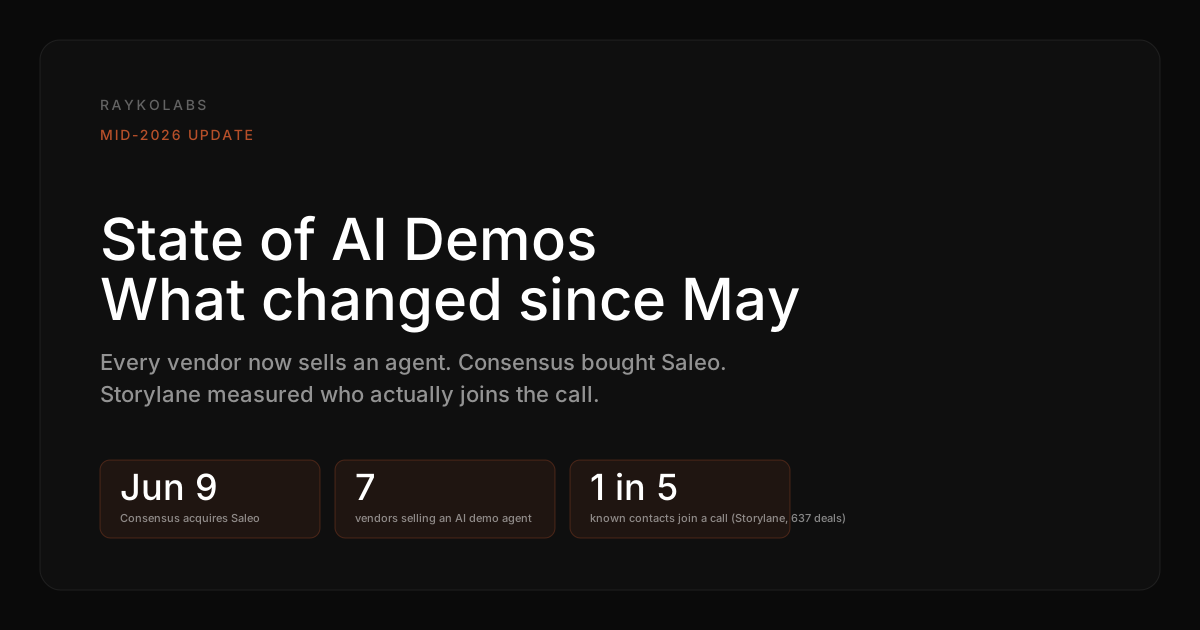
Every major demo vendor now sells an AI demo agent, Consensus bought Saleo, and Storylane measured who joins sales calls. What four months changed for buyers.
Quick answer
Between May and September 2026 the AI demo category consolidated around agents: Consensus acquired Saleo on June 9, Storylane launched RepX, Walnut and Navattic repositioned around agents, and Supademo shipped an AI Demo Agent. Three architectures now compete, live-product agents, captured-demo agents, and data-injection demos. Storylane's analysis of 637 deals shows only one in five buying contacts ever joins a sales call, which is the case for an always-on demo.
Want this running on your product? Rayko demos it live, with your prospects asking questions by voice.
START LIVE DEMOIn May we published the State of AI Demos 2026 and a sourced benchmark reference. Four months later the category looks different enough to warrant an update rather than a revision. This post covers what actually happened between May 17 and September 10, 2026, with a link to each vendor's own announcement, and what it means if you are evaluating demo software in the fourth quarter.
Two ground rules, consistent with our methodology: every figure below is attributed to the organisation that published it, and vendor performance claims are labelled as vendor claims.
The four months in one table
| Date | Event | Source |
|---|---|---|
| June 9 | Consensus acquires Saleo and closes its Peel acquisition; the combination is branded the Consensus Product Experience Platform | Consensus press release |
| August 12 | Storylane publishes an analysis of 2,021 sales conversations across 637 deals | Storylane |
| August 18 | Navattic publishes "The 6 Best AI Demo Software" | Navattic |
| August 19 | Navattic publishes a build-versus-buy guide for AI demo software based on 38 buyer interviews | Navattic |
| September 2 | Navattic's three co-founders publish their case for agentic demos | Navattic |
| September 2 | Walnut announces its agents now cover both sides of the buying experience | Walnut |
| September 3 | Storylane launches RepX, an AI sales agent that runs demos inside a voice or chat conversation | Storylane |
| September 8 | Walnut publishes "AI Demo Agents or Live Reps? The 2026 Playbook" | Walnut |
| September 9 | Storylane publishes sourced interactive demo statistics and engagement benchmarks | Storylane |
Not on that list, because it happened earlier but matters now: Navattic announced Navattic Agents on March 9, 2026, Saleo published its AI Demo Agent page on January 9, 2026, and Karumi launched on Hacker News in late 2025 as a Y Combinator Fall 2025 company describing itself as an agent that operates a real web app in a shared browser session.
Every major vendor now sells an agent
In May the phrase "AI demo agent" belonged to a handful of new entrants. By September it is on the product page of every established interactive demo vendor. Walnut's playbook defines the category as "an autonomous, conversational, intent-driven product experience that guides a buyer through a personalized product story without a human sales rep present." Navattic's co-founders put the bet more bluntly: Randy Frank predicts that "the future of product content will be completely bespoke. No two experiences should look the same."
The word is now shared. The products are not. Three architectures compete under the same label, and the difference decides what your prospect actually sees:
- Live-product agents operate the deployed application in a real browser and talk the buyer through it. This is how RaykoLabs works, using Playwright on Browserbase for browser control and real-time voice models for the conversation. Karumi describes the same approach. Nothing is captured, so nothing goes stale when the interface changes.
- Captured-demo agents guide buyers through interactive demos that were recorded first. Supademo's AI Demo Agent supports voice and text in 50 or more languages, runs 24/7, asks discovery questions, and surfaces the matching captured demo, video or deck. It is a usage-based add-on on Scale plans and above; every workspace starts with 1,500 free credits, which Supademo describes as roughly 75 demo calls. Navattic Agents and Walnut's agent platform are built on their capture-based products.
- Data-injection live demos run the native product with curated demo data loaded into it, so complex enterprise software looks complete for every buyer. Saleo pioneered this for sales engineers, added a chat-based, multilingual AI Demo Agent in January, and is now sold inside Consensus.
We wrote a longer definition, with a comparison table against interactive demos, demo videos and chatbots, on the new What is an AI demo agent page. The short version for buyers: ask which of the three you are being shown, and ask to see it on your own product.
Consolidation: Consensus, Saleo and Peel
The Consensus announcement of June 9 is the largest structural change of the period. In the company's words, "Saleo brings flawless, data-rich live product demos to the Consensus platform. Built on proprietary technology that injects tailored demo data directly into the native product, Saleo enables revenue teams to run live demos that reflect the buyer's actual reality." The release names SAP, Salesforce, Seismic, Clari and 6sense as Saleo customers and Oracle, Atlassian, Salesforce and SAP as Consensus customers. Financial terms were not disclosed.
For buyers, three practical consequences follow. A Saleo evaluation is now a Consensus evaluation, with Consensus pricing and packaging. The enterprise, sales-led end of the market has consolidated into one platform that spans demo videos, live data-injected demos and an agent. And the self-serve, per-usage end of the market, where RaykoLabs, Supademo and Karumi sit, is now clearly a different purchase. Our Saleo comparison and Consensus comparison reflect the new ownership.
The buying-committee data that changes the demo brief
Storylane's August study is the most useful new dataset of the period because it measures who is absent. From 2,021 recorded conversations across 637 mid-market and enterprise deals, the average buying account had about 23 known contacts in the CRM but only 2.3 people on calls; roughly one in five known contacts ever joined a call. Champions had frequently evaluated competitors before the first conversation. Economic buyers shaped requirements and timelines without attending. Security, legal and finance first appeared at contract stage, and procurement calls averaged 1.89 attendees.
Read against the demo motion, the study says the call is the minority channel. Four out of five people who influence the deal will only ever meet your product asynchronously, on their own schedule, without a rep. That is the brief an AI demo agent has to satisfy: answer the champion's question at the moment it is asked, give the absent CFO something she can evaluate in ten minutes, and leave the sales team a record of who asked what. It is also why we price per completed demo rather than per seat: the value is in the conversations that happen when nobody is on a call.
Vendor claims worth reading with the label on
Two numbers will circulate from this period, and both deserve their provenance attached. Navattic's co-founders write that interactive demos appeared on 0.2 percent of websites in 2020 and on 18 percent of B2B websites by 2026, citing Navattic's own 2026 State of the Interactive Product Demo report. Walnut's playbook cites Walnut platform data for 34 percent faster sales cycles, 32 percent higher conversions and 26 percent higher engagement with personalised, intent-driven demos; the article does not reference an independent source for those figures.
Neither number is wrong for being vendor data, but neither is an industry benchmark, and both measure click-through interactive demos rather than agent-led demos. Storylane's September 9 statistics post makes the same point in its title, "Sourced, Not Recycled", and our benchmarks reference exists for the same reason. If you see any of these figures quoted without a source in a vendor deck, including ours, ask for the report.
What it means for a buyer evaluating in Q4 2026
- Decide the architecture before the vendor. Live product, captured demo, or injected data determines maintenance cost, accuracy and what prospects trust. Everything else on the feature list is secondary.
- Test the unknown question. Ask the agent something not in the docs. The right behaviour is to say so and offer a human. Walnut's own framing applies: "The real question is not 'AI or live rep?' The real question is 'which job belongs to which?'"
- Model pricing at your traffic. Per completed demo, per creator seat plus credits, and sales-led enterprise contracts produce very different bills at 200 demos a month. Our Supademo comparison lays the models side by side.
- Check what the sales team receives. Transcript, screens visited, objections and a score should arrive without anyone asking for a recap.
- Ask what happens at the next redesign. For captured-demo agents, the answer is re-capture. For live-product agents, nothing.
- Treat the acquisition as a packaging change. If Saleo was on your shortlist, request Consensus pricing and the roadmap for the combined platform before assuming continuity.
What it means for RaykoLabs
Our position did not change; the neighbourhood did. RaykoLabs remains the live-product, voice-first agent with published, per-demo pricing and a self-serve pilot. What changed is that the definition we used in May is now the industry's definition, and two of the largest vendors have adopted the language. We take that as validation of the category and as a signal that the differences between architectures will matter more, not less, as buyers get used to the word "agent" on every pricing page.
Three things we shipped in response this week: the AI demo agent definition page, a methodology and data notes page that states how every figure on this site is sourced, and side-by-side comparisons with Supademo and Saleo. Try the agent on our own product from the live demo, then judge the architecture question for yourself.
What we will publish next
A short explainer on what the Consensus and Saleo deal means for a mid-evaluation buyer, an honest comparison of Supademo alternatives, and a support-side roundup of customer support automation platforms. One post a week, each with sources, and none of them editing what we have already published.
That explainer is now published: see Consensus acquires Saleo.
Frequently asked questions
What changed in the AI demo market between May and September 2026?
Consensus acquired Saleo on June 9, 2026 and closed its Peel acquisition, branding the combination the Consensus Product Experience Platform. Storylane launched RepX, a voice and chat AI sales agent that runs demos inside the conversation. Walnut relaunched as an agent platform covering both sides of the buying experience. Navattic's co-founders published their bet on agentic demos, and Supademo added a credit-based AI Demo Agent to its paid plans. Every major vendor now sells an agent.
Which vendors sell an AI demo agent in 2026?
RaykoLabs, Supademo, Saleo (now part of Consensus), Navattic, Walnut, Storylane (RepX) and Karumi all sell a product they describe as an AI demo agent or agentic demo. They differ mainly in what the agent operates: the live product, a captured demo, or the native product with injected demo data.
Is Saleo still a separate company?
No. Consensus announced on June 9, 2026 that it had acquired Saleo. Financial terms were not disclosed. Saleo's live, data-injected demos and its chat-based AI Demo Agent now sit inside the Consensus Product Experience Platform, and a buyer evaluating Saleo is evaluating a Consensus product line.
What did Storylane's 637-deal study find?
Analysing 2,021 recorded sales conversations across 637 mid-market and enterprise deals, Storylane found that the average buying account has about 23 known contacts in the CRM but only 2.3 people on calls, so roughly one in five known contacts ever joins a call. Champions had often evaluated competitors before the first call, economic buyers shaped deals without attending, and procurement functions appeared only at contract stage.
How should a buyer evaluate AI demo agents after these changes?
Ask which of the three architectures you are buying: a live-product agent that operates the deployed application, a captured-demo agent that guides buyers through recordings, or a data-injection demo that loads curated records into the native product. Then check voice support, behaviour on unknown questions, what the sales team receives, how handoff works, what breaks on a UI change, and whether pricing scales with demos delivered or with seats and credits.
Sources
- Consensus Acquires Saleo, Creating the Industry's First Agentic Product Experience Platform, Consensus, June 9, 2026
- 4 in 5 buyers never join your calls (and three more buying trends from 637 B2B deals), Storylane, August 12, 2026
- The deals human reps shouldn't be closing: where (and why) RepX fits into the sales cycle, Storylane, September 3, 2026
- The Evolution of Demo Software and Future with Agents, Navattic, September 2, 2026
- Why we built Navattic Agents, Navattic, March 9, 2026
- AI Demo Agents or Live Reps? The 2026 Playbook, Walnut, September 8, 2026
- Walnut's AI Agents Now Cover Both Sides of the Buying Experience, Walnut, September 2, 2026
- AI Demo Agents, Supademo
- Supademo Pricing, Supademo
- AI Demo Agent: Autonomous 24/7 Product Demos, Saleo
- Launch HN: Karumi (YC F25), Personalized, agentic product demos, Hacker News
- Interactive Demo Statistics 2026: Sourced, Not Recycled, Storylane, September 9, 2026
Cite this article
Utkarsh Agrawal. "State of AI Demos, Mid-2026 Update: What Changed Since May." RaykoLabs Blog, September 10, 2026. https://raykolabs.com/blog/state-of-ai-demos-mid-2026-update

Utkarsh Agrawal is CTO of RaykoLabs, where he leads engineering on Rayko, the AI demo agent that runs live, voice-enabled product demos in a real browser for B2B SaaS teams. His work spans real-time voice interaction, browser automation with Playwright and Browserbase, speech-model orchestration, and the infrastructure that keeps autonomous demos reliable around the clock. On the RaykoLabs blog he writes practical guides on voice-enabled product demos, demo automation, and what it takes to ship production AI agents for sales: how to qualify prospects mid-demo, how to measure demo performance, and how buying teams actually evaluate demo software. His comparisons of demo platforms are built from hands-on testing and vendor documentation, with trade-offs stated plainly so buyers can decide fit.
See RaykoLabs in action
Watch an AI agent run a live, personalized product demo, no scheduling, no waiting.
START LIVE DEMO