Loading...

2026 24/7 SaaS Support: Cover Nights Without Hiring
Cover 24/7 SaaS support with AI for routine volume plus on-call for incidents, and add regions only past break-even. Learn the model. Read the guide.
Quick answer
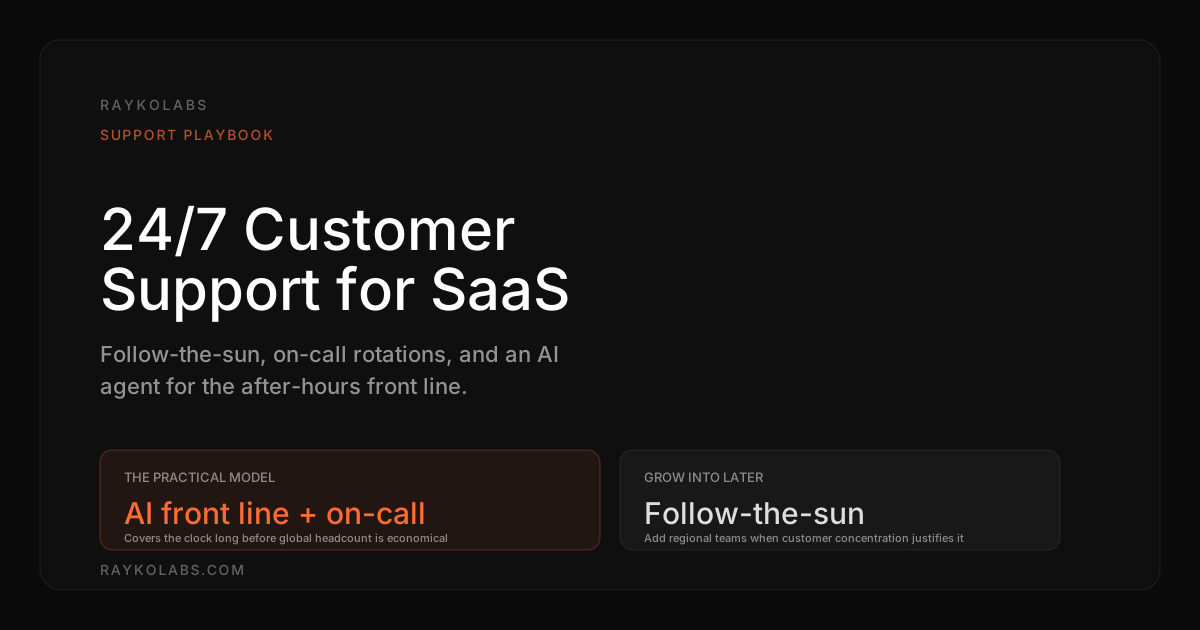
To provide 24/7 customer support for a SaaS product, solve the Off-Hours Coverage Equation: split overnight demand by severity, then cover each band with the model whose cost per covered hour is lowest. An AI front line handles routine volume, on-call covers rare incidents, and follow-the-sun comes only past its regional break-even. AI plus on-call covers the clock before global headcount is economical.
Want this running on your product? Rayko demos it live, with your prospects asking questions by voice.
START LIVE DEMOThe product I work on is a live AI agent: it runs the demo before a sale and handles setup and how-to questions afterward. Reading its off-hours transcripts taught me something the org chart hides: a SaaS product is available at 3 a.m. whether or not anyone is, an admin in another time zone is mid-setup during their workday while yours is asleep, and someone is configuring an integration on a Sunday because that is their only quiet window. The product created the 24/7 expectation the moment it became always-on. The real question is the economics: how to cover the clock without staffing a night shift you cannot yet justify. This post is the cost model I use for that. It is the support-side coverage companion to our 24/7 AI demos for after-hours inbound post, and both sit under the AI demo agents complete guide pillar.
The Off-Hours Coverage Equation
The reason "should we hire a night shift" is the wrong question is that it treats overnight as one undifferentiated thing to staff. It is not. Overnight demand is two very different populations with very different costs to serve, and the right model is whichever one covers each population most cheaply. State that as an equation:
Total off-hours cost = (routine off-hours volume x cost per routine resolution) + (incident off-hours volume x cost per incident response)
The whole strategy is minimizing that sum, and the two terms behave nothing alike. The first term is large in volume but each resolution can be made nearly free. The second term is tiny in volume but each response is expensive and must be human. A single model applied to both is guaranteed to be wrong on one term: staff for incidents and you massively overpay the routine term, deflect everything and you fail the incident term catastrophically. You minimize the sum by covering each term with a different model chosen on one metric: cost per covered hour, the total cost of a model divided by the hours it actually covers well. That single comparison, applied per severity band, is the entire method, and it is borrowed deliberately from reliability engineering rather than from support tradition.
Why the routine term collapses to near zero is the shape of overnight demand. After-hours contact is dominated by the same repetitive routine questions as daytime (how do I do X, where is this setting, why did this fail, is this expected) plus a much smaller incident band. That is the consistent pattern in the Rayko demo and support transcripts I read: the overnight mix looks much like the daytime mix, low-complexity contacts heavily outnumber genuine incidents, and that ratio does not flip just because it is 3 a.m. So the bulk of what a night shift would do is exactly the deflectable routine term, whose cost per covered hour can be driven near zero, while the residual incident term is usually low enough for on-call to absorb. Staffing a full night shift makes the routine term expensive for no reason.
Cost per covered hour: how the models actually compare
The equation says compare models by cost per covered hour, per severity band. Spelling that comparison out is what makes the answer obvious instead of reflexive.
| Model | What it covers | Why its cost per covered hour behaves this way | Best fit |
|---|---|---|---|
| AI front line | Routine how-to, setup, navigation, severity triage | Tooling cost is roughly fixed, so cost per covered hour falls as routine volume rises | Almost every SaaS company, as the always-on first layer |
| On-call rotation | Severe incidents needing a human | Pays availability plus rare incident work, not full staffing, so cost per covered hour stays low while incidents are rare | Companies with real but infrequent overnight incidents |
| Follow-the-sun | Full spectrum, continuously, no night work | Staffs regional teams, so cost per covered hour only beats AI-plus-on-call past a regional volume break-even | Companies past their multi-region break-even |
| Dedicated night shift | Full spectrum overnight in one region | Staffs the lowest-density hours, so cost per covered hour is structurally high | Rarely optimal, usually a reflex default |
The dedicated night shift is in the table only because it is what teams reach for first and it is almost never the right starting point: it pays full staffing across the lowest-density hours to serve volume that is mostly deflectable, so its cost per covered hour is high by construction. The equation's solution for the large majority of SaaS companies is the AI front line covering the routine term plus on-call covering the incident term, with follow-the-sun added later and deliberately past its break-even.
Solving the routine term: the AI front line
The AI front line is the layer that makes 24/7 economically feasible because it is the only one whose cost per covered hour falls as routine volume rises. A night shift's cost per covered hour is fixed by salaries regardless of how light the night is. An AI front line's cost is roughly fixed tooling spread across whatever routine volume arrives, so the more routine overnight contact it absorbs, the cheaper each covered hour gets. That is the structural reason a small SaaS company can offer credible around-the-clock support at all, and it is not a marginal optimization.
The honest version of what it covers, because the boundary is what makes the model trustworthy. It genuinely covers routine how-to and setup questions in real time at any hour ("how do I configure the integration," "where do I change my plan," "how do I invite a teammate"), the dominant overnight band; navigation and is-this-expected questions, answered overnight exactly as at noon; and severity triage and context assembly, where on a genuine incident it applies clear severity rules, gathers the account, error, and reproduction steps, and hands a complete picture to the on-call path so the paged human starts resolving immediately. The customer-effort argument is directly relevant here: the Harvard Business Review article "Stop Trying to Delight Your Customers" made the case that customers prefer a low-effort resolution over channel-switching, and an instant correct answer at 3 a.m. is the lowest-effort outcome there is. Post-sale setup and onboarding is the niche Rayko occupies: the same agent that ran the pre-sale demo answers setup and how-to questions after the sale, on your real product, around the clock.
It does not cover severe incidents (an outage, data integrity issue, or security concern at 3 a.m. needs a human now, and the AI's only correct job is fast accurate severity detection and an immediate clean page, never an attempt to resolve), account-specific actions needing access or authorization (refunds, data corrections, account-state changes under judgment), or high-stakes and emotionally charged contacts (a customer mid-costly-failure wants a human who can own it, route up immediately and visibly). Rayko is a routine front line and a deflection layer, not a full help desk replacement, and pretending the AI covers the incident term is the single most dangerous misconfiguration of this whole model. It only works if the AI is grounded in accurate documentation and real product behavior, applies a consistent explicit severity definition, escalates cleanly with full context the instant it is out of depth, and never traps a customer with a real emergency behind a bot. Pick a tool whose transcripts you can read daily, because the overnight transcripts are a precise continuously refreshed map of what customers hit when no human is watching, the highest-value tuning input for both the agent and your docs.
Solving the incident term: the on-call rotation
The AI front line drives the routine term toward zero. The on-call rotation covers the incident term: the residual that genuinely needs a human. These pair well for a specific economic reason. On-call pays for availability plus the relatively infrequent actual incident work, not for continuously staffing low-density hours, so once the AI front line has absorbed the routine volume, what remains for on-call is small, which keeps both the rotation humane and its cost per covered hour low. Designing it well is mostly on-call discipline applied to support, with clear severity definitions, fast paging with full context, and protection of the rotation.
Define severity unambiguously. The front line can only route correctly if severity-1 has a precise testable definition (customer-facing outage, data integrity issue, security concern, or complete loss of a critical workflow). Ambiguous severity is the single biggest cause of both missed real incidents and 3 a.m. pages for things that could have waited.
Make the page fast and the context complete. When the AI escalates, it should page through your existing alerting tool with the account, symptom, affected scope, and reproduction steps already assembled, so the on-call human's first action is resolving, not investigating. A clean context handoff is the difference between a fifteen-minute incident and a ninety-minute one, and it materially lowers the human cost of being on-call by reducing operational load on responders.
Protect the rotation. On-call is sustainable only if pages are rare and almost always legitimate. The front line absorbing routine volume is what keeps the page rate low. If on-call is paged for things the front line should have handled, the front line is under-grounded or the severity rules are wrong. Treat a noisy rotation as a tuning signal, never as a reason to add people.
Have a clear next-business-hour fallback. Not every after-hours contact is routine or a severe incident. Account-specific but non-urgent issues should be queued by the AI with full context for the next business hour in the customer's region, with the customer told clearly when to expect a response. This keeps non-emergencies out of the page stream entirely.
The model you grow into: follow-the-sun and its break-even
Follow-the-sun is the gold standard for mature global SaaS support, and it is deliberately the last layer to add. It means regional teams holding the active queue in their normal working hours, handed across time zones as each region's day ends: no one works nights and coverage is genuinely continuous across the full severity spectrum.
It is not the starting point because of its break-even. Follow-the-sun's cost per covered hour only beats AI-plus-on-call once a region has enough volume and revenue to justify hiring, training, and managing a team there, plus the operational overhead of cross-region handoffs, consistent quality, and shared tooling. Below that regional volume, follow-the-sun is expensive coverage for a routine term the AI front line already serves far more cheaply. The honest sequencing falls directly out of the equation: start with the AI front line plus on-call, which delivers credible 24/7 immediately at a cost most companies can absorb regardless of where customers are; add a regional team when one region's customer concentration crosses its break-even and a local team is both economical and a meaningful experience improvement, with the AI front line staying as the first layer everywhere; grow into follow-the-sun as regional teams accumulate and the handoff structure forms naturally, with the AI front line continuing to absorb routine volume in every region so each regional team stays focused on complex work. The AI front line is not a temporary scaffold you discard at follow-the-sun. It is the permanent first layer that keeps every later model's cost per covered hour lower, because it keeps the routine term near zero in every region forever.
What most teams get wrong: defaulting to staffed coverage by reflex
The contrarian core. The instinctive answer to "we need 24/7" is "we need people working nights," and it feels responsible, which is exactly why it is so expensive. The reflex optimizes for the worst case (a severe 3 a.m. incident) by staffing the worst case continuously, which means paying the highest cost per covered hour across the lowest-density hours to serve a routine term that did not need humans at all. It conflates the two terms of the equation and pays the expensive model on the cheap term. The damage is invisible on an org chart, which always looks reassuringly covered, and only shows up in the cost per covered hour nobody computed.
The decision rule that prevents it: never pick a single coverage model for "after-hours." Split overnight demand into the routine band and the incident band, then assign each band the model with the lowest cost per covered hour for that band specifically. The only thing that should be staffed continuously is on-call availability for the rare real incident, never a full team working low-density hours. A model that staffs the routine band with humans has failed the equation no matter how good the org chart looks.
And the boundary that keeps the coverage real, not nominal: a high overnight resolution rate only counts if the customers were genuinely resolved, not suppressed. Enforce it by reading after-hours CSAT specifically, not overall CSAT, alongside the on-call false-page rate. If overnight resolution is high while after-hours CSAT holds at or above daytime CSAT and false pages are near zero, the coverage is real. If after-hours CSAT drops or real incidents are sitting in a deflection layer, the coverage is a bot suppressing contact while real problems wait, which is the precise opposite of coverage and the failure mode the SRE discipline exists to prevent.
Putting the bands together at 3 a.m.
A concrete picture makes the equation tangible. A customer contacts support overnight. If it is routine (how-to, setup, navigation, is-this-expected), the AI front line resolves it in the moment: no human, no shift, customer unblocked immediately, and this is the large majority of overnight contacts. If it is account-specific but not urgent (a data question, a plan change needing authorization), the AI gathers full context and queues it for the next business hour in the customer's region, telling the customer clearly when to expect a response: no page, no night shift, no customer left guessing. If it is a genuine severe incident (outage, data integrity, security), the AI applies the explicit severity rule, pages on-call immediately through your alerting tool with full context assembled, and the on-call human starts resolving within minutes: rare, but covered fast. If it originates in a region where you have a local team (once past that break-even), the front line still takes first contact and resolves routine volume, and anything it escalates goes to the regional team in their working hours. The clock is covered at every severity, and the only thing staffed around the clock is on-call availability for rare real incidents. That is the economic shape that makes 24/7 SaaS support feasible well before global headcount is.
Metrics that prove the coverage is real
A 24/7 model can look covered on an org chart and fail in practice. Four metrics tell you whether it is genuine, read together so a good number on one cannot hide a failure on another. After-hours resolution rate without a human is the leading indicator the front line is genuinely carrying the routine term. After-hours CSAT specifically, not overall CSAT, holds at or above daytime CSAT if the front line is genuinely good, and dropping means the coverage is nominal and will return as churn. On-call page rate and false-page rate: a rising page rate or high false-page rate means the front line is under-grounded or severity rules are ambiguous, and this protects the humans on the rotation. Time-to-human for genuine incidents, from severe-incident detection to a human actively working it, is the metric that proves the incident path is real, and a large number means the escalation path, not the front line, is broken. The headline you steer toward is "after-hours resolution high, after-hours CSAT at parity with daytime, on-call page rate low and almost always legitimate, time-to-human for incidents minimal." That set is genuine 24/7 coverage. A high resolution rate alone is easily a bot suppressing contact while real problems wait.
What to read next
If your broader problem is that overnight volume is one symptom of too many routine tickets overall, how to reduce customer support ticket volume covers the debt-ledger work that shrinks the routine term the front line then carries around the clock. If your concern is keeping support sustainable as you grow rather than specifically the clock, how to scale customer support without hiring covers the leverage-ratio architecture this coverage model sits on top of. The AI demo agents complete guide is the pillar connecting the post-sale support agent to the pre-sale motion. Who is writing this and from what experience is on the author page.
For the demo-side companion specifically, 24/7 AI demos for after-hours inbound covers the same always-on agent capturing and qualifying inbound leads when no rep is online, the pre-sale mirror of everything here. For Rayko itself, the same live AI agent that runs your pre-sale demo is the after-hours routine front line afterward, on your real product, around the clock: one conversation surface covering both ends of the customer lifecycle, with a clean human escalation path for everything it should not handle alone.
Does this coverage model still hold in September 2026?
Yes. As of September 2026, the economical order of operations is unchanged: an AI front line carries routine overnight volume, on-call covers rare severe incidents, and regional staffing waits until one region clears its break-even. Nothing in the cited Salesforce, Zendesk, or Intercom service research changes that sequencing, because the cost structure behind it has not changed.
What to recheck this month is narrower. First, reread your severity definition against the last 30 days of overnight transcripts and confirm the AI paged only genuine severity one contacts. Second, compare after hours CSAT against daytime CSAT rather than trusting blended CSAT, since blended scores hide overnight degradation. Third, confirm your follow the sun math still uses current hiring cost for the region you would staff next, not the cost from the original plan. If those three checks pass, the Off-Hours Coverage Equation needs tuning, not replacement. The failure mode to watch for is the same one described above: a high overnight resolution rate paired with soft after hours sentiment, which signals suppression rather than coverage.
Verdict: Cover nights with AI for routine work and on call for incidents
The most economical 24/7 SaaS support model pairs an AI front line for routine how to and setup questions with a clear on call path for incidents. Add follow the sun staffing only when regional volume clears a dedicated team cost.
Define severity bands the AI can apply consistently, page on call only for genuine severity one issues, and queue the rest with full context for morning. Compare night CSAT to day CSAT separately so blended scores do not hide gaps.
Frequently asked questions
How do I provide 24/7 support without a night shift?
Solve coverage by severity band, not by staffing the clock. Most overnight demand is routine how-to, setup, and navigation, which an AI front line resolves in real time with no shift. Behind it, a tight on-call escalation path covers the small number of genuine incidents that need a human fast. This combination delivers around-the-clock coverage without a dedicated night shift, because the night shift's actual workload is mostly deflectable and the residual incident band is low enough for on-call to absorb. In the Off-Hours Coverage Equation this is simply choosing, for each band, the model whose cost per covered hour is lowest. You add regional staffing later, only when one region's volume crosses its break-even.
What is follow-the-sun support?
Follow-the-sun is a model where regional teams in different time zones hold the active queue, each handing off as their working day ends, so coverage is continuous with no one working nights. It is the gold standard for global 24/7 support, but its cost per covered hour only beats AI-plus-on-call once a region has enough volume and revenue to justify standing up and managing a team there, plus cross-region handoff overhead. That crossover is its break-even, and most SaaS companies are below it for years. That is why an AI front line plus on-call is the economical path to 24/7 long before follow-the-sun pays off, and why follow-the-sun is the model you grow into, not the one you start with.
Can an AI agent provide 24/7 customer support?
Yes, for the routine band, which is most overnight volume. A modern LLM-powered agent grounded in your documentation and product behavior resolves how-to, setup, and navigation questions in real time at any hour with no shift to staff, at a cost per covered hour that does not scale with volume the way headcount does. The honest boundary is that it handles the repetitive routine band well and must escalate cleanly, with full context, for genuine incidents, account-specific issues, and judgment or system-access work. So the AI agent provides the 24/7 routine front line, and a human on-call rotation provides the 24/7 incident path behind it. Together they cover the clock. The AI alone does not handle severe incidents and should not pretend to.
How do I handle after-hours support escalations?
Define severity bands explicitly and route by them. A clear severity-1 incident (outage, data integrity issue, security concern, complete loss of a critical workflow) pages on-call immediately through your alerting tool. Everything below the AI front line resolves, or if it is account-specific but not urgent, queues with full context for the next business hour in the customer's region. The keys are an unambiguous severity definition the AI can apply consistently, a fast visible escalation path so a customer with a real emergency is never trapped, and a clean context handoff so the on-call human starts resolving immediately instead of starting an investigation at 3 a.m. Borrow the discipline from site reliability on-call practice, it transfers directly.
How much does 24/7 SaaS support cost?
It depends entirely on which model covers which band, and the cost gap between models is large. The right way to compare is cost per covered hour, total cost of a model divided by the hours it actually covers. A dedicated night shift or full follow-the-sun staffs all low-density hours, so cost per covered hour is high. An on-call rotation pays availability plus rare incident work, far less per covered hour. An AI front line adds a tooling cost that does not scale with volume the way headcount does, so its cost per covered hour falls as volume rises. The economical path for most SaaS companies is AI front line plus on-call, with follow-the-sun reserved for past its regional break-even.
Sources
- State of Service Report, Salesforce Research
- CX Trends Report, Zendesk
- Customer Service Transformation Report, Intercom
- Stop Trying to Delight Your Customers, Harvard Business Review
Cite this article
Utkarsh Agrawal. "2026 24/7 SaaS Support: Cover Nights Without Hiring." RaykoLabs Blog, May 17, 2026. https://raykolabs.com/blog/24-7-customer-support-saas

Utkarsh Agrawal is CTO of RaykoLabs, where he leads engineering on Rayko, the AI demo agent that runs live, voice-enabled product demos in a real browser for B2B SaaS teams. His work spans real-time voice interaction, browser automation with Playwright and Browserbase, speech-model orchestration, and the infrastructure that keeps autonomous demos reliable around the clock. On the RaykoLabs blog he writes practical guides on voice-enabled product demos, demo automation, and what it takes to ship production AI agents for sales: how to qualify prospects mid-demo, how to measure demo performance, and how buying teams actually evaluate demo software. His comparisons of demo platforms are built from hands-on testing and vendor documentation, with trade-offs stated plainly so buyers can decide fit.
See RaykoLabs in action
Watch an AI agent run a live, personalized product demo, no scheduling, no waiting.
START LIVE DEMO