Loading...

How to Scale Customer Support Without Hiring
Scale support by raising your Support Leverage Ratio: resolved volume per human hour. The economics, the marginal-cost test, and when you should still hire.
Quick answer
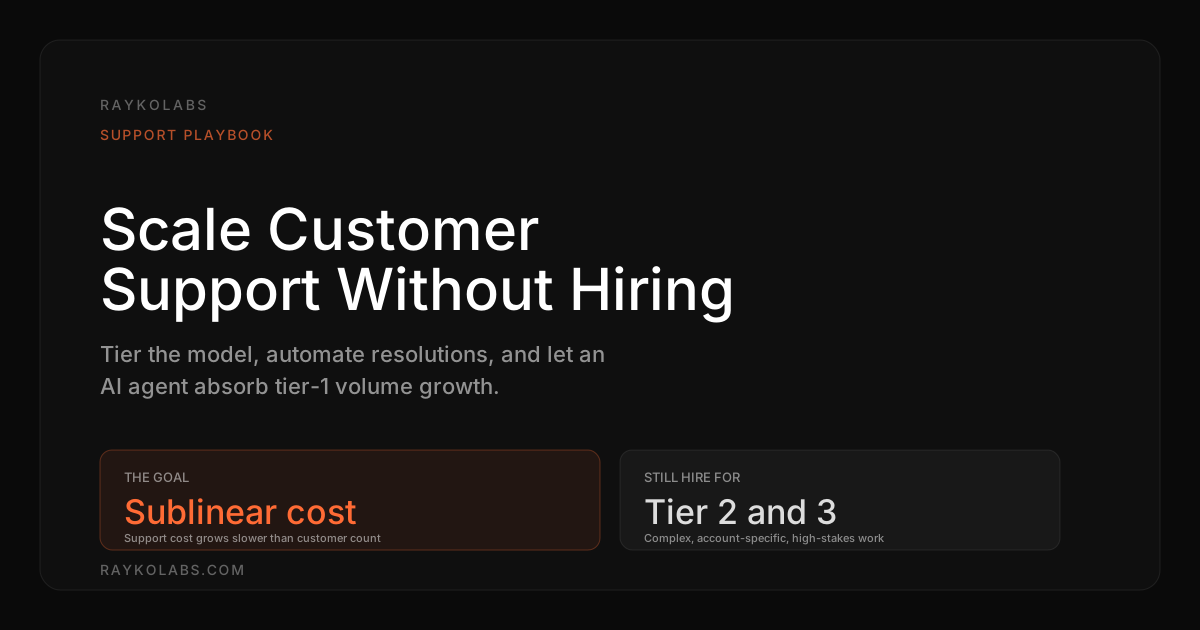
To scale customer support without hiring, raise your Support Leverage Ratio, the volume resolved per human support hour. Push the marginal cost of the next customer toward zero by routing repetitive volume off humans, automating deterministic resolutions, and putting an AI agent on tier-1. Aim for sublinear cost, not zero headcount. Still hire for complex, high-stakes work.
Want this running on your product? Rayko demos it live, with your prospects asking questions by voice.
START LIVE DEMOI spend my time building a live AI agent that demos a product before the sale and answers its setup and how-to questions afterward. The thing I keep seeing in growing companies is a support hiring plan that is really just a copy of the customer growth chart, shifted right by one quarter. Volume goes up, headcount goes up to match, repeat. From the post-sale side of our agent I get to watch what that volume is actually made of, and the answer is what changes the math. This post is the economic model I use for it, distinct from raw volume reduction. It is the scaling companion to how to reduce customer support ticket volume, and it sits under the AI demo agents complete guide, which covers the same agent on the pre-sale side.
The metric that decides whether support scales: the Support Leverage Ratio
Most support orgs are measured on queue length, response time, and CSAT. None of those tells you whether support scales, because all three can look fine while cost grows in a perfect straight line with customers. The metric that actually decides it is one ratio:
Support Leverage Ratio = total volume resolved / total human support hours consumed
Management leverage is the idea that output is measured per unit of time, not by activity itself. Support has the identical structure and almost nobody measures it that way. If your Support Leverage Ratio is flat, every new customer's volume must be met with proportional human hours, and support is a linear cost forever. If the ratio rises as you grow, the same human hours resolve more volume, and support cost grows sublinearly. Scaling support without hiring is not a tactic. It is the single objective of making this one ratio go up while customers go up.
The ratio reframes every decision. A change is worth doing if it raises resolved-volume-per-human-hour. Hiring raises the denominator without touching the numerator's efficiency, so on its own it leaves the ratio flat: it buys capacity, never leverage. Automation that resolves volume with zero human hours raises the numerator at fixed denominator, so it raises the ratio directly. That asymmetry, not a preference for software, is why the order of moves below is what it is.
The marginal-cost test: what supporting the next customer actually costs
The leverage ratio tells you whether support scales. The marginal-cost test tells you which specific volume to attack first. For every ticket type, ask one question: what is the human cost of resolving this for the next customer who hits it.
Repetitive tier-1 volume has a brutal property: its marginal human cost is roughly constant and positive. The thousandth "how do I set up the integration" costs almost exactly what the first one cost, because a human answers each one fresh. Multiply a constant positive marginal cost by volume that grows with customers and you get a linear cost line by construction. No amount of efficiency coaching changes the shape, because the shape is set by the marginal cost being a positive constant, not by how fast agents type.
The only way to bend that line is to drive the marginal human cost of the high-volume tier toward zero. A resolution path with near-zero marginal human cost (a deterministic self-serve action, a grounded AI answer) breaks the multiplication: volume can grow while the human cost per additional customer approaches zero, so total human cost flattens even as customers rise. This is the precise mechanism, and it gives a clean prioritization rule: rank ticket types by volume times marginal human cost, and attack the types where that product is largest and most growth-coupled first. That is almost always repetitive tier-1, which is why tier-1 is the leverage point and not an afterthought.
The three moves that raise the ratio, in order
There are exactly three structural moves, and they compound. The order is dictated by the math above, not by taste.
- Tier the model so each ticket type has the lowest-marginal-cost path that resolves it well and high-volume low-judgment work never lands on a human.
- Automate the resolution itself, not just the routing, so deterministic cases close with zero human hours and the numerator rises without the denominator.
- Put an AI agent on tier-1 so the fastest-growing, near-zero-marginal-cost-eligible layer scales with customer count without scaling hours.
Tiering without automation just sorts the queue faster while a human still resolves every ticket, so the ratio does not move. Automation without tiering means automating an undifferentiated mess with no idea what is safe, so trust collapses. The AI agent without tiering and grounding is a chatbot bolted onto chaos. Done together and in order, the ratio rises and the cost curve bends.
Move 1: tier by marginal cost, not by who answers today
Tiering is classifying every ticket type by what its resolution genuinely requires and assigning the lowest-marginal-cost adequate path. A practical tiering:
| Tier | Examples | Volume share | Resolution path | Marginal human cost |
|---|---|---|---|---|
| Tier 0 | Password reset, "where is X," basic how-to | Largest | Self-serve + AI agent | Near zero |
| Tier 1 | Setup guidance, integration config, plan questions | Large | AI agent, escalate edge cases | Near zero, escalation aside |
| Tier 2 | Account-specific issues, suspected bugs, data fixes | Medium | Skilled human, AI-prepared context | High, by design |
| Tier 3 | Enterprise incidents, escalations, judgment calls | Small | Senior / named owner | Highest, by design |
The shape is near-universal: the tiers needing the least judgment carry the most volume, and the tiers needing the most judgment carry the least. That inversion is the entire opportunity, because the largest, fastest-growing tiers are exactly the ones whose marginal human cost can be driven to near zero. Two rules make it real. Classify by what resolution requires, not by who currently handles it, because tier-0 questions reaching senior agents purely out of routing habit is destroyed leverage. And keep escalation paths short and visible, because tiering fails the moment a customer with a tier-2 problem gets stuck bouncing through tier-0 with no fast way up.
Move 2: automate the resolution, not the routing
The most common automation mistake is automating triage and stopping. Auto-tagging and smart routing get the ticket to the right place faster, but a human still resolves every one, so the denominator is unchanged and the ratio does not move. Raising leverage requires automating the resolution itself where it is deterministic.
What is genuinely automatable end to end: deterministic self-service actions (password resets, in-policy plan changes, resending receipts, toggling well-defined settings), where the customer completes a known safe rule-bound action with zero human and zero AI judgment, the highest-leverage and most under-built tier of all; known-answer informational resolution ("how do I invite a teammate," "what does this error mean"), where the answer is stable but the phrasing varies infinitely, which is where the AI in move 3 does the heavy lifting; and context assembly for the tickets that do reach a human, where automation removes the slow back-and-forth so the human starts resolving instead of investigating, which raises effective leverage on even the high-cost tiers without adding people. The discipline is to automate only what is genuinely deterministic or known-answer and escalate everything else cleanly. Over-automating into judgment territory is how teams generate the horror stories that make leadership distrust automation entirely.
Move 3: put an AI agent on tier-1
Tiering says which volume can move to near-zero marginal cost. Automation closes the deterministic cases. The AI agent handles the largest remaining piece: known-answer informational tier-1 volume where the answer is stable but phrasing is endlessly variable and customers ask a person rather than search because asking is easier. Left on humans, this is the volume that forces linear hiring.
The honest version, because the boundary is the whole game. It genuinely raises leverage on repetitive how-to and setup questions at any concurrency (a human answers one at a time at linear cost, a grounded AI answers a thousand simultaneously at effectively flat marginal cost, which is literally the cost-curve-bending mechanism), navigation and where-is-this volume that grows directly with customer count, and triage and context assembly that raise tier-2 effective capacity without hiring into tier-2. Post-sale setup and onboarding is the niche Rayko occupies: the same agent that runs the pre-sale demo answers setup and how-to questions after the sale, on your real product, around the clock.
It does not raise leverage on account-specific issues needing system access or authorization (refunds, data corrections, account-state changes under judgment), suspected bugs and novel edge cases, or high-stakes, emotionally charged, relationship-critical contacts. For these the AI's only correct job is clean escalation with full context, never resolution. Rayko is a tier-1 layer and a deflection front line, not a full help desk replacement, and treating it as one is the over-automation that destroys trust faster than any cost saving it produces. The reason automation pays off here at all is structural, not a benchmark: the routine, repetitive tier is where leverage concentrates because its answers are stable and its volume grows with customers, while the complex tier resists automation by definition, so the return is in automating the routine layer and nowhere else. The non-negotiable rules: the agent must be grounded in accurate documentation and real product behavior, escalate cleanly the moment it is out of depth, and never trap a customer who wants a human. Pick a tool whose transcripts you can read, because those transcripts are a continuously refreshed map of where customers get stuck, feeding both the agent and your self-serve.
For the pre-sale, demand-capture version of this same always-on pattern, our 24/7 AI demos for after-hours inbound post covers how the agent qualifies and books leads when no rep is online. That post scales lead capture before the sale. This post scales support after it. Same agent architecture, opposite end of the lifecycle, deliberately not duplication.
What most teams get wrong: hiring buys capacity and is mistaken for buying scale
The contrarian core. Hiring a great support rep genuinely helps, which is exactly why this mistake is so durable. A new rep adds real capacity and the queue visibly improves, so it feels like progress. But capacity is not leverage. Adding a rep raises the denominator of the Support Leverage Ratio and does nothing to the volume-per-hour efficiency, so the ratio is flat and the cost line is still linear, just shifted up. The improvement you see is the level, not the slope, and slope is what determines whether support scales. Teams optimize the level for years, hiring ahead of each volume bump, and never notice the slope never changed, because every local metric looks healthy after each hire.
The decision rule that prevents it: before approving any support headcount, state which tier the role serves and why that tier's marginal cost cannot be driven toward zero. If the honest answer is "to keep up with routine tier-1 volume," the request is a leverage failure, not a hiring need, and the budget belongs in tiering and automation instead. Headcount is correct only for tiers whose marginal cost is supposed to stay high.
And the boundary that keeps the ratio honest, the Honest Leverage rule: a resolution counts toward the numerator only if it actually resolved the question. Suppression (hiding the human path, trapping customers in a bot) inflates the apparent ratio while degrading the experience, which is leverage on paper and churn in reality. Enforce it by tracking deflected CSAT specifically, not overall CSAT, alongside repeat-contact rate within seven days. A rising ratio with flat-or-up deflected CSAT and flat repeat-contact is real leverage. A rising ratio with degrading deflected CSAT is displacement, and it returns as churn.
When you should still hire
Scaling without hiring is a statement about routine volume, not a vow against headcount. Hire when the constraint is judgment, ownership, or stakes, the deliberately low-leverage work. Hire when complex work is queuing because tier-2 and tier-3 are starved, and note that successful tier-1 automation often surfaces this gap precisely because it stops masking it with rushed senior agents. Hire when strategic and enterprise accounts need named ownership, which is a relationship investment, not a volume problem, and does not scale through automation and should not. Hire when escalation handle time is rising, the early signal your higher tiers are under-resourced for the complexity reaching them. Hire when you enter a new market or product line, because new domains need human expertise before they can be documented well enough to automate: hire the expertise, let it build the knowledge, then automate the now-routine layer that emerges. Do not hire because routine tier-0 and tier-1 volume rose with customer growth. That is the trap this entire model exists to break.
Measure the slope, not the queue
The metric that proves you are scaling without hiring is the Support Leverage Ratio trended over quarters, read alongside cost and satisfaction so you can prove the savings are real, not displaced. Track the leverage ratio itself, trended: rising means the same hours resolve more volume, flat or falling means you are still scaling linearly somewhere. Track support cost per customer, trended: it should fall even as absolute customers and volume rise. Track tier-0 and tier-1 share resolved without a human, the leading indicator that drives the ratio, where the return on automation shows up first because that is the tier whose marginal cost can actually be driven toward zero. Track deflected CSAT specifically and escalation handle time: if leverage is real, tickets reaching humans are higher-complexity but resolve faster because they arrive with full context, and deflected CSAT holds at parity. The headline you steer toward is "Support Leverage Ratio up, cost per customer down, deflected CSAT at parity, escalation handle time stable." That set proves the slope bent without quality bending with it. Queue length alone proves nothing about scale and often hides displacement.
What to read next
If your immediate problem is the absolute volume rather than the slope, start with how to reduce customer support ticket volume, which covers the debt-ledger work that lowers the baseline this architecture then keeps from regrowing linearly. If your specific constraint is overnight and weekend coverage, how to provide 24/7 customer support for SaaS covers the coverage math and where an AI agent fits the after-hours window. The pillar that connects this post-sale support agent to the pre-sale demo it grew out of is the AI demo agents complete guide. For my background and the vantage point behind this analysis, see the author page.
In Rayko's case, the very agent running your pre-sale demo goes on to answer tier-1 setup and how-to questions after the sale, on your real product, around the clock. It is the tier-1 layer that raises your leverage ratio so skilled people work the complex cases, one conversation surface working both ends of the customer lifecycle rather than two separate tools.
What keeps support scalable without hiring in September 2026?
Leverage still comes from resolving routine volume without human hours. Tier by effort, automate deterministic fixes, keep AI on repetitive guidance, and reserve people for judgment and relationships.
Reviewed in September 2026 against the sources cited above, including Salesforce State of Service, Zendesk experience trends, and Intercom transformation research, the leverage ratio framing in this post still holds. Routine tier volume still grows with customers, while complex account work still requires skilled ownership, so the priority remains moving repetitive resolutions to near zero human cost. The September check is classification accuracy. Confirm tier definitions still match what resolution truly requires, keep escalation short and visible, automate only deterministic outcomes, and ground AI answers in current docs and product behavior. Track leverage alongside deflected satisfaction and repeat contact so rising efficiency cannot mask displaced demand. Hire where judgment or ownership is the constraint, never to absorb routine load that belongs on a cheaper resolution path.
Frequently asked questions
How do I scale customer support without hiring more people?
Raise your Support Leverage Ratio, the volume resolved per human support hour, instead of adding hours to match volume. Three moves do it. Route repetitive volume to layers that resolve without a human so human hours are not consumed by it. Automate the deterministic resolutions themselves, not just the routing. Put a capable AI agent on tier-1 to absorb the routine how-to and setup volume that scales with customer count. Done together, the marginal cost of the next customer's support trends toward zero and total cost grows sublinearly. You still hire, but for the low-leverage complex tier, not to keep pace with routine volume that automation handles better and cheaper.
When should I still hire support staff?
Hire when the constraint is judgment, relationships, or stakes, which is deliberately low-leverage work. Specific triggers: complex account-specific issues are queuing because there are not enough skilled humans, strategic accounts need named owners and proactive attention, escalation handle time is rising because tier-2 is starved, or a new market or product line needs human expertise before it can be documented. The wrong reason to hire is routine volume rising in proportion to customer growth, because that is exactly the volume the leverage ratio is designed to absorb without hours. Hire to add capability and ownership where leverage should stay low, never to manually service repetitive load that should cost sublinearly.
What is tier-1 support deflection?
Tier-1 is the front line: password resets, how-to, setup guidance, navigation, and is-this-expected questions. These are high-volume, low-complexity, and highly repetitive, which makes them the highest-leverage automation target because each resolution removed from a human frees the most hours per unit of effort. Tier-1 deflection means resolving these before they consume a human, through self-serve and an AI agent grounded in your docs and product. It is the single biggest lever on the Support Leverage Ratio, because tier-1 is where volume grows fastest as you add customers and where the work depends least on human judgment. Deflecting it frees skilled people for tier-2 and tier-3.
Can AI handle tier-1 customer support?
Yes, for the repetitive how-to, setup, and navigation questions that make up most tier-1 volume. A modern LLM-powered agent grounded in your documentation and product behavior resolves these in the moment, at any concurrency, with no per-ticket human time cost. That property, flat marginal cost at rising volume, is mathematically what bends the support cost curve. The realistic boundary is that it handles the routine repetitive tier well and must escalate cleanly, with full context, for account-specific issues, suspected bugs, and judgment or system-access work. Treat AI as the tier-1 layer that absorbs volume growth, not a replacement for the skilled humans who own complex work. The combination scales, either alone does not.
Does scaling support with automation hurt quality?
It improves quality when done right and degrades it when used as cost-cutting cover. Automation improves quality on the routine tier because a well-grounded instant answer beats a long queue for the same answer, and it frees skilled humans to spend real time on complex cases that were previously rushed. It degrades quality when automation hides the path to a human, when the AI is not grounded in accurate content, or when escalation is broken so customers get trapped. The discipline is the Honest Leverage rule: a resolution only counts toward the leverage ratio if it actually resolved the question, measured by deflected CSAT and repeat-contact, with a fast visible human path for everything automation should not handle.
Sources
- State of Service Report, Salesforce Research
- CX Trends Report, Zendesk
- Customer Service Transformation Report, Intercom
Cite this article
Utkarsh Agrawal. "How to Scale Customer Support Without Hiring." RaykoLabs Blog, May 17, 2026. https://raykolabs.com/blog/scale-customer-support-without-hiring

Utkarsh Agrawal is CTO of RaykoLabs, where he leads engineering on Rayko, the AI demo agent that runs live, voice-enabled product demos in a real browser for B2B SaaS teams. His work spans real-time voice interaction, browser automation with Playwright and Browserbase, speech-model orchestration, and the infrastructure that keeps autonomous demos reliable around the clock. On the RaykoLabs blog he writes practical guides on voice-enabled product demos, demo automation, and what it takes to ship production AI agents for sales: how to qualify prospects mid-demo, how to measure demo performance, and how buying teams actually evaluate demo software. His comparisons of demo platforms are built from hands-on testing and vendor documentation, with trade-offs stated plainly so buyers can decide fit.
See RaykoLabs in action
Watch an AI agent run a live, personalized product demo, no scheduling, no waiting.
START LIVE DEMO